Property Dedicated To Deity Is Neither Trustee’s Personal Estate Nor Is Available For Disposal At Will Of Anyone Administering Temple: Karnataka High Court
 |
The Karnataka High Court has held that a property dedicated to a deity is not the personal estate of the trustee, nor is it a property available for disposal at the pleasure of whoever happens to administer the temple.
The High Court was considering a writ appeal filed against an order allowing a petition filed by the Sri Jagadguru Renukacharya Education Society challenging the orders concerning a property situated at Thindlu Village, Sarjapura Hobli, Anekal Taluk, with a direction to the revenue authorities to enter the name of the petitioner-Society in the revenue records in respect of the Subject Land.
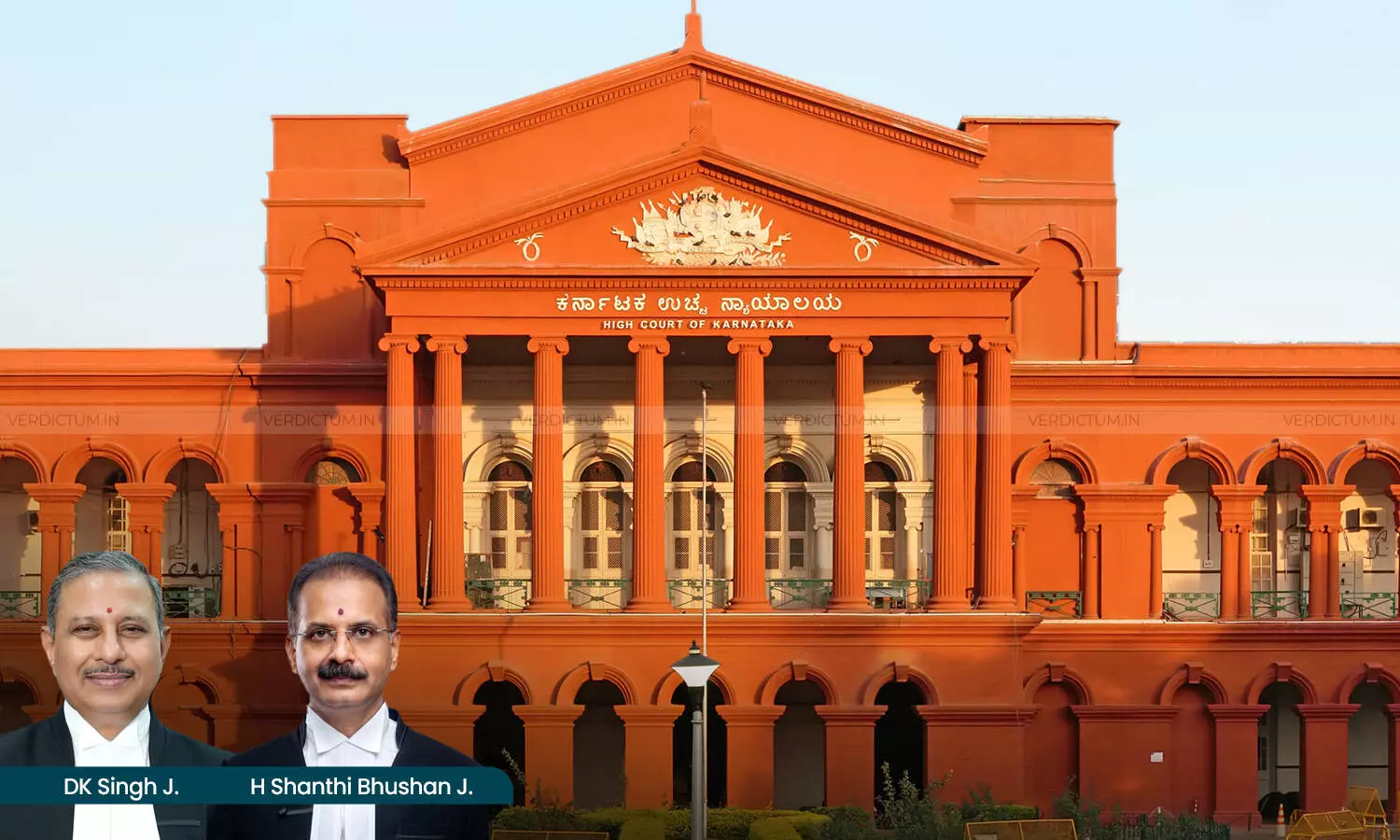
The Bench comprising Justice D K Singh and Justice H. Shanthi Bhushan held, “Property dedicated to a deity is not the personal estate of the trustee, nor is it a property available for disposal at the pleasure of whoever happens to administer the temple. The deity is the owner; the trustee is only a custodian, entrusted with the duty of preserving and protecting the property for the deity and the worshippers. As the saying goes, “The custodian may hold the keys to the temple, but he does not hold the title to the deity’s property.”
“The office of trustee is a sacred responsibility and not a licence to alienate what has been dedicated to God. A person entrusted with the protection of temple property cannot turn around and deal with it as though it were his own. “What is offered to God cannot become the personal bounty of the person who receives it in trust.” When those entrusted with its protection seek to dispose of it, the law must step in to protect the rights of the deity. One may well say that when the custodian fails in his duty, it is for the law to stand guard over the property of the deity. A gift of such property, without lawful authority, cannot be sustained merely because it is clothed in the form of a registered instrument or supported by a stated public purpose”, it stated.
Additional Govt. Advocate S.H. Raghavendra represented the Appellant, while Advocate Vishwanath H.M. represented the Respondent.
Factual Background
The petitioner, Sri Jagadguru Renukacharya Education Society (petitioner-Society), is an educational institution established for imparting education to students belonging to different sections of society. It was the case of the Society that Sri Jagathjyothi Basaveswara Temple Trust Sarjapura (Trust), by its resolution, resolved to gift the Subject Land in favour of the petitioner-Society. The petitioner-Society claimed that the Trust, after obtaining permission from the State Government, executed a registered Gift Deed in its favour and the Government had also accorded permission under Section 109 of the Karnataka Land Reforms Act, 1961.
The petitioner-Society claimed that it secured conversion of the land for non-agricultural purposes and thereafter approached the Town Planning Authority (Respondent 5) for permission to establish an educational institution. The authority issued the single-site approval for educational purposes. The petitioner-Society asserted that, acting upon the permissions granted by the competent authorities, it proceeded with the construction of the school building and had invested substantial amounts towards the establishment of the institution.
The subject land was stated to be a Government Inam land, and the Deputy Commissioner was stated to take appropriate action. Consequent thereto, the Deputy Commissioner withdrew the conversion order, and the Tahsildar issued a show cause notice calling upon the petitioner-Society to explain as to why the Single Site Layout Plan approved under Section 76(O) of the Karnataka Town and Country Planning Act, 1961 (KTCP Act), should not be cancelled. Aggrieved therefrom, the Society instituted a petition seeking to quash the said orders.
Reasoning
The Bench was of the view that the fact that a temple is not under the control or supervision of the Muzrai Department does not establish that the land belongs to a private Trust. “Equally, the fact that an institution is described as a private temple or private Trust does not, by itself, establish that every property claimed by it belongs to that institution. The title to Sy.No.128/1 has to be traced to its source and established independently. The endorsements relied upon by the petitioner-Society do not answer the specific objection of the State founded upon the historical revenue records”, it added.
The Bench observed that the permission granted to the petitioner-Society to accept the proposed gift cannot be treated as an adjudication of the Trust’s title over the Subject Land. “Such permission does not confer upon the Trust a right which it did not possess, nor does it operate as a declaration that the property was free from any pre-existing dedication or claim of the deity”, it stated. The Bench further observed, “The registered Gift Deed dated 09.04.2010 and the rectification deed dated 07.07.2010 may evidence the transaction between the Trust and the petitioner-Society; however, registration of the document cannot cure a defect in the title of the Trust itself.”
The Bench also noted that the Subject Land had been dedicated to the deity, i.e., Basavanna Devaru/Basaveshwara Devaru, Thindlu, and there was no material to establish that the Trust had lawfully acquired the Subject Land from the deity, the Trust could not treat the Subject Land as its own property and gift it to the petitioner Society. Reference was also made to the judgment in K. Ramalingam and Others v. Government of Tamil Nadu, represented by its Secretary and Others (2026), wherein the Apex Court, wherein it was observed that the trustee or custodian holds the property in a fiduciary capacity for the deity. “However, in the instant case, there is no convincing material placed on record to establish that the Subject Land was transferred from the deity to the Trust”, it held.
Dealing with the claim that substantial amounts, stated to be more than Rs 13 crore, were invested in the project, the Bench stated that expenditure incurred on the property or the public purpose for which it is proposed to be used cannot, in law, substitute proof of title. The Bench was also of the view that a public purpose, however beneficial, cannot by itself validate a transaction which the applicable law does not permit. The interest of the petitioner-Society and the expenditure incurred by it cannot take precedence without first determining the character of the land and the authority of the person who purported to convey it.
The Bench held that the endorsements relating to the non-applicability of the Muzrai Department, the Government permission and the registered Gift Deed dated did not, individually or collectively, dispense with the requirement of establishing the donor’s title. “The failure to examine these material aspects has a direct bearing on the conclusion reached in W.P. No.7966/2014. The order under appeal, insofar as it concerns the said writ petition, therefore, cannot be sustained and warrants interference in this appeal”, it held while allowing the appeal and setting aside the order passed by the Single Judge.
Cause Title: State of Karnataka v. Sri. Jagadguru Renukacharya Education Society (Neutral Citation: 2026:KHC:53883-DB)