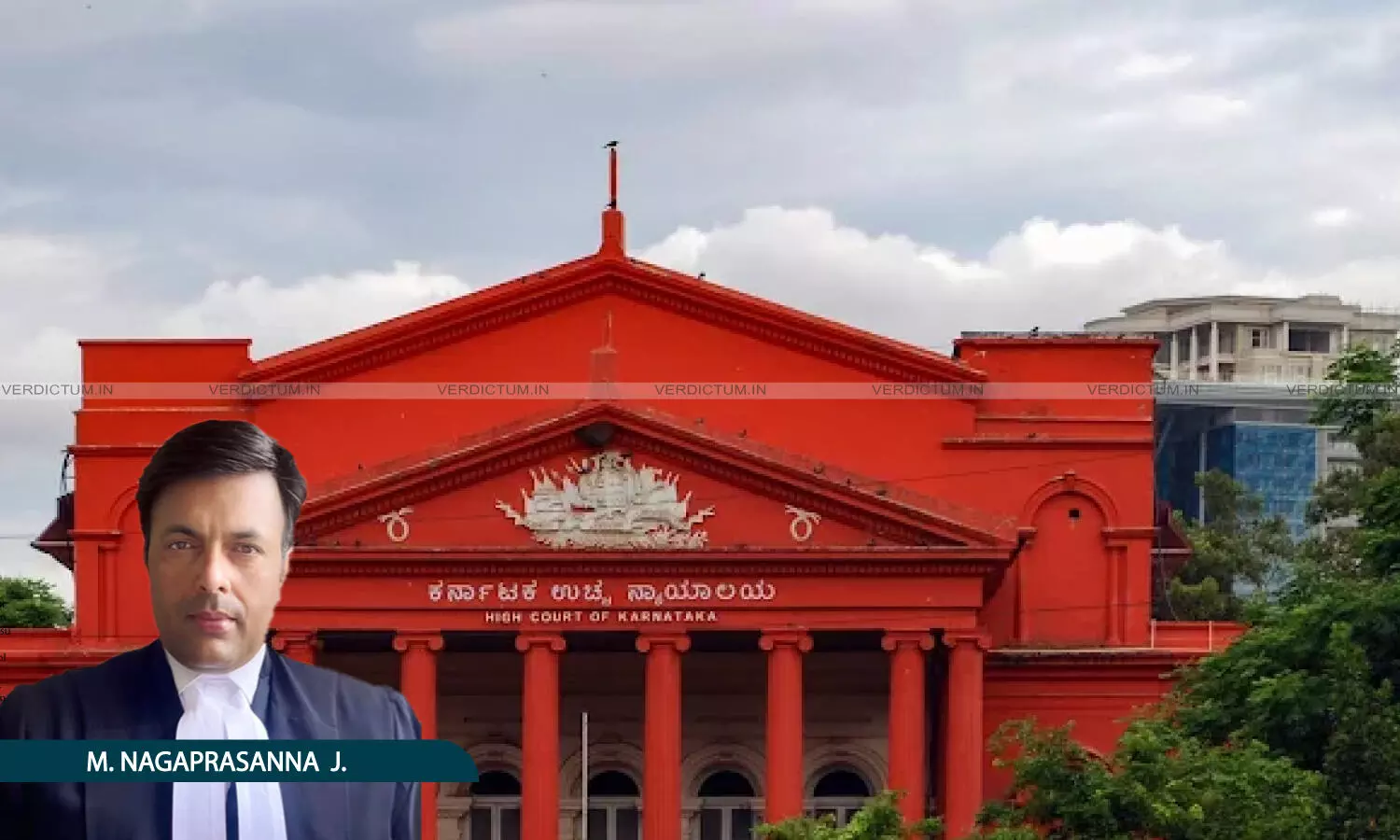
Justice M. Nagaprasanna, Karnataka High Court
Disputed Two-Minute Loudspeaker Use Beyond Election Time Limit Not An Offence: Karnataka High Court Quashes Case Against MLA
 |
|The Court noted that the complaint did not indicate the standard clock by which the alleged 120-second overrun was measured.
The Karnataka High Court has quashed criminal proceedings against an MLA over the alleged use of a loudspeaker for two minutes beyond the prescribed election-time limit, holding that such a disputed allegation could not make out the offences projected by the flying squad.
The Court found that the complaint rested on an alleged overrun till 10.02 p.m., while the petitioner’s case was that it was only 10 p.m., and no standard clock was indicated.
The Court was hearing a criminal petition under Section 482 of the Code of Criminal Procedure, filed under Section 528 of the Bharatiya Nagarik Suraksha Sanhita, seeking quashing of an FIR registered by Bidar Rural Police Station for offences under Sections 143, 147, 290 read with Section 149 of the IPC and Section 109 of the Karnataka Police Act, 1963.
A Single Judge Bench of Justice M. Nagaprasanna observed: “The fulcrum of the complaint is two minutes beyond the time limit prescribed for usage of the loudspeaker during the time of elections. Two minutes in what, which is the standard clock that is seen, is not even indicated. According to the flying squad, it is two minutes. According to the petitioner, it was only 10 p.m. For two minutes, a crime is registered on this disputed question of fact. If it were to be beyond 10, 15 or 20 minutes, then there would have been some semblance of allegation. 120 seconds in which clock, is not indicated. Therefore, there cannot be an offence of the kind that is projected by the flying squad.”
Advocate Naveed Ahmed appeared for the petitioner; Additional SPP Surya Mukhundaraj appeared for the State.
Background
The petitioner was arrayed as an accused in the complaint of a flying squad official during the Karnataka Legislative Assembly elections. The Court recorded that the petitioner was elected as an MLA in 2023.
The allegation was that the petitioner continued election publicity, including use of a loudspeaker, up to 10.02 p.m., though the prohibition on loudspeaker use was from 10 p.m. On that basis, a crime was registered for unlawful assembly, public nuisance and related offences under the IPC and the Karnataka Police Act.
The petitioner contended that, by his watch, it was 10 p.m. and that a two-minute difference in the watch of the flying squad could not become an offence when no standard clock was identified. The State opposed quashing, contending that whether the petitioner continued to use the loudspeaker beyond 10 p.m. was a seriously disputed question of fact.
Court’s Observations
The Court noted that the facts were limited and arose entirely from the complaint alleging use of a loudspeaker beyond the permitted time.
The Court observed: “The afore-narrated facts are not in dispute. They lie in a narrow compass. The entire issue gets triggered from a complaint on 05.05.2023.”
It was recorded that the allegation was confined to continuation of publicity till 10.02 p.m., making the difference only two minutes beyond the stated time limit.
The Court took note of the petitioner’s argument that the alleged offence depended entirely on the timing recorded by the flying squad, while the petitioner’s case was that it was still 10 p.m.
The Court recorded the petitioner’s submission: “If it is 10.02 p.m. in the watch of flying squad, that cannot become an offence, as there is nothing like a standard clock to be looked into for the particular offence of this kind, where the allegation is the usage of a loudspeaker goes beyond the time limit by two minutes i.e., 120 seconds.”
The Court found that, on the facts, the complaint did not identify the clock or standard by which the alleged two-minute overrun was measured.
The State argued that the question whether the petitioner had continued to use the loudspeaker beyond 10 p.m. could not be examined in quashing proceedings.
The Court recorded the State’s stand: “Per contra, learned Additional SPP appearing for the respondent-State would vehemently contend that it is seriously disputed question of fact as to whether the petitioner continued to use the loudspeaker beyond 10 p.m. and up to what point and this Court cannot quash the proceedings on the said score.”
The Court, however, held that even if the allegation was taken as true, it would not make out the offence projected by the flying squad.
The Court referred to State of Haryana v. Bhajan Lal (1992), where the Supreme Court recognised categories of cases in which the High Court may exercise jurisdiction to prevent abuse of process or secure the ends of justice.
Referring to the precedent, the Court noted the principle that quashing may be warranted where allegations, even if accepted at face value, do not prima facie constitute any offence or make out a case against the accused.
Applying that principle, the Court held: “In the light of the judgment of the Apex Court, even if the allegation is considered to be true, it would not make out an offence.”
Conclusion
The Court allowed the criminal petition and quashed the proceedings pending before the Additional JMFC II Court, Bidar District, qua the petitioner.
Cause Title: Rahim Khan v. State of Karnataka and Another (Neutral Citation: 2026:KHC:42062)