Wrong To Assume “Unemployed Woman” Would Not Have Funds: Karnataka High Court On Absolute Ownership U/S 14 Hindu Succession Act
 |
|The Court set aside the partition decree, holding that the trial court wrongly presumed that a “woman” who was “unemployed” could not have purchased property in her own right.
The Karnataka High Court has held that the trial court's finding that a property could not have been the self-acquired property of a woman merely because she was unemployed and had no independent source of income rests on an impermissible assumption unsupported by evidence. The Court held that once a registered sale deed records a woman as the purchaser, records receipt of consideration from her, and delivers possession to her, the burden lies on the party asserting that the property was in fact acquired from joint family funds to prove the existence of an adequate joint family nucleus, a burden that cannot be discharged by merely pointing to the woman's lack of employment.
The Court further held that under Section 14(1) of the Hindu Succession Act, 1956, any property acquired by a female Hindu, including by purchase, is held by her as full and absolute owner, and not as a limited owner, with the result that she is entitled to deal with and dispose of such property in any manner she deems fit, unconstrained by any presumption that it forms part of joint family property merely because a joint family existed at the relevant time.
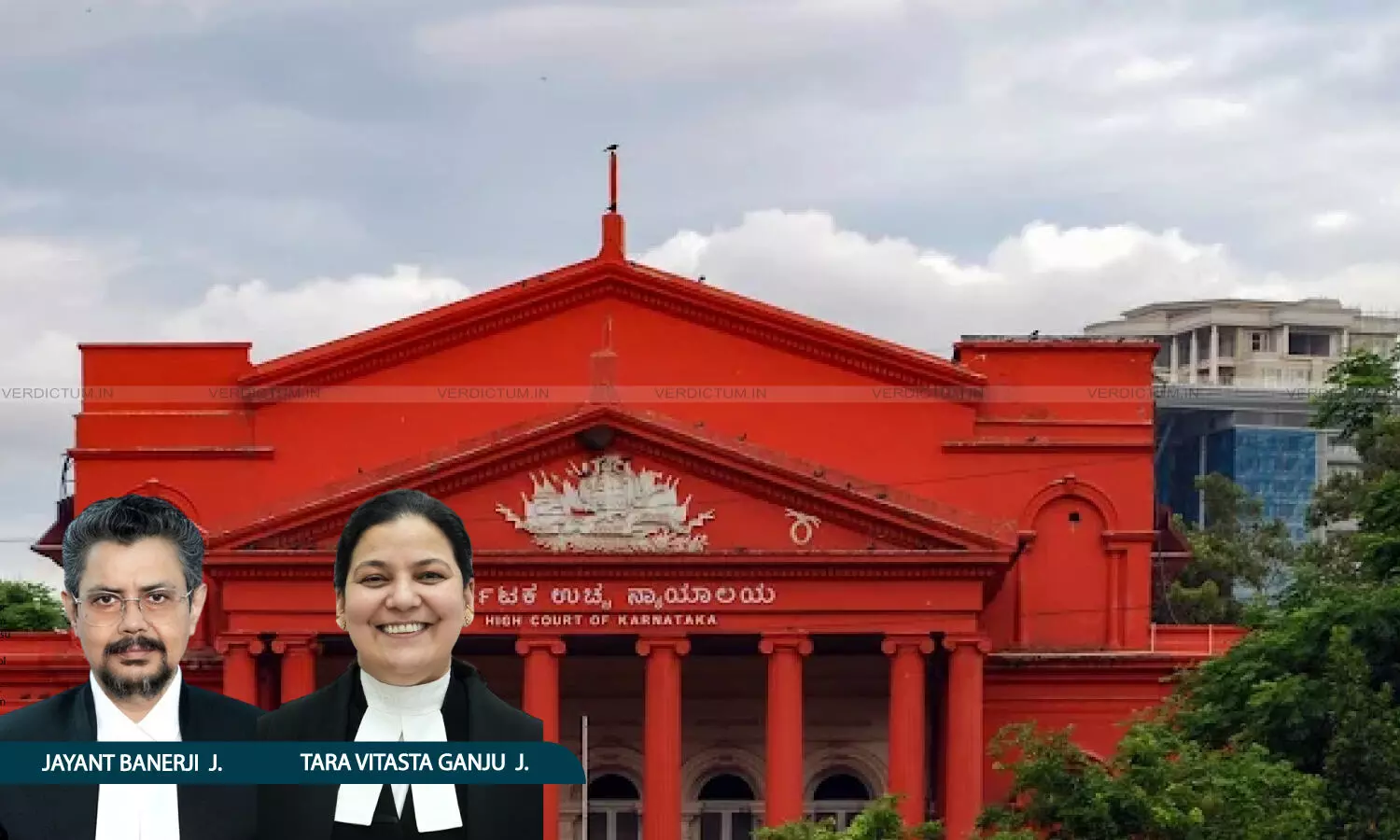
A Division Bench comprising Justice Jayant Banerji and Justice Tara Vitasta Ganju observed, “…Merely to assume, that because Smt. Lalithamma was a woman and was unemployed, she would not have any funds, as has been assumed by the learned Trial Court, would not be in order. It is not disputed that Lalithamma was the second wife of late Sri. D.M.Subbaiah and the Suit Schedule Property this is stated to be the only property registered in her name. The right to property of a female Hindu is absolute in terms of Section 14 of the Hindu Succession Act and the record does reflect that Smt. Lalithamma was dealing with the property in the manner she deemed fit much as an absolute owner during her lifetime, after which defendant No.1 succeeded to it”.
Advocate Rohan Kothari appeared for the appellant and Advocate C. Shankara Reddy appeared for the respondent.
The suit schedule property was purchased under a registered sale deed dated March 14, 1963 in the name of Smt. Lalithamma, the second wife of late Sri D.M. Subbaiah. Following her death intestate in 1987, her son, Defendant No. 1, succeeded to the property and executed a sale deed in favour of the appellant, M/s Rajesh Exports Limited, in 2004.
The plaintiffs, wife and sons of Defendant No. 1, filed a suit for partition, contending that although the property stood in the name of their grandmother, it was in truth acquired out of joint family funds provided by her husband and held by her only for convenience, and that Defendant No. 1 therefore had no right to alienate the entire property.
The Trial Court decreed the suit for partition, holding that the property was joint family property since Lalithamma had no independent source of income, and declared the subsequent sale deed in favour of the appellant not binding on the plaintiffs' shares.
The appellant's first appeal led to a remand for additional evidence, which was set aside by the Supreme Court, restoring the appeal to the High Court for decision on the existing record. The matter accordingly came to be decided afresh by the High Court.
Examining the 1963 sale deed, the Court found it expressly recorded Lalithamma as the purchaser, acknowledged receipt of the entire consideration from her, and recorded delivery of possession together with the right to collect rents, additionally recording that the vendor's own khata transfer form was handed to her. The Court relied on the Supreme Court's rulings in Gangamma v. G. Nagarathnamma & Ors. (2009) 15 SCC 756 and Marabasappa (Dead) by LRs. v.. Ningappa (dead) by LRs and others (2011) 9 SCC 451, noting that there is no presumption of a joint Hindu family and that the burden lies on the person asserting joint family character to first establish the availability of the alleged joint-family nucleus at the relevant time of acquisition.
Evaluating the plaintiffs' evidence, the Court found that none of their witnesses had personal knowledge of the 1963 transaction, and that documents produced showing prior sale and mortgage transactions did not, by themselves, establish a joint family nucleus adequate to fund the purchase. By contrast, the Court noted that a subsequent 1979 lease deed showed Lalithamma describing herself as "sole and absolute owner" and dealing with the property in her own capacity, unconnected to any representative or family status.
The Court also rejected the plaintiffs' alternative contention that the 1963 transaction was benami, relying on Mangathai Ammal (Died) through Legal Representatives and Others v. V. Rajeswari and Others (2020) 17 SCC 496, and holding that an apparent purchaser starts with an initial presumption in her favour" which the plaintiffs had failed to displace [Jaydayal Poddar v. Bibi Hazra, (1974) 1 SCC 3].
Accordingly, the appeal was allowed, and the judgment and decree dated September 15, 2009 passed by the Additional City Civil Judge, Bangalore, was set aside, and the suit filed by the plaintiffs for partition was dismissed. Pending applications, if any, were closed, with no order as to costs.
Cause Title: M/s Rajesh Exports Limited v. Sri B. Devaraj & Ors. (Neutral Citation: 2026:KHC:46919-DB)
Appearances:
Appellant: Rohan Kothari, Advocate.
Respondents: C. Shankara Reddy, P. Usman, K.R. Ashok Kumar, Advocates.