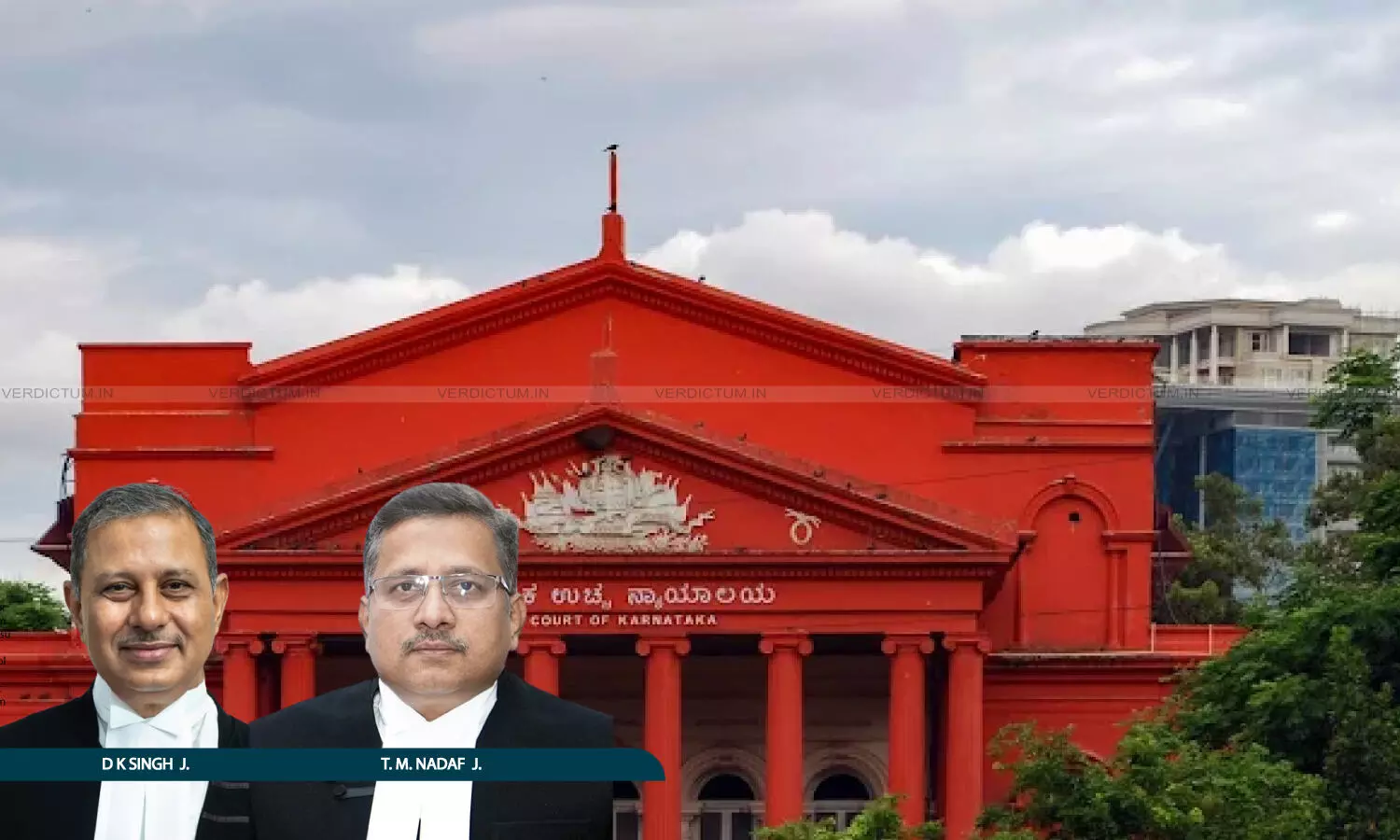
Justice D K Singh, Justice T.M. Nadaf, Karnataka High Court
Several Judges Are Living In Rented Accommodation: Karnataka High Court Dismisses PIL Against Re-Allotment Of Land For Judges' Residences
 |
|Dismissing a PIL filed by veterinary associations challenging the transfer of land from the Veterinary College campus at Hebbal, the Court held that the allotment of 4 acres for the construction of official residences for High Court Judges would not adversely affect the institution, which possesses land far in excess of its prescribed requirements.
The Karnataka High Court has dismissed a Public Interest Litigation challenging a government decision allotting 4 acres of land belonging to the Karnataka Veterinary Animal and Fisheries Sciences University (KVAFSU) for the construction of official residences for serving Judges of the High Court.
The Court held that the allotment serves a larger public interest by ensuring adequate residential infrastructure for Judges and found that the Veterinary College would suffer no prejudice as it possesses land far in excess of the minimum prescribed requirements.
The Court was hearing a PIL filed by the Karnataka Veterinary Association, Bangalore Veterinary College Alumni Association, and others challenging the Government Order dated 08.01.2026 approving the transfer of 4 acres of land for the construction of Judges' residences and 3 acres for a Super-Speciality Hospital.
The petitioners contended that the transfer would adversely affect the educational, research and extension activities of the Veterinary College and reduce land available for future expansion.
A Division Bench of Justice D.K. Singh and Justice T.M. Nadaf observed: “We have taken note of the fact that only 19 official residences are available to the High Court judges against the strength of 62 Judges, several Judges are living in rented accommodation not befitting the stature of a constitutional authority like a High Court Judge.”
The Bench further observed: “Admittedly, the respondent No.4-College is in excess of a huge extent of land to meet its requirements. The decision taken by the Government to transfer 4 acres of land for the construction of official residences for the serving Judges of the High Court in the vicinity of the existing 15 residences at Nyayagrama will have no adverse effect on the respondent No.4-College, in any manner, as alleged.”
Senior Advocate K.N. Phanindra appeared for the petitioners. Additional Government Advocate M.N. Sudev Hegde appeared for the State. Senior Advocate Prabhuling K. Navadgi appeared for the High Court of Karnataka.
Background
The challenge was directed against a Government Order by which 7 acres of land belonging to the Veterinary College, Hebbal, Bengaluru, was transferred. Of the transferred land, 4 acres were earmarked for the construction of residential quarters for serving Judges of the Karnataka High Court, while 3 acres were allotted for the establishment of a Super-Speciality Hospital for the benefit of the public.
The petitioners contended that the Veterinary College campus was being used for teaching, research, fodder cultivation, livestock management and other academic activities. It was argued that diversion of land would adversely affect the institution's future development plans and could result in non-compliance with the norms prescribed by the Veterinary Council of India.
The State, the University and the High Court opposed the petition, contending that the institution possessed approximately 317.73 acres of land, whereas the applicable regulations required only 30 acres for a veterinary college. It was further submitted that the transfer was approved by the University's Board and served important public purposes.
Court's Observations
The Court extensively discussed the constitutional significance of an independent judiciary and the role of adequate service conditions in preserving that independence.
The Bench observed: “The independence of Judiciary is a fundamental, basic-structure feature of the Constitution, and the conditions of service of High Court and Supreme Court Judges (including salary, pension, housing, libraries, training, transport and retirement age) are part of the framework that sustains judicial independence.”
The Court held that providing suitable official accommodation to Judges is not a matter of luxury but an institutional requirement linked to the independence of the judiciary.
The Court accepted the State's contention that the existing residential infrastructure available for Judges was insufficient.
The Court noted that the proposed residences were to be constructed adjacent to the existing residential complex at Nyayagrama and were intended to address the shortage of official accommodation available to serving Judges.
Rejecting the petitioners' contention that the transfer would adversely affect the institution, the Court found that the Veterinary College possessed land far beyond the minimum prescribed requirements.
The Court observed: “The Board has approved the transfer of the land. Admittedly, the respondent No.4-College is in excess of huge extent of land to meet its requirements.”
The Court noted that the institution had approximately 317.73 acres of land available, substantially exceeding the requirement of 30 acres prescribed under the applicable regulations.
The Court reiterated that policy decisions of the Government cannot ordinarily be interfered with unless they are shown to be arbitrary, illegal or contrary to statutory provisions.
Referring to settled principles, the Bench observed: “It is well settled that policy decisions cannot be challenged in absence of (a) arbitrariness; (b) procedural impropriety; (c) perversity so as to shock the conscience of the public; and (d) blatant derogation of the governing provisions.”
The Court found that none of these grounds had been established by the petitioners.
The Court ultimately concluded that the allotment was in furtherance of the larger public interest rather than contrary to it.
The Bench observed: “Therefore, we do not find that the allotment of 4 acres of land which is adjacent to Nyayagrama in any manner will impede or is against the public interest, but it is in furtherance of the larger public interest i.e., to ensure the independence of the Judiciary which is the basic foundation of the Constitution.”
With regard to the remaining 3 acres, the Court observed: “In fact, the larger public interest would be served by having a Super-Speciality Hospital for general public by the State.”
“We, therefore, find no substance in this writ petition inasmuch as no public interest is abridged or acted against in providing 4 acres of land to the High Court for construction of official residences to the Hon'ble Judges and 3 acres of land for constructing the Super-Specialty Hospital for general public”, the Court concluded.
Conclusion
Holding that the Veterinary College possessed substantial excess land and that no public interest was adversely affected by the transfer, the Karnataka High Court dismissed the PIL challenging the Government Order.
The Court held that the allotment of 4 acres for the construction of official residences for serving Judges was justified in view of the shortage of official accommodation and the need to preserve judicial independence. The Court further held that allotment of 3 acres for the establishment of a Super-Speciality Hospital would serve the larger public interest.
Cause Title: Karnataka Veterinary Association & Ors. v. State of Karnataka & Ors.
Appearances
Petitioners: Senior Advocate K.N. Phanindra for Vikram H. Bhat, Advocate.
Respondents M.N. Sudev Hegde, Additional Government Advocate, J. Prashanth, Advocate, Senior Advocate Prabhuling K. Navadgi for B.V. Vidyulatha, Advocate.