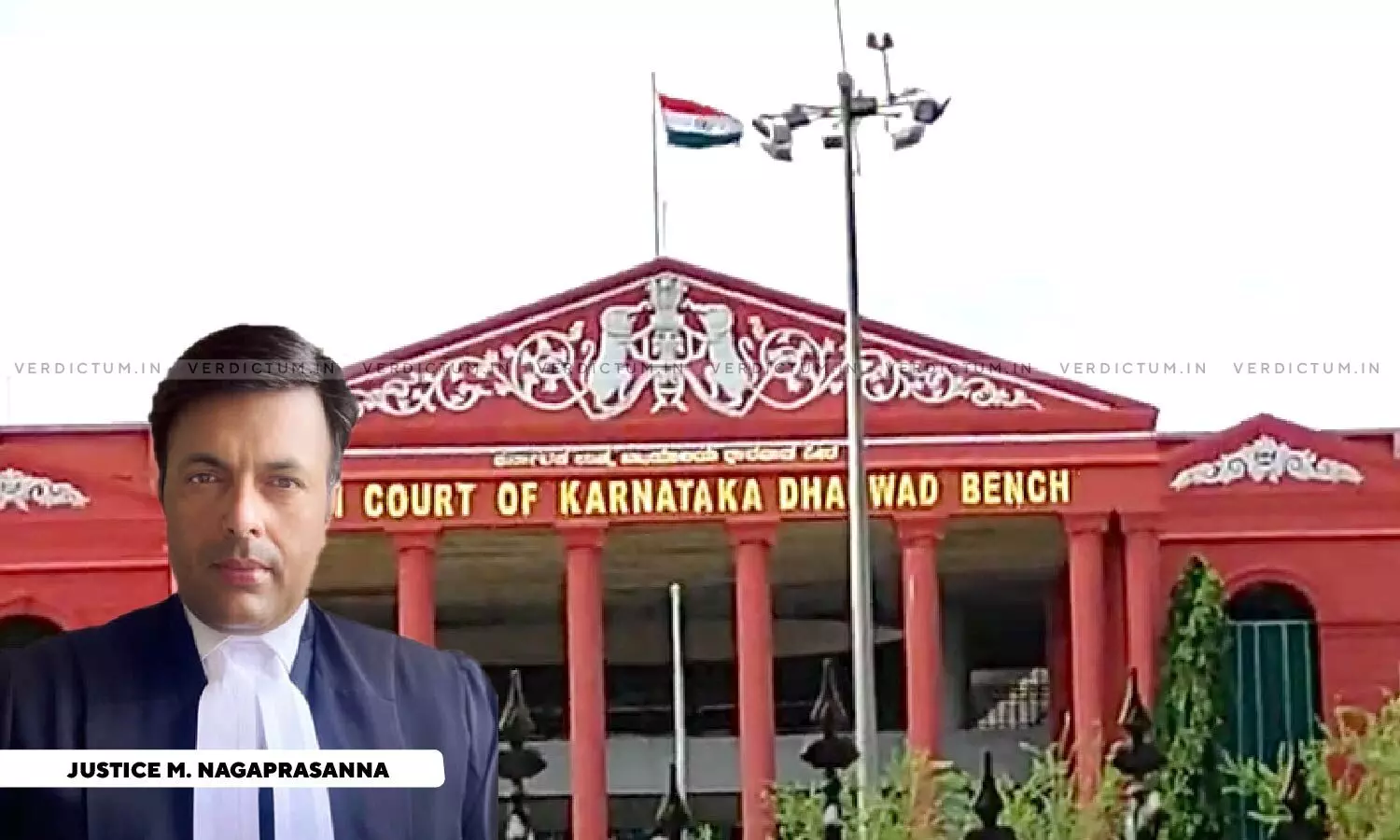
Justice M. Nagaprasanna, Karnataka High Court, Dharwad Bench
Not A Plea For Privilege But Dignity & Fairness: Karnataka High Court Directs Strict Implementation Of Menstrual Leave Policy Across All Sectors
 |
|The Court noted the State's already formulated policy granting 1 day paid menstrual leave per month, restricted to 12 days annually, for women aged 18 to 52.
The Karnataka High Court, Dharward Bench has disposed of a writ petition by directing the State Government to ensure strict and uniform implementation of its existing Menstrual Leave Policy across both organised and unorganised sectors. The Court emphasised that acknowledging biological differences between men and women, particularly regarding health and bodily autonomy, does not violate the guarantee of equality under Article 14 of the Constitution of India but rather gives it substantive meaning.
Pending the formal enactment of the "Karnataka Menstrual Leave and Hygiene Bill, 2025", the Court has mandated that the State operationalise the policy through rigorous administrative instructions and guidelines to protect vulnerable women workers.
Justice M. Nagaprasanna categorically observed, “…beyond its clinical description lies a lived experience, one that may be accompanied by discomfort, fatigue, and emotional upheavals. True, equality, as envisioned by the Constitution, demands a more compassionate and nuanced approach, one that acknowledges difference not as a ground for discrimination, but as a basis for accommodation. Thus, the call for menstrual leave, is not a plea for privilege, but an assertion of dignity, fairness and humane understanding within the spaces women inhabit”.
The petitioner, Chandravva Hanamant Gokavi, is a 41-year-old hotel worker employed in a small establishment in Belagavi District. Her duties involved arduous physical tasks such as cleaning, washing utensils, and serving food from early morning until late evening in an environment often lacking adequate hygiene.
She approached the Court highlighting the severe physical and physiological strain faced by women workers during menstruation, particularly those in the unorganized sector who lack access to minimal respite or leave.
The petitioner, therefore, sought a mandamus directing the State to implement the Menstrual Leave Policy introduced via Government Notification on November 12, 2025, and subsequent orders dated November 20, 2025. The petitioner further requested the framing of specific guidelines to ensure that women in small commercial units and hotels are not excluded from these benefits.
The Court observed that the State of Karnataka had already taken progressive steps by formulating a policy that grants one day of paid menstrual leave per month, restricted to 12 days annually, for women aged 18 to 52. It noted that the Law Commission of Karnataka had supported this policy, emphasizing that "presenteeism" is an antithesis to productivity and that prioritizing women's health is a hallmark of an egalitarian society.
The Court drew from historical precedents, such as Kerala's 1912 provision for girl students and Japan's 1947 labor regulations, to validate the necessity of such leaves. The Bench reasoned that while men and women are equal before the law, they are biologically distinct, and the law must accommodate these differences to secure workplace justice.
“…it becomes incumbent upon the State to undertake comprehensive measures aimed at sensitizing all sectors, both organized and unorganized. While the organized sectors may be regulated through Government orders and legislative intervention, the unorganized sector requires a more facilitative mechanism. However beyond regulatory frameworks, what remains imperative is, a sustained and pervasive effort to sensitize all segments of society, reaching every corner of the State to foster awareness, empathy and compliance”, the Bench noted.
“The significance of menstrual leave policy is not merely administrative, but deeply rooted in the Constitutional promise of equality that embraces all citizens, beneath its expansive canopy. While the law proclaims men and women as equals, nature, in its intricate design, has bestowed upon women, certain biological experiences that set them apart - menstruation being one such profound reality. Menstruation, often referred to as periods, is not an aberration, but a natural and indispensable facet of women’s reproductive cycle. It is a recurring monthly phenomenon wherein, the body governed by delicate hormonal rhythms sheds the uterine lining resulting in bleeding, that typically endures for 3 to 7 days. Yet beyond its clinical description lies a lived experience, one that may be accompanied by discomfort, fatigue, and emotional upheavals”, the Bench further noted.
The Court issued the following directions:
-The State must ensure the strict and faithful implementation of the existing Menstrual Leave Policy pending the formal enactment of the proposed legislation.
-Upon enactment of the "Karnataka Menstrual Leave and Hygiene Bill, 2025", the State shall frame appropriate Rules without undue delay.
-The State is directed to issue suitable guidelines, circulars, and administrative instructions to secure uniform and consistent implementation across all sectors, including the unorganised sector.
-The Court clarified that the State should not be deterred by misplaced apprehensions regarding Article 14 of the Constitution of India when implementing these gender-specific welfare measures.
Cause Title: Chandravva Hanamant Gokavi v. State of Karnataka & Others (Writ Petition No. 109734 of 2025)
Appearances:
Petitioner: Deeksha N. Amruthesh, Advocate.
Respondents: Prathima Honnapura, Additional Advocate General (AAG).