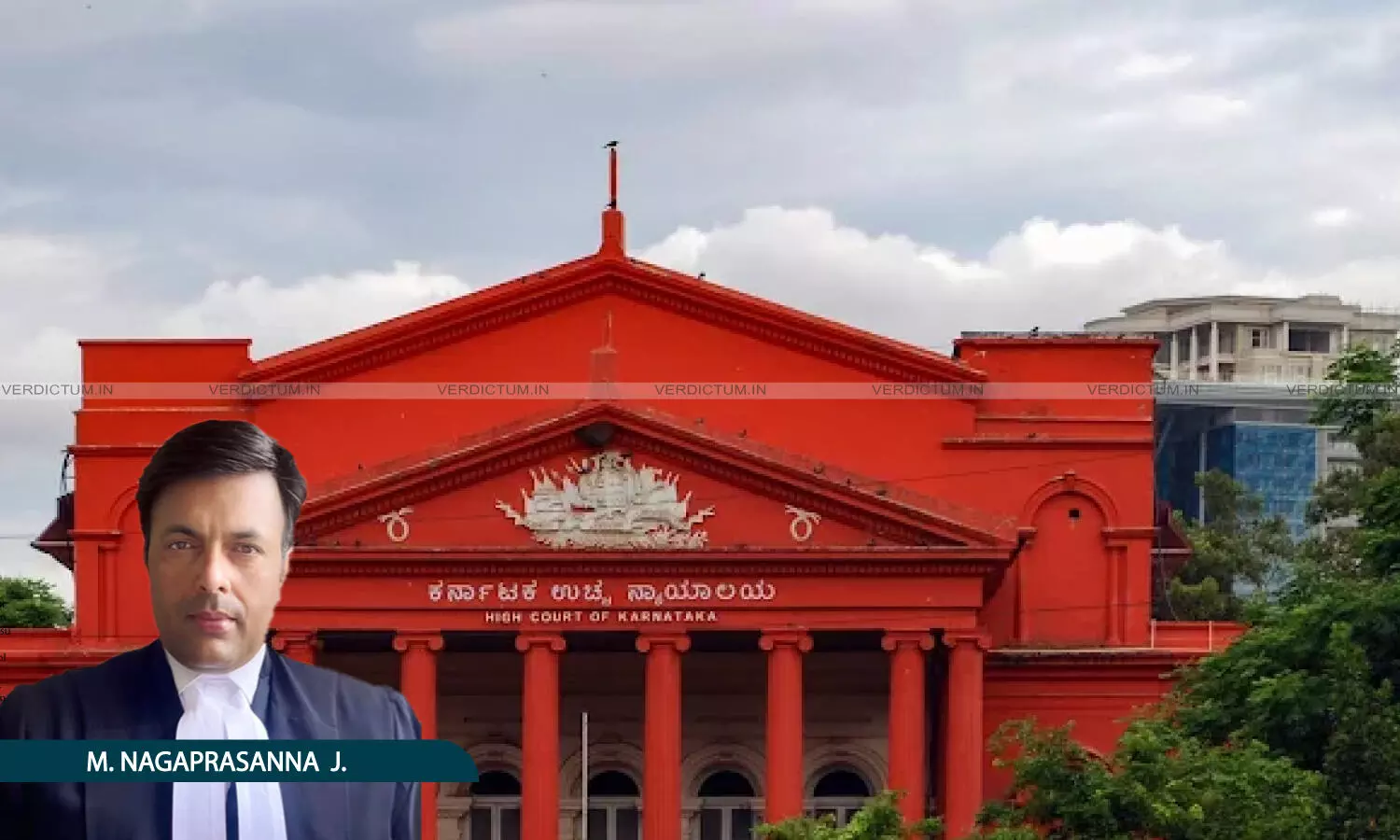
Justice M. Nagaprasanna, Karnataka High Court
"What Could Not Legally Be Owned Appears To Be Bartered Within The Family": Karnataka High Court Refuses To Quash Land-Grab Case Against Ex-MLA
 |
|The Court ordered investigation into a 37-site layout allegedly carved out of protected government land, observing that Government "B" Kharab land cannot be privately appropriated, not even a single gunta.
The Karnataka High Court has refused to quash a preliminary enquiry and FIR registered against a former Member of the Legislative Assembly and a retired Municipal Commissioner over allegations of illegally converting Government "Hullu Banni Kharab" land into a private residential layout.
The Court further held that Rule 21 of the Karnataka Land Revenue Rules admits of no ambiguity: "B" Kharab land is reserved Government land incapable of private appropriation or conversion into residential layouts, and "cannot be transformed into a private commodity merely because power, influence, or administrative silence aided such transformation," reaffirming the settled principle that even a single gunta of such land cannot be appropriated by private citizens.
Justice M. Nagaprasanna observed, “…The conclusion therefore is not difficult to draw. Government land appears to have been treated, as though it was ancestral property, partitioned inter se amongst family members, and dealt with as a commodity of private ownership. What could not legally be owned appears to have been privately divided; what could never be alienated appears to have been bartered within the family… Sites were formed. Sites were sold. Khatas were issued. Third-party interests were created. Government land had, for all practical purposes, vanished beneath concrete and private possession.”.
Senior Advocate Y.R. Sadashiva Reddy appeared for the petitioner and Advocate Keerthi Reddy appeared for the respondent.
A complaint was lodged in 2016 before the Anti-Corruption Bureau (now Karnataka Lokayukta) alleging that petitioner No.1, a former MLA, and his sons had encroached upon 1 acre 19 guntas of Government Kharab land in Survey No.11 at Kannampalli village, Chintamani Taluk, adjoining their own converted lands in Survey Nos.12 and 13.
Revenue records from 1965-66 onward consistently classified the land as Government Hullu Banni Kharab. Following his election as MLA in 1989, his sons obtained conversion of the adjoining private survey numbers for residential use; a subsequent family partition deed, however, carved out sites from Survey No.11 itself, and an unregistered General Power of Attorney enabled sale of numerous sites to a housing cooperative society, with municipal khatas issued despite absence of any approved layout plan. Petitioner No.2, then Municipal Commissioner, was alleged to have facilitated registration of these khatas.
Pursuant to a complaint by a local Councillor in 2015, the Deputy Commissioner ordered a spot survey, which confirmed encroachment of Survey No.11 and formation of residential sites with five houses constructed.
A demolition notice issued by the Tahsildar was earlier read down by a Coordinate Bench of the High Court as a mere show-cause notice for want of prior hearing. Upon reply, the accused shifted their defence to a claim of title by adverse possession. Following further preliminary enquiry, Crime No.4 of 2017 was registered under Sections 13(1)(c)(d) of the Prevention of Corruption Act and Section 447 r/w 34 IPC. Both accused separately petitioned the High Court under Articles 226/227 read with Section 482 CrPC to quash the FIR.
The Court found the shift in defence from denial of possession to a claim of adverse possession to be itself an implicit admission, observing that "a person claiming adverse possession does not say, 'I do not possess.' He says, 'I possess, and though the land belongs to another, my possession has matured into title.'"
Placing reliance on Section 67 of the Karnataka Land Revenue Act and the Coordinate Bench rulings in Agricultural Produce Market Committee v. Executive Officer and Sena Vihar Owners Welfare Association v. Bandarappa Bhakthadigala Sangha, the Court held that Kharab land vests in the State with public rights attached, which can be extinguished only through the specific procedure under Section 68, not through unilateral private conversion.
“…When the revenue records of 1965–66 are placed shoulder to shoulder with those of 2026, one incontrovertible truth emerges with remarkable clarity is, the character of Survey No.11 has remained immutable. Time has marched forward, governments have changed, offices have changed hands, 17 political fortunes have risen and fallen—but Survey No.11 has remained what it always was: Government Hullu Banni Kharab land”, the Bench said.
“Land grabbing by ordinary citizens is a serious illegality. Land grabbing by those clothed with political power strikes at something far deeper—it erodes public faith in governance itself. When custodians of public trust become beneficiaries of alleged public wrongs. This Court cannot permit investigation to be throttled at inception in a matter of such gravity. To interdict investigation, at this stage, would amount to shutting the door on truth, before it has even entered the room. Investigation, therefore, is not merely warranted; it is indispensable”, the Bench noted further.
Consequentially, both the writ petitions were dismissed as devoid of merit. The Court clarified its observations would not bind or influence the investigation or further proceedings, and directed the investigating agency to conclude investigation with utmost expedition, in any event within six months from receipt of the order.
Cause Title: B.H. Narayanappa v. State of Karnataka and Others, W.P. No.24242 of 2017
Appearances:
Petitioner: B.K. Manjunath, Y.R. Sadashiva Reddy, Senior Advocate, Advocate.
Respondents: Thejesh P., HCGP, Venkatesh Arbatti, Special PP, Keerthi Reddy, Mayur D. Bhanu and Padmanabha J., Advocates.