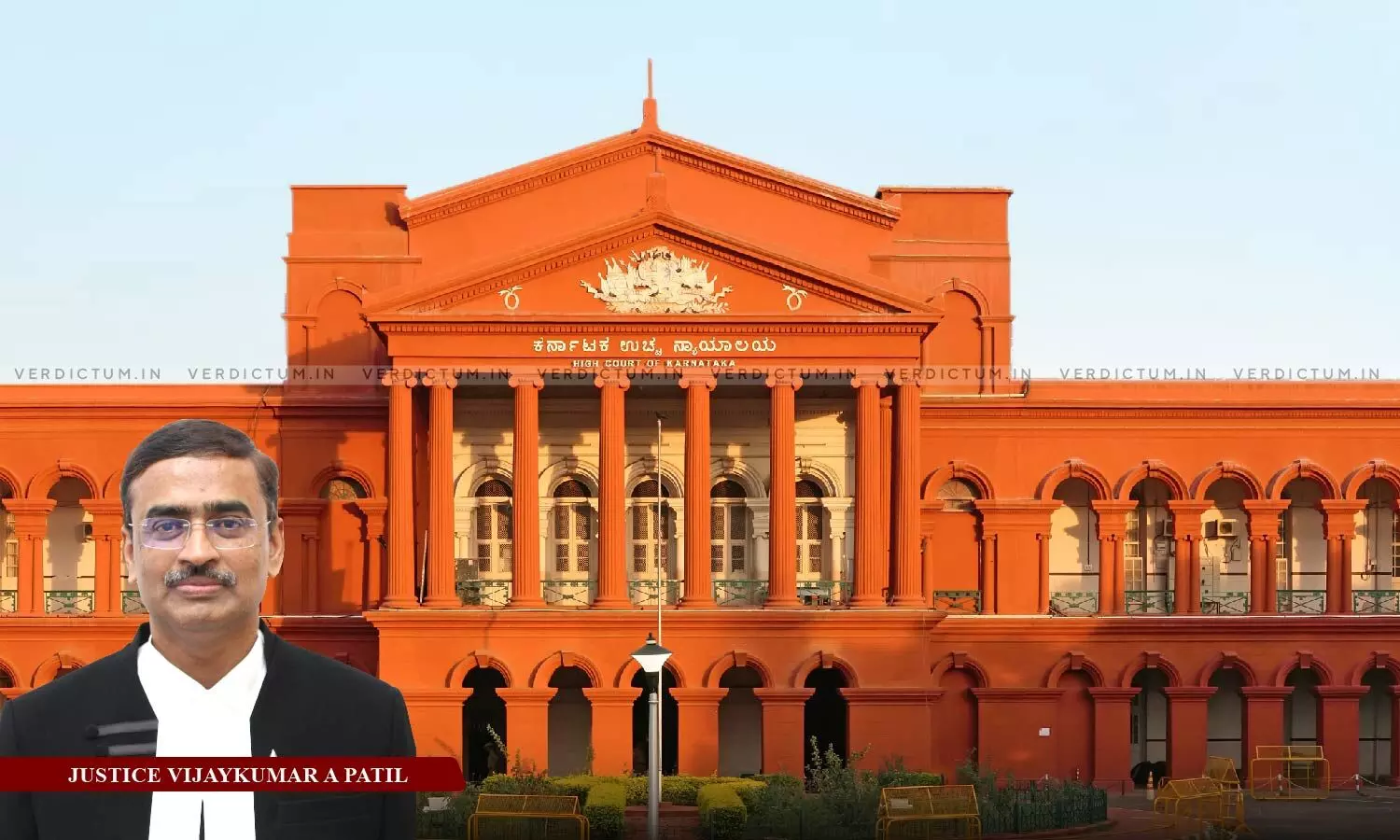
Justice Vijaykumar A. Patil, Karnataka High Court
Karnataka High Court Directs State To Frame Interim Compensation Scheme For Victims & Next Of Kin In Mob Violence & Lynching Cases Within 3 Months
 |
|The Court found that though the Sessions Court committed a grave error by not hearing the next of kin before granting bail, the accused persons’ liberty could not be curtailed merely on that procedural lapse when there was no allegation of bail-condition violation or misconduct.
The Karnataka High Court has directed the State Government to formulate a scheme for the grant of interim compensation to victims or the next of kin of victims in mob violence and lynching cases within three months, and to file a compliance report before the Court.
The Court issued the direction while dismissing connected petitions filed by the State and the next of kin of the deceased seeking cancellation of bail granted to accused persons in a mob violence/lynching case.
The Court was hearing a batch of criminal petitions filed under Section 439 of the Code of Criminal Procedure, 1973 read with Section 483 of the Bharatiya Nagarik Suraksha Sanhita, 2023, challenging bail orders passed by the II Additional District and Sessions Judge, Dakshina Kannada, Mangaluru, in a case registered for offences under the Bharatiya Nyaya Sanhita, 2023.
A Bench of Justice Vijaykumar A. Patil directed: “The State Government is directed to formulate a scheme for grant of interim compensation to the victim or the next of kin of the victim within 3 months of passing of this order and file compliance report before this Court.”
Advocate Clifton D’Rozario appeared for the next of kin of the deceased; State Public Prosecutor-I B.N. Jagadeesha appeared for the State; Senior Counsel Aruna Shyam appeared for the accused in several connected petitions.
Background
The case arose from an incident during a cricket match organised by a friends club, where the deceased allegedly raised a slogan and was thereafter followed and assaulted by several persons. The judgment records that he suffered blunt injuries and later succumbed to them.
The police registered a case against the accused and others for offences under Sections 103(2), 115(2), 189(2), 190, 191(1), 191(3) and 240 of the Bharatiya Nyaya Sanhita, 2023. The accused were arrested, remanded to judicial custody, and later granted regular bail by the Sessions Court on grounds including parity with co-accused, absence of names in the initial complaint or FIR, subsequent implication during investigation, and absence of criminal antecedents.
The next of kin argued that under Tehseen S Poonawalla v. Union of India and Others (2018), victims or next of kin in mob lynching cases must be given timely notice of court proceedings and be heard in applications such as bail, discharge, release and parole. It was also argued that no scheme for interim compensation had been formulated by the State Government. The State supported cancellation of bail, while the accused opposed interference, submitting that the charge sheet had already been filed, custodial interrogation was no longer required, and setting aside bail would affect their liberty.
Court’s Observations
The Court noted that the Sessions Court had not issued notice to, or heard, the next of kin while granting regular bail to the accused. It considered the distinction between setting aside a bail order on the ground that it was illegal, perverse, unjustified or arbitrary, and cancelling bail on account of supervening circumstances such as breach of bail conditions.
The Court observed: “In the instant case, it is not in dispute that the Sessions Court has neither issued notice nor heard the next of kin of the victim, while considering the application for regular bail, hence, it is contended that as a result, the order of grant of bail stands vitiated.”
Referring to Jagjeet Singh and Others v. Ashish Mishra and Another (2022), the Court held that denial of the right of the victim or next of kin to participate in proceedings can be a ground to cancel bail, without depriving the accused of the right to seek bail on relevant considerations.
The Court held that the Sessions Court had erred in not issuing timely notice to the next of kin and in not allowing them to object to the bail applications. However, it declined to set aside the bail orders.
The Court observed: “Keeping in mind the aforesaid propositions of law, I am of the considered view that the Sessions Court has committed a grave error in failing to issue timely notice to the next of kin of the deceased and also failed to provide an opportunity to the next of kin of the deceased to object the application seeking regular bail filed by the accused.”
The Court declined interference because the charge sheet had already been filed, no custodial interrogation was required, a Coordinate Bench had granted bail in connected matters after hearing the next of kin, and appeals by the State against bail granted to two accused had been rejected by the Supreme Court. It also noted that remitting the bail applications would delay disposal of the case despite the time limit indicated in Tehseen S Poonawalla (2018).
The Court added: “In the instant case, though bail has been granted without following the due procedure, neither the petitioner nor the State are alleging that the accused have violated the conditions of bail or have committed any further crime. Hence, I am of the view that the liberty of the accused cannot be curtailed merely on the ground of procedural lapse by the Court specially when there is no allegation of violation of bail conditions or misconduct.”
The Court also rejected the State’s request to impose an additional condition requiring the accused to appear before the police station every month to prevent witness tampering.
The Court held: “Insofar as the contention of the learned State Public Prosecutor-I appearing for the State to include an additional condition in the bail conditions to make themselves present before the Police Station to prevent witness tampering is concerned, I am of the view that the same is required to be rejected as there is no allegation against the accused either for violation of the existing bail conditions or for tampering of any witness.”
The Court recorded that the State had filed a memo with documents showing point-wise compliance with directions issued in Tehseen S Poonawalla (2018). The compliance chart referred to steps such as appointment of a District Nodal Officer, constitution of a Special Task Force, identification of vulnerable areas, preventive measures, patrolling, filing of charge sheet, and departmental action against a police officer.
However, the Court found that the Government Order relied upon by the State, though providing compensation to victims or next of kin, did not contain a provision for interim compensation.
The Court observed: “However, it is to be noticed that the said order does not contain any provision for grant of interim compensation to the victim or the next of his/her kin as per the guidelines in the case of TEHSEEN S POONAWALLA, referred supra. Hence, I am of the considered view that the State is required to be directed to formulate a scheme to inculcate the provision for interim compensation to the victims or the next of their kin in consonance with the guidelines in the case of TEHSEEN S POONAWALLA, referred supra.”
The Court observed that mob lynching is a grave threat to rule of law, human rights and the social fabric, and noted that Section 103(2) BNS criminalises mob-driven murder by a group of five or more persons acting in concert on specified grounds.
The Court observed: “Mob lynching represents a grave threat to the rule of law, human rights, and social fabric, as it replaces legal justice with brutal, collective lawlessness driven by prejudice, intolerance and hate.”
It reiterated guidelines based on Tehseen S Poonawalla (2018), including appointment of Nodal Officers, creation of Special Task Forces, identification of vulnerable areas, periodic review meetings, police patrolling, action against inflammatory content, prompt FIR registration, nodal supervision of investigation, interim relief, fast-track trial, victim participation, free legal aid, witness protection and disciplinary action against officials for non-compliance.
Conclusion
The Court dismissed the criminal petitions. It directed the Registrar General/Registrar (Judicial) to circulate the order to all Principal District Judges and Sessions Judges for mandatory compliance with the guidelines. It directed the State Government to formulate an interim compensation scheme within three months and file a compliance report. It further directed circulars to be issued so that objections are raised if the victim is not arrayed as a party in cases involving mob violence or lynching.
The Sessions Court was directed to endeavour to complete the trial and pronounce judgment in a time-bound manner as stipulated in Tehseen S Poonawalla (2018). No order as to costs was passed.
Cause Title: Abdul Jabbar v. Sachin And Connected Matters (Neutral Citation: 2026:KHC:44907)
Appearances
Appellants: Advocate Clifton D’Rozario, instructed by Advocate Maitreyi Krishnan
Respondents: State Public Prosecutor-I B.N. Jagadeesha, with High Court Government Pleader Ranjith Kumar; Senior Counsel Aruna Shyam, with Advocates Suyog Herele E and Renspre Prithesh D’Souza; Advocates M.R. Balakrishna, Ashwin Joyston Kutinha and V.R. Balaraj