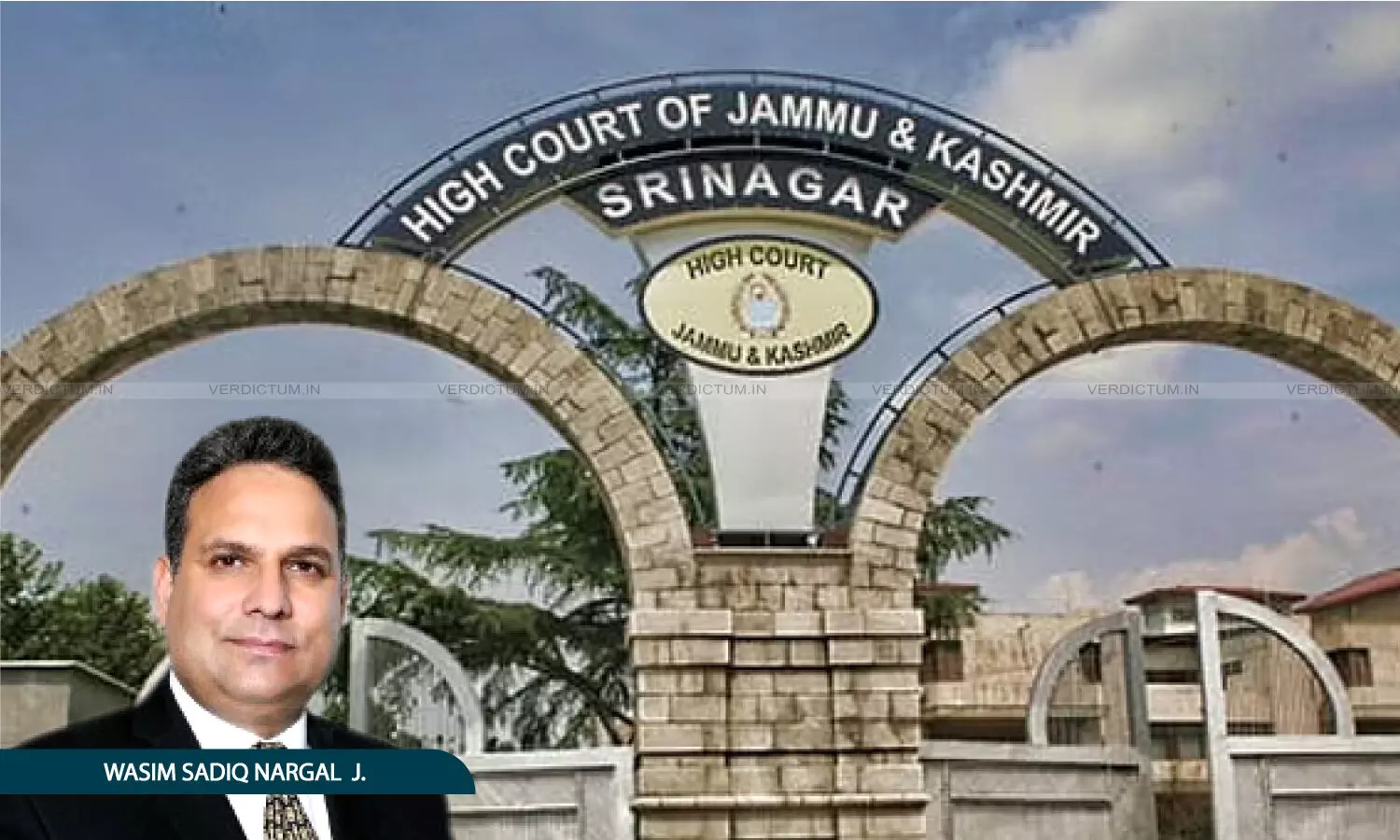
Justice Wasim Sadiq Nargal, Jammu & Kashmir & Ladakh High Court
Alleged Attack By Absconding Co-Accused Relevant To Witness-Interference Apprehension: J&K And Ladakh High Court Denies Bail To Former Sarpanch
 |
|The High Court also found that the applicant’s incomplete disclosure of his criminal antecedents weighed against bail, while the CCTV footage relied upon as an alibi required examination at trial.
The Jammu & Kashmir and Ladakh High Court has denied regular bail to a former Sarpanch in a case concerning an alleged pre-planned armed assault on two persons, holding that an earlier alleged attack on one of the injured persons, continuing threats, five absconding co-accused and the incomplete investigation gave substance to the apprehension that he could influence witnesses or impede the investigation if released.
The Court was hearing a successive application for regular bail after the Principal Sessions Judge, Rajouri, had declined bail in a case involving offences under Sections 109, 126(2) and 191(2) of the Bharatiya Nyaya Sanhita, 2023 and Sections 4 and 25 of the Arms Act, 1959.
A Bench of Justice Wasim Sadiq Nargal observed: “The apprehension expressed by the prosecution regarding the applicant's possible interference with the investigation and the witnesses also cannot, in the facts of the present case, be brushed aside as a mere vague or fanciful apprehension. The complainant has specifically referred to an earlier attack upon one of the injured persons approximately two months prior to the present occurrence, allegedly involving some of the co-accused in the present FIR, followed by continuous threats and warnings of dire consequences. Though these allegations are also subject to investigation and adjudication in accordance with law, they constitute a relevant circumstance while assessing the apprehension expressed by the victims and their family members. Five co-accused are still absconding, one of the injured persons is yet to be examined and recovery of the weapons allegedly used in the occurrence remains pending. In such circumstances, the possibility of the applicant influencing the witnesses, hampering the investigation or otherwise obstructing the course of justice is a relevant consideration while deciding whether he should be permitted to remain at large.”
Senior Advocate Sunil Sethi appeared for the applicant; Government Advocate Bhanu Jasrotia appeared for the Union Territory, while Senior Advocate Aseem K Sawhney appeared for the complainant.
Background
According to the prosecution, two persons returning from their shop were intercepted and assaulted by several persons using hockey sticks, sharp-edged weapons and other weapons, causing them serious injuries. The complainant also alleged that one of the injured persons had been attacked around two months earlier by several persons, including some of the co-accused in the present case, and that threats had continued thereafter.
The applicant’s earlier bail plea was rejected primarily because the injured persons were undergoing treatment. In the successive application, he contended that both had since been discharged and that this constituted a material change in circumstances. He also submitted that no specific overt act or recovery was attributed to him and relied on CCTV footage from his petrol pump to claim that he was not present at the scene.
The Union Territory opposed bail on the ground that the investigation remained incomplete. It submitted that five co-accused were absconding, the weapons had not been recovered, the statement of one injured person remained to be recorded and the relevant medical reports were awaited. The status report also referred to three previous criminal cases involving the applicant, two pending before the competent court and one under investigation.
The complainant, who is the father of one injured person and the uncle of the other, sought permission to participate in the bail proceedings. He contended that the applicant had not fully disclosed his criminal antecedents and could influence or intimidate witnesses if released.
Court’s Observations
The Court considered the complainant’s relationship with the injured persons and relied upon Jagjeet Singh v. Ashish Mishra (2022) and M/s J.K. International v. State Government of NCT of Delhi (2001) while allowing his impleadment application.
The Court observed: “Having regard to the nature of the allegations, the status of the applicant as the complainant and a close relative of the injured persons, and the legal position relied upon, this Court finds the application for impleadment to be maintainable and, accordingly, allows the same.”
The Court stated that a successive bail application is maintainable, but the applicant must demonstrate a substantial change in the factual or legal circumstances that informed the rejection of the earlier application.
It underscored: “It is well settled that though a successive bail application is maintainable, the Court considering such an application is required to bear in mind the reasons which weighed with the Court while rejecting the earlier application and to ascertain whether any substantial change in the factual or legal position has occurred. The mere reiteration of grounds which have already been considered and rejected cannot, by itself, furnish a basis for a different conclusion.”
Although the applicant claimed that both injured persons had been discharged, the Court noted that one injured person’s statement and medical reports were still awaited. The circumstances that had informed the earlier refusal of bail had, therefore, not entirely ceased to be relevant.
The Court found that the investigation remained at a nascent stage. Apart from the pending arrest of five co-accused and recovery of the alleged weapons, the material before it included witness statements, seizure of the vehicle allegedly used in the occurrence and an analysis of call-detail records.
The Court remarked: “This Court is conscious that, at the stage of bail, it is neither permissible nor desirable to undertake a meticulous examination of the evidence or to record findings which may prejudice the trial. At the same time, the Court cannot altogether disregard the prima facie material placed on record.”
The allegations concerned a concerted assault involving several persons and the use of weapons. The Court held that the allegations could not, at that stage, be characterised as vague or inherently improbable.
It also considered the earlier alleged attack and subsequent threats relevant to assessing the complainant’s apprehension. The applicant’s position as a former Sarpanch, his standing in the locality and his antecedents were taken into account while examining the possibility of interference with the investigation or intimidation of witnesses.
The Court noted that the applicant had disclosed two previous criminal cases, while the status report referred to a third case. Although his counsel maintained that he was unaware of that case, the Court found it unnecessary to determine at the bail stage whether the omission was deliberate.
The Court observed: “Whether such omission was deliberate or otherwise is not necessary to be conclusively determined at this stage. What remains material is that the bail application did not contain a complete disclosure of the criminal cases stated by the Investigating Agency to be pending against the applicant. This incomplete disclosure of the criminal antecedents, therefore, constitutes an additional circumstance which weighs against the applicant.”
The Court referred to Zeba Khan v. State of Uttar Pradesh (2026) on the obligation of a bail applicant to make a complete and candid disclosure of material particulars. It also relied on Neeru Yadav v. State of Uttar Pradesh (2016) while considering the relevance of criminal antecedents to the exercise of bail discretion.
The applicant relied upon CCTV footage from his petrol pump to establish that he was elsewhere when the alleged assault occurred. The Court declined to reach a conclusive finding on that material while deciding bail.
The Court held: “However, its evidentiary value, authenticity, continuity and ultimate effect upon the prosecution case would require appreciation in the light of the entire evidence. This Court, while exercising jurisdiction at the stage of bail, cannot undertake a detailed appreciation of such material or conclusively determine the applicant's assertion regarding his absence from the place of occurrence. The effect of the CCTV footage is, therefore, best left for consideration during trial.”
Drawing upon State through CBI v. Amarmani Tripathi (2005), Prasanta Kumar Sarkar v. Ashis Chatterjee (2010), Mahipal v. Rajesh Kumar @ Polia (2020) and Brijmani Devi v. Pappu Kumar (2022), the Court reiterated that a bail determination requires consideration of the prima facie case, gravity of the accusations, criminal antecedents, risk of absconding, possible influence over witnesses and obstruction of justice.
The Court concluded: “This Court is conscious that personal liberty is a valuable constitutional right and that pre-trial incarceration cannot be permitted to become punitive in character. However, the grant of bail is not to be made as a matter of course, and the discretion has to be exercised upon a judicious assessment of the competing considerations. In the present case, the gravity and manner of the alleged occurrence, the prima facie material collected during investigation, the antecedents of the applicant, the incomplete investigation and the possibility of interference with the witnesses and evidence, when considered cumulatively, outweigh the considerations advanced on behalf of the applicant.”
Conclusion
The High Court allowed the complainant’s impleadment application but dismissed the applicant’s successive plea for regular bail, finding that he had failed to establish a material change in circumstances warranting his release.
It clarified that its observations were confined to the bail application and should not be construed as expressing an opinion on the merits of the prosecution case. The Trial Court was directed to consider the matter independently on the evidence placed before it.
Cause Title: Kewal Krishan v. UT of Jammu and Kashmir & Anr.
Appearances
Applicant: Senior Advocate Sunil Sethi, with Advocates Parimoksh Seth and Amullaya Gupta
Respondents: Government Advocate Bhanu Jasrotia; Senior Advocate Aseem K Sawhney, with Advocates Nishant Verma, Kashif Malik, Sarfraz Ahmed and Anil Kumar