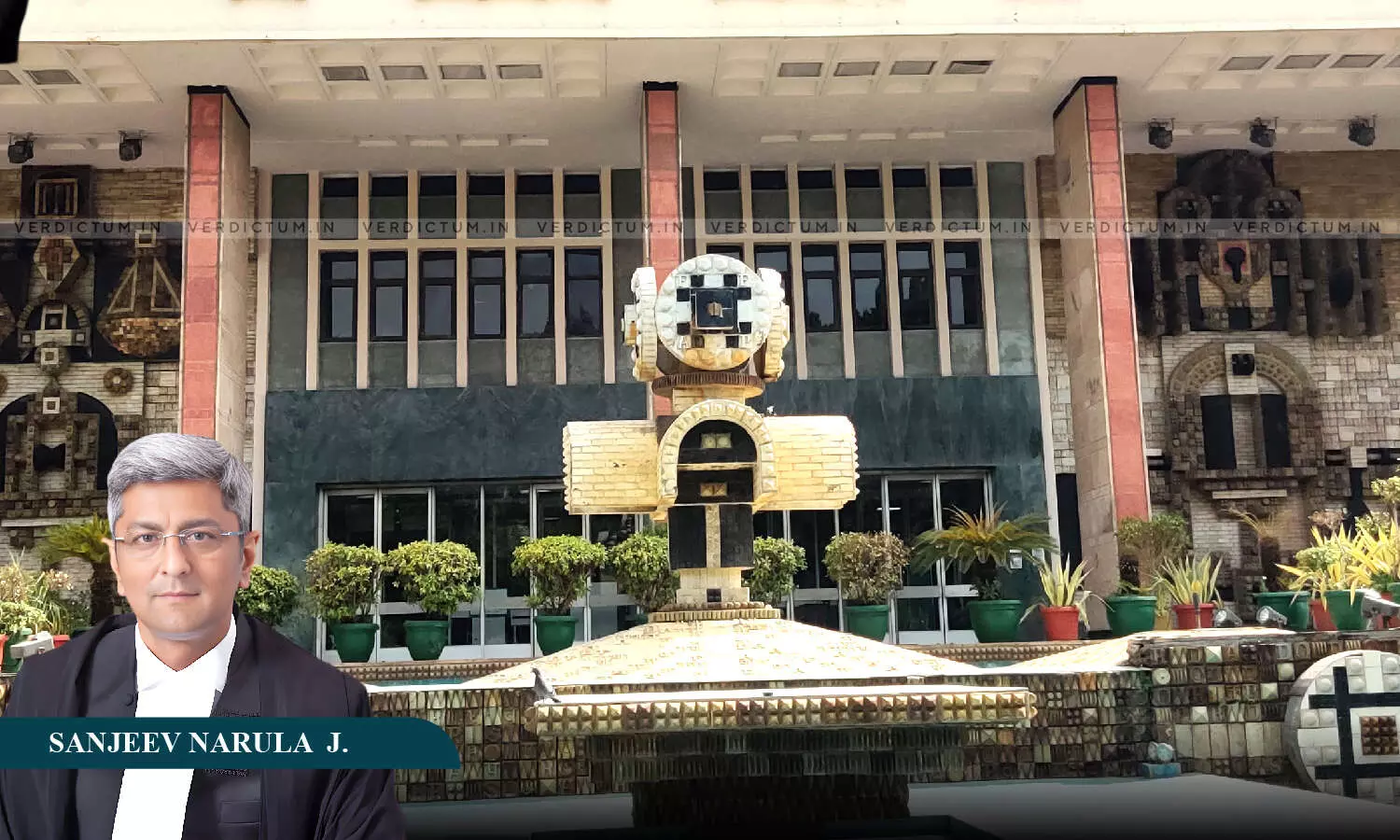
Justice Sanjeev Narula, Delhi High Court
Victim’s Wish To Preserve Family With Accused & Child’s Interest Not Sufficient To Quash POCSO Case: Delhi High Court
 |
|The High Court held that a later marriage in adulthood cannot retrospectively supply legal consent for alleged sexual intercourse during the victim’s minority.
The Delhi High Court has refused to quash a prosecution alleging aggravated penetrative sexual assault under the Protection of Children from Sexual Offences Act, 2012, despite the victim’s stated wish to live with the accused-petitioner, their subsequent marriage and the birth of their child.
The Court held that the victim’s present choice and the child’s interest in receiving the care of both parents were substantial considerations. On the record before it, however, the Court held, those circumstances did not establish that continuing the prosecution would amount to an abuse of process.
The Court was hearing a petition under Section 528 of the Bharatiya Nagarik Suraksha Sanhita, 2023, seeking quashing of the FIR and consequential proceedings concerning alleged sexual intercourse during the victim’s minority. The charge sheet had been filed, and the matter was awaiting consideration of charge before the Special Court.
A Bench of Justice Sanjeev Narula observed: “The victim’s wish to live with the Petitioner, and their child’s interest in the care of both parents, are substantial considerations. They explain the force of the request before the Court. They do not, in this Court’s assessment of the present record and the jurisdiction it exercises, furnish sufficient grounds to extinguish the prosecution.”
The Bench added: “The case for quashing is, therefore, not made out. The complaint followed the disappearance of a minor; the investigation disclosed pregnancy during her minority and material connecting the Petitioner to the alleged acts. Her account of a voluntary relationship does not remove that foundation, although it may bear upon the proof of particular charges. The prosecution has not been shown to be manifestly false, malicious or an abuse of process. Nor do the subsequent marriage, compromise and family circumstances, considered together, justify its termination to secure the ends of justice.”
Advocate Aman Goyal appeared for the petitioner. Additional Public Prosecutor Tarang Srivastav appeared for the State.
Background
The proceedings began when the victim’s mother reported that her daughter had left home and could not be found. The victim was then approximately 16 years and seven months old, while the petitioner was 20.
The victim was subsequently traced, and her medical examination indicated that she was pregnant. In her statement before the Magistrate, she stated that she had voluntarily accompanied the petitioner and had not been coerced. She also referred to a marriage ceremony performed while she was still a minor.
The judgment noted that the victim later resumed living with the petitioner and their child. After she attained majority, she supported his bail application and stated that she wished to remain with him. They subsequently solemnised their marriage after both had attained the prescribed marriageable age and later executed a compromise deed seeking termination of the proceedings.
The petitioner argued that the relationship had always been voluntary, that the victim had not correctly disclosed her age to him and that continuing the prosecution would cause uncertainty and hardship to their family.
The State opposed the petition by relying on the victim’s undisputed minority, the medical evidence of pregnancy and the material collected during the investigation.
Court’s Observations
Willingness During Minority Does Not Constitute Legal Consent
The Court observed that Section 2(1)(d) of the POCSO Act defines a child as a person below 18 years of age. It held that the absence of consent is not an ingredient of penetrative sexual assault upon a child under Section 3 of the Act. Clause sixthly of Section 375 of the Indian Penal Code, 1860 similarly covers sexual intercourse with a girl below 18, with or without her consent.
Explaining the legal effect of the victim’s account of a voluntary relationship, the Court observed: “Willingness may explain the relationship; it does not take the alleged act outside the statute.”
The Court held that Parliament had prescribed a uniform age threshold instead of requiring an individual assessment of whether a particular child possessed sufficient maturity to consent. It added that a court could not substitute its own assessment of maturity for that legislative choice.
The Court further stated that child protection under the statute did not depend upon proof of grooming, deception or overt force. Clarifying that it was not making any such finding against the petitioner, the Court observed: “An enduring relationship cannot retrospectively supply legal consent.”
The Court also held that describing the victim as “nearly eighteen” did not resolve the statutory issue. It noted that she was approximately 17 months short of attaining majority when she initially left home and that pregnancy was medically documented during her minority.
Subsequent Adult Marriage Does Not Alter Earlier Alleged Acts
The Court observed that the parties’ subsequent marriage was solemnised after the victim had attained 18 and the petitioner had attained 21. Their earlier ceremony, however, had allegedly occurred when neither had reached the prescribed marriageable age.
The Court held that the later marriage could not determine the legality of sexual intercourse allegedly occurring during the victim’s minority.
Referring to Section 3 of the Prohibition of Child Marriage Act, 2006, the Court stated that a child marriage is ordinarily voidable at the option of the contracting party who was a child, subject to the circumstances in which the Act treats it as void. The Court added that the provisions governing maintenance, residence, custody and legitimacy address the consequences of child marriage but do not authorise sexual intercourse with a child.
The Court observed: “Even a subsisting marriage would not displace POCSO.”
The Court relied on Independent Thought v. Union of India and Another (2017), in which the Supreme Court read down Exception 2 to Section 375 IPC so that marriage would not exclude sexual intercourse with a wife below 18 from the offence of rape. It also referred to Society for Enlightenment and Voluntary Action and Another v. Union of India and Others (2024), which reiterated that sexual intercourse with a minor wife attracts the POCSO Act.
Prima Facie Factual Foundation Of Prosecution Remained
The Court held that even if the victim’s account of a voluntary relationship were accepted for deciding the petition, the factual foundation of the prosecution remained.
The Court noted that the victim did not deny that the relationship was sexual, pregnancy had been medically documented during her minority and the petitioner had accepted paternity for the purposes of the petition. It held that the material prima facie brought Section 5(j)(ii), read with Section 6 of the POCSO Act, into consideration.
The Court clarified that it was making no assumption concerning the forensic report, which remained awaited when the charge sheet was filed.
It further observed that the victim’s assertion that she had misstated her age concerned what the petitioner was told rather than her actual age. The circumstances of that representation and any legally available defence had to be examined by the Special Court.
POCSO Does Not Exclude The High Court’s Quashing Jurisdiction
The Court clarified that the invocation of the POCSO Act did not, by itself, exclude its jurisdiction under Section 528 BNSS or Article 226 of the Constitution.
Explaining the distinction between the statutory ingredients and the exercise of quashing jurisdiction, the Court observed: “The invocation of POCSO does not, by itself, exclude either jurisdiction. The inquiries are distinct: willingness cannot constitute legal consent during minority, but the Court must nonetheless examine whether the circumstances as a whole warrant termination of the proceedings.”
The Court applied State of Madhya Pradesh v. Laxmi Narayan (2019) and Ramgopal and Another v. State of Madhya Pradesh (2021), which require consideration of the nature and seriousness of the offence and its impact upon society.
It held that alleged sexual conduct involving a child was not converted into a predominantly matrimonial or family dispute merely because the parties subsequently married.
Concern Over Adolescent Relationships Requires Legislative Consideration
The Court acknowledged the concern surrounding prosecutions arising from genuine adolescent relationships.
Referring to State of Uttar Pradesh v. Anurudh (2026), it noted that the Supreme Court had asked the Union Government to consider measures including a “Romeo-Juliet” clause to exempt genuine adolescent relationships from the operation of the law.
The Court held that the observation recognised a problem requiring attention but did not introduce an exception into the existing statute. Defining an exception, its permissible age limits and safeguards required legislative consideration.
Quashing Decisions Depend Upon Their Particular Records
The Court examined In Re: Right to Privacy of Adolescents (2024), where the Supreme Court held that the romantic nature of a relationship did not alter the statutory ingredients of a POCSO offence. The Court noted that the case involved different ages and had already reached trial, but considered it relevant to the proposition that the nature of the relationship cannot change the offence’s statutory elements.
The Court separately considered Ayyub Malik and Another v. State of Uttarakhand and Another (2026), where the Supreme Court quashed proceedings after considering the parties’ voluntary marriage, nearly six years of matrimonial life and the birth of a child. The Court distinguished that decision because the victim’s minority had been disputed there, whereas minority and pregnancy during childhood were undisputed in the present case.
The Court distinguished Mahesh Mukund Patel v. State of Uttar Pradesh and Others (2025) because the Supreme Court had found from the documents that the woman was already an adult when the alleged offence occurred.
The Court also considered Harmeet Singh v. State of GNCT Delhi and Another (2026), in which a Coordinate Bench quashed a POCSO prosecution after considering the victim’s consistent stand, the parties’ marriage, their child and the consequences for the family. It held that Harmeet Singh required sensitive consideration of the entire factual matrix but did not prescribe quashing whenever such features existed.
The Court further referred to Prince Kumar Sharma and Others v. State NCT of Delhi and Another (2025) and Mohd. Dilsad @ Adil v. State and Others (2025), where subsequent marriage and parenthood were held insufficient to erase the statutory ingredients of the alleged offences.
After considering these authorities, the Court observed: “The subsequent family life makes the continuation of the prosecution painful; on the present record, however, it does not establish that such continuation would amount to an abuse of process or that termination of the proceedings is necessary to secure the ends of justice.”
Article 142 Relief Could Not Supply A Rule For Quashing
The Court considered K. Kirubakaran v. State of Tamil Nadu (2025), where the Supreme Court took account of the consequences of the appellant’s incarceration for his wife and child. Although recognising that proceedings arising from a heinous offence could not ordinarily be quashed through a compromise, the Supreme Court had exercised its extraordinary power under Article 142 of the Constitution and expressly directed that the relief should not be treated as a precedent.
Referring to Indian Bank v. ABS Marine Products (P) Ltd. (2006), the Court distinguished between the law declared by the Supreme Court and relief moulded under Article 142 on the special facts of a case. It held that the exceptional relief granted in K. Kirubakaran could not supply a corresponding rule for the exercise of the High Court’s jurisdiction.
The Court also considered the later decision in In Re: Right to Privacy of Adolescents (2025), where the Supreme Court retained the conviction but exercised Article 142 jurisdiction to direct that the accused would not undergo the sentence. The Supreme Court had expressly stated that the case was not to be treated as a precedent.
Family Hardship Did Not Justify Terminating The Prosecution
The Court acknowledged that the consequences of prosecution would affect the victim, her husband and their child. It held that her concern could not be treated as legally irrelevant.
The Court nevertheless observed that terminating the proceedings on the grounds advanced would permit subsequent marriage, parenthood and family acceptance to outweigh the protection afforded to the victim when she was a child.
The Court held that child protection could not depend solely upon whether the relationship survived or later received the family’s approval. It concluded that the hardship arising from the prosecution did not justify terminating an otherwise sustainable case.
Conclusion
The Court dismissed the petition after holding that the prosecution had not been shown to be manifestly false, malicious or an abuse of process. It found that the subsequent marriage, compromise and family circumstances, considered together, did not justify terminating the proceedings.
The Court clarified that its conclusion did not question the victim’s present choice or require her to describe her experience in terms she rejected. Its observations were confined to the prayer for quashing.
The Court directed the Special Court to consider the charges, evidence and every legally available defence independently, without being influenced by any prima facie assessment in the order.
The Court clarified that dismissal of the petition would not disturb the petitioner’s existing bail. It also preserved his liberty to pursue remedies before the Supreme Court and place the family’s exceptional circumstances before it, including in support of a request for relief under Article 142 of the Constitution.
Cause Title: X v. The State
Appearances
Petitioner: Advocates Aman Goyal, Yogesh Kalra and Gaurav Kashyap
Respondents: Additional Public Prosecutor Tarang Srivastav
Click here to read/download Judgment