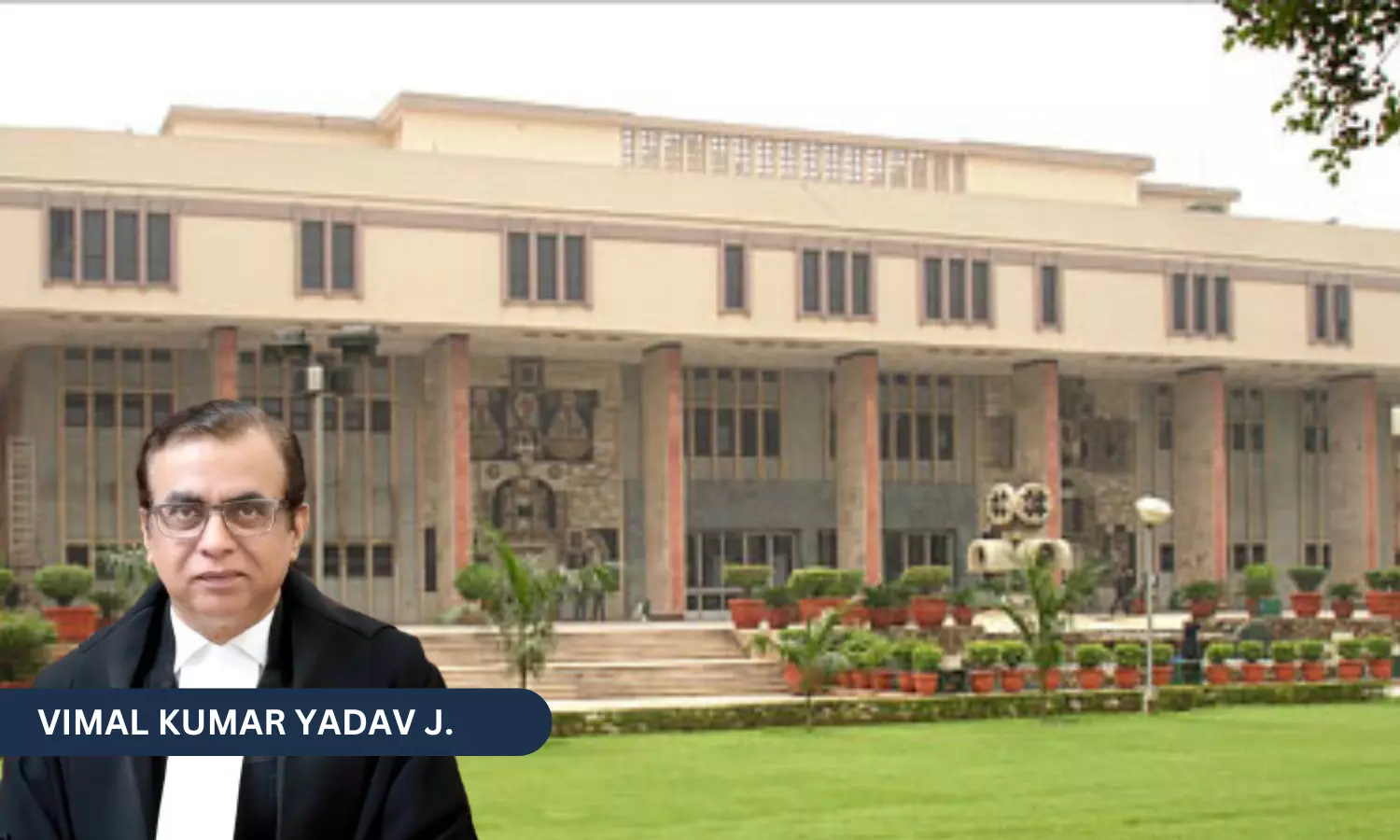
Justice Vimal Kumar Yadav, Delhi High Court
There Was No Misuse Of Power, Wealth, Status Or Age: Delhi High Court Directs Release Of Man In 2009 Minor's Rape Case, Cites Absence Of "Force Or Coercion"
 |
|The Court noting that 17 years have passed by, and the subsequent marriages of both parties separately, prosecutrix’s wish not to contest appeal, remarked, “…where the truth sits naked. In her heart of hearts…she must also be looking for answers”.
The Delhi High Court has modified the sentence of a man convicted of kidnapping and raping a 14-year-old girl in 2009, directing his release on the basis of the period of incarceration he has already undergone, after noting that the Trial Court itself had earlier found special and adequate reasons to impose a sentence lower than the statutory minimum prescribed under the unamended Section 376 IPC. Noting the facts, the Court observed that there was no element of force or coercion involved, and explored the possibility of an "adolescent relationship" between the two, who were then aged 18 and 14 respectively.
Acknowledging that the incident was of the year 2009, which was before the enactment of Protection of Children from Sexual Offences Act, 2012, the Bench noted that there were certain questions which were left answered like, the tattoo on the prosecutrix’s chest, her name tattooed on the appellant’s hand, their trip to Manali, why did she not complain before etc. The Bench noted that those were indicative of the fact that the Appellant alone is not to be blamed.
The Court also took into account that the prosecutrix, now an adult, had expressed a wish not to contest the appeal, that both she and the appellant are separately married, and that more than 17 years had elapsed since the incident, It noted, “…Therefore, sending the Appellant, who has otherwise, clean antecedents, would be nothing short of a travesty of justice. The fallout of the punishment would not be confined to the Appellant alone. The Appellant is heading towards the evening of his life…”.
A Single Judge Bench of Justice Vimal Kumar Yadav observed, “So far as the instant case is concerned, the incident pertains to the year 2009, there was intimacy between Appellant and the prosecutrix, which could not be recognized due to the prosecutrix being minor and now both the Appellant and the prosecutrix are settled in their respective married lives. The Appellant was 18 years of age and the prosecutrix was 14 years of age at the relevant time...there is no element of force or coercion used in the alleged act of taking away the prosecutrix, no weapon or other malafide was found and that even the Appellant too was of a younger age at the time of incident. All these facts have to be kept in mind.”.
“…The prosecutrix has expressed her desire not to contest the case, as has been noted in the order dated 03.12.2025. It seems, some sort of soul searching was there, where the truth sits naked. In her heart of hearts, deep down somewhere, she must also be looking for answers and explanation for the tattoos and travel to Manali, etc…These unanswered and open ended situations are indicative of the fact that the Appellant alone is not to be blamed. The only factor which weighed against the Appellant was the age of the prosecutrix, who, indeed, was a minor at the relevant time and, therefore, the case has taken a turn in which the Appellant has been held responsible”, it noted.
Advocate Saahila Lamba appeared for the appellant and Raj Kumar, APP appeared for the respondent.
The prosecutrix, then about 14 years of age, went missing from her home on June 15, 2009. An FIR under Section 363 IPC was registered two days later, on June 17, 2009, following which she returned home.
During the intervening period, she and the appellant had travelled to Manali, Himachal Pradesh, before returning to Delhi. Her medical examination was conducted on June 17, 2009, at which stage her account was broadly consistent with the appellant's version of events.
Her statement under Section 164 Cr.P.C., recorded over a week later on June 26, 2009, took a materially different position implicating the appellant, a position she maintained in her substantive deposition before the Trial Court. The Trial Court convicted the appellant under Sections 363, 366 and 376 IPC.
The appellant was convicted by judgment dated May 07, 2011 and sentenced, with the Trial Court awarding a sentence below the statutory minimum after recording special and adequate reasons for doing so. In the present appeal, the challenge was confined solely to the sentence, with the conviction not being pressed.
Before the High Court, counsel for the appellant relied on various mitigating circumstances, and also placed reliance on State of Uttar Pradesh v. Anurudh & Anr. [2026 SCC OnLine SC 40], in which the Supreme Court had recommended that the government consider introducing a "Romeo-Juliet clause" to address cases of genuine adolescent relationships prosecuted under child protection legislation, as well as decisions from the Kerala and Delhi High Courts on similar lines.
“Admittedly, the prosecutrix takes a contrary stand against the Appellant from then onwards and that manifests itself in the statement under Section 164 Cr.P.C. Ex. PW-2/A recorded on 26.06.2009. The prosecutrix has, thereafter, maintained the same. Above all, in the substantive statement made before the Court, she has deposed against the Appellant, although, she did not have any convincing answers to certain aspects such as what was the occasion with her to have the name of the Appellant tattooed on her chest. She has also admitted that her name was tattood by the Appellant on his hand. There is no reason or explanation or answer as to why, she accompanied the Appellant and did not raise any alarm or protest at any point of time…However, learned Trial Court has also noted all these facts and found special and adequate reasons to punish the Appellant for a sentence, which is lesser than the minimum sentence prescribed under the un-amended Section 376 IPC”, the Court thus noted.
“The prosecutrix has taken a stand that she was under constant threat of being harmed or that her family would be harmed. This, however, does not seems to be the situation inasmuch as she was in her home when she allegedly received a telephonic call from the Appellant, who called her to meet. She could have easily reported this then and there to her parents and had the option not to go as per the dictates of the Appellant. She has also stated that the Appellant used to roam around her school and used to tease her, but then she did not report it to anyone leave alone her parents or school authorities”, the Bench further noted.
The Court accepted the submissions made on behalf of the appellant and directed that the period of incarceration already undergone by him be treated as sufficient punishment, ordering his release on that basis. The sentence of fine imposed by the Trial Court was left undisturbed.
Cause Title: Vakul Kapoor v. State (Neutral Citation: 2026:DHC:7579)
Appearances:
Appellant: Saahila Lamba, Advocate.
Respondent: Raj Kumar, APP, Megha Singh, Advocate.