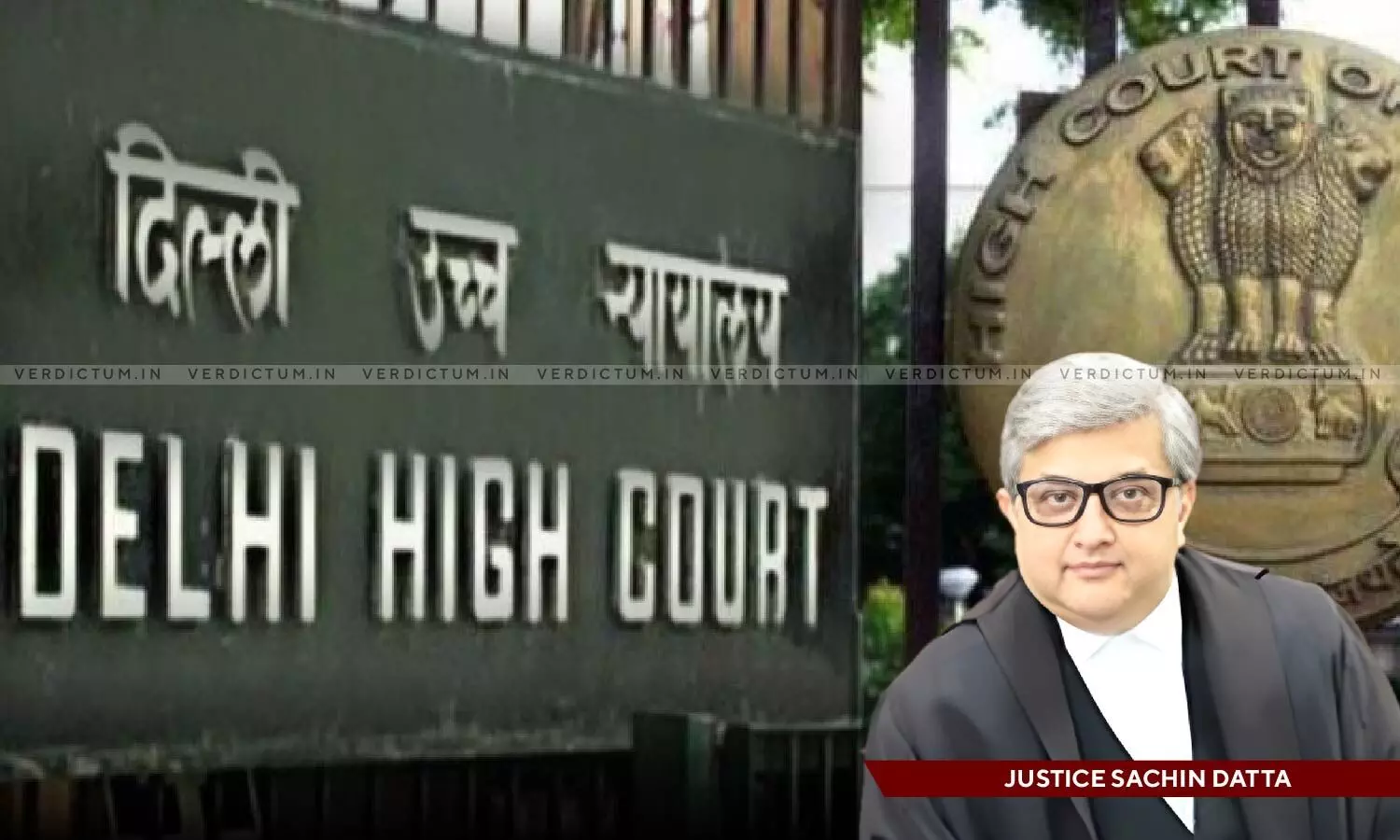
Justice Sachin Datta, Delhi High Court
Unnatural Death In Custody Even If By Suicide, Not A Private Act: Delhi High Court Awards ₹18.44 Lakh Compensation To Father For Death Of 19-Year-Old Son
 |
|The Court rejected the State’s defense of restricting remedy to statutory schemes; applied motor accident multiplier principle to quantify constitutional relief.
The Delhi High Court allowed a writ petition filed by a grieving father seeking accountability for the tragic loss of his son, directing the State to pay ₹18.44 lakh in financial compensation for the custodial death of the 19-year-old boy who died of ante-mortem hanging within a room at Police Station Karawal Nagar.
Condemning the gross negligence of the police personnel who failed to secure the arrestee or transfer him to a standard lock-up facility, the Court held that the State bears an absolute, strict, and non-delegable duty of care to protect the lives of individuals in its custody. The Court said that when a citizen's fundamental right to life under Article 21 of the Constitution of India is flagrantly violated inside a police station, the traditional defense of sovereign immunity is completely inapplicable to constitutional remedies sought under Article 226 of the Constitution of India.
It observed that while statutory frameworks exist, constitutional courts possess the independent authority to adopt objective parameters, specifically the multiplier framework used in motor accident claims, to ensure that the financial solace awarded to the next of kin is just, fair, and reflective of the gravity of the State's operational omission.
Justice Sachin Datta observed, “…An unnatural death in custody, even if by suicide, is not a private act divorced from State responsibility, but reflects an omission of duty on the part of those charged with safekeeping. The State cannot escape responsibility by invoking statutory schemes or by contending absence of direct culpability. The very fact of custodial death, being unnatural, attracts liability and obliges the Court to mould relief in the form of compensation…”.
“…The writ jurisdiction of this Court under Article 226 is wide enough to mould compensation as an equitable relief. Such compensation is distinct from and in addition to the statutory or private law remedies. The statutory scheme under Section 357A of the Code of Criminal Procedure, 1973 is only one avenue of relief; it supplements and does not curtail or exclude the power of this Court under Article 226 to award compensation for established infringement of fundamental rights. Custodial death, being unnatural, prima facie attracts liability under Article 21. Therefore, in view of the above discussion, this Court is inclined to hold that the petitioner is entitled to monetary compensation, to be determined in accordance with the multiplier principle in terms of Sarla Verma (supra)”, the Bench further observed.
Senior Advocate Trideep Pais appeared for the petitioner and Premtosh K. Mishra, CGSC appeared for the respondent.
As per the brief facts of the case, on January 15, 2018, the petitioner's 19-year-old son, was arrested by Sub-Inspector Sandeep from Karkardooma Courts in connection with an existing FIR.
The petitioner alleged that he was briefly detained, threatened, and physically assaulted alongside his son, and a bribe was demanded for his son's release. The next morning, the petitioner was informed that his son had allegedly committed suicide while confined in a room at Police Station Karawal Nagar, and a medical board later declared the cause of death as asphyxia due to ante-mortem hanging.
Thereafter, a magisterial inquiry was initiated under the Chief Metropolitan Magistrate, culminating in a Final Inquest Order dated July 22, 2019, which concluded that the cause of death was hanging, finding no external injuries on the body to definitively establish murder by the police.
Concurrently, a Departmental Enquiry was initiated against the concerned duty officers and the investigating officer, finding them guilty of gross negligence for failing to get the deceased medically examined or transferred to a standard lock-up facility, leading to a permanent forfeiture of one year of approved service. The petitioner subsequently filed the present writ petition under Article 226 seeking just financial compensation for the custodial death of his son.
Referring to landmark judgments, the Court noted that the right to life guaranteed under Article 21 cannot be suspended or denuded for a person in custody, and monetary compensation in a public law jurisdiction serves as a practical, constitutional mode of applying "balm to the wounds" of the bereaved family.
It rejected the state's contention that a suicide minimizes its accountability, affirming that the complete failure of the police personnel to secure the premises and strictly monitor the arrestee established an unyielding causal relationship between the State's omission and the death.
Accordingly, the Court applied the multiplier principle from Sarla Verma v. Delhi Transport Corporation, (2009) 6 SCC 121 based on a determined monthly income of ₹12,000 for the 19-year-old deceased.
Adding 40% for future prospects and applying a 50% deduction for personal expenses alongside a multiplier of 18, the Court calculated the loss of dependency at ₹18,14,400. After adding ₹15,000 each for loss of estate and funeral expenses under conventional heads, the Court ordered the respondents to pay a total compensation amount of ₹18,44,400 to the petitioner within the stipulated time.
Cause Title: Shyam Sundar v. State (NCT of Delhi) & Ors. (Neutral Citation: 2026:DHC:5226)
Appearances:
Petitioner: Trideep Pais, Senior Advocate, Sanya Kumar, Chiranjeev Singh Marwaha, Saloni Ambastha, Sakshi Jain, and S. Abinaya, Advocates.
Respondents: Premtosh K. Mishra, CGSC, Shrey Sharma, Anubhav Upadhyay, Arpit Bansal, Advocates.