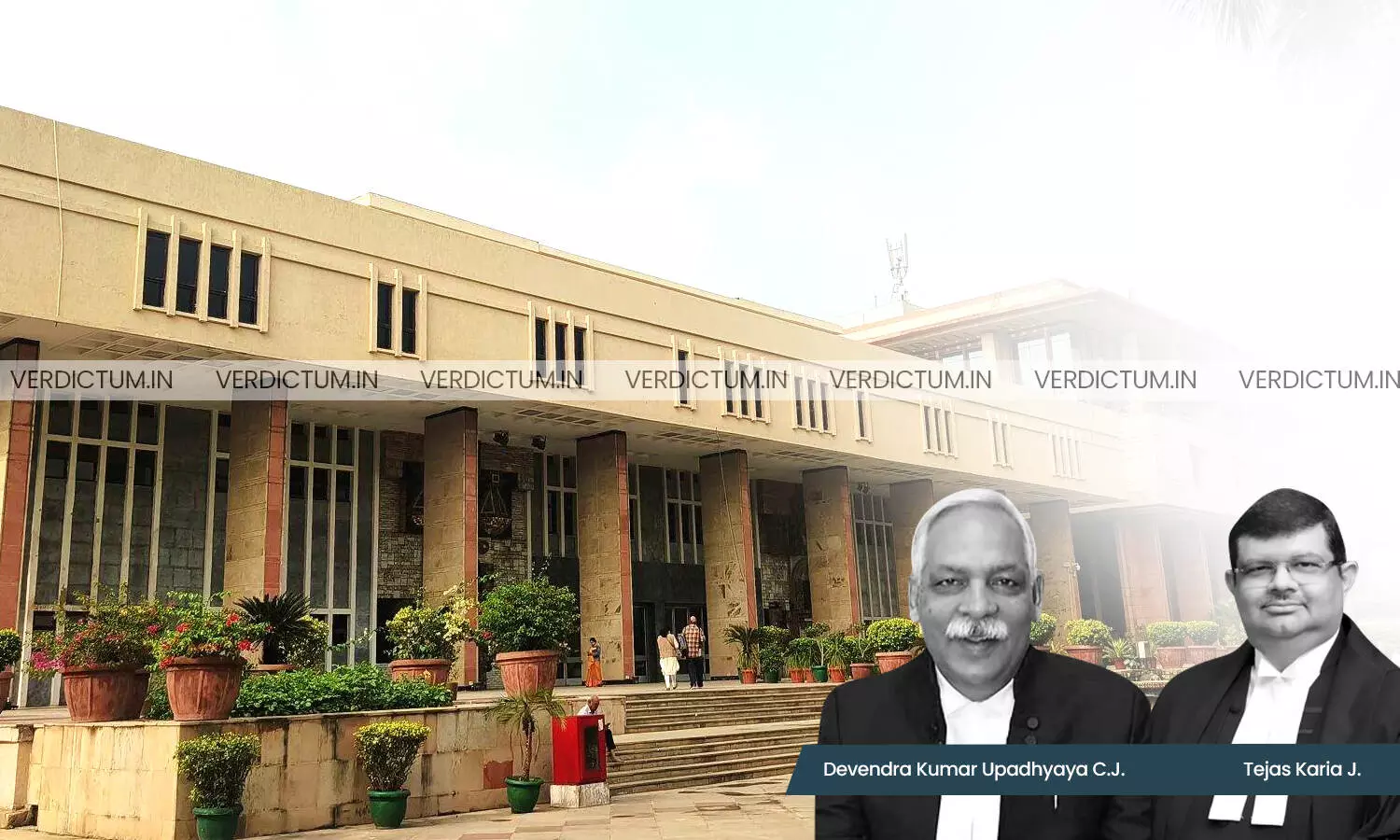
Chief Justice Devendra Kumar Upadhyaya, Justice Tejas Karia, Delhi High Court
"Absolutely Fallacious": Delhi High Court Rejects Plea Challenging Victim's Appeal Provision U/S 372 CrPC
 |
|The petitioner had argued that the impugned proviso casts a discrimination between the right of a victim and right of the State to challenge an order of acquittal, which the Court refused to accept.
The Delhi High Court has dismissed a writ petition seeking a declaration that the proviso to Section 372 of the CrPC and its counterpart under Section 413 of the BNSS are unconstitutional, ultra vires, and void for violating Articles 14 and 21 of the Constitution of India. The petitioner had argued that the provision, by permitting a victim to appeal an acquittal without first seeking leave to appeal, unfairly discriminated against the State, which must obtain such leave under Section 378 of the CrPC before challenging an acquittal.
Rejecting this contention in unambiguous terms, the Court described the argument as "absolutely fallacious," holding that the right of a victim to challenge an order of acquittal is constitutionally and legislatively distinct from the right available to the State or an ordinary complainant, and cannot be tested on the same footing.
A Division Bench comprising Chief Justice Devendra Kumar Upadhyaya and Justice Tejas Karia observed, “…The contention is that in case the State has to challenge an order of acquittal passed by a Magistrate in respect of a cognizable and bailable offence, it can file an appeal under Section 378 of the Cr.P.C., however, the State for filing the said appeal has to undergo the rigors of seeking leave to appeal under sub-section 3 of Section 378 of the Cr.P.C., whereas a victim can challenge an order of acquittal in a cognizable and bailable offence by filing an appeal under the proviso appended to Section 372 of the Cr.P.C. without being required to undergo the said rigor as envisaged under Section 378(3) of the Cr.P.C. The submission, thus, is for this reason the proviso creates an anomalous situation where, in the matter of right to appeal the State is discriminated vis-à-vis the victim. It is further stated that, in fact, to remove such a discriminatory provision even a victim must also be required to go through the rigors of seeking leave to appeal in case the victim intends to challenge an order of acquittal. The aforesaid submission, in our considered opinion, is absolutely fallacious”.
Advocate Guninder Kaur Gill appeared for the petitioner and Amit Tiwari, CGSC appeared for the respondent.
The petitioner, acquitted by a Magistrate under Section 509 of the IPC in a case arising from a police FIR registered in 2016, faced an appeal filed by the complainant-victim before the Sessions Court under the proviso to Section 372 of the CrPC. The petitioner objected that such an appeal, arising from a cognizable and bailable offence, could lie only before the High Court and only with leave under Section 378(4) CrPC, and separately challenged the very constitutionality of the enabling proviso.
The Sessions Judge, by order dated April 06, 2026, rejected the petitioner's preliminary objection on maintainability and held the victim's appeal to be properly instituted. The petitioner assailed that order before the Delhi High Court under Article 226, coupling the challenge with a prayer to strike down the proviso itself as unconstitutional, or, in the alternative, to confine its application only to privately instituted complaints.
The Court placing reliance on the Supreme Court's rulings in Celestium Financial v. A. Gnanasekaran 2025 SCC OnLine SC 1320 and Khem Singh v. State of Uttarakhand 2025 SCC OnLine SC 1778, the Bench reiterated that "the right of a victim of an offence to prefer an appeal cannot be equated with the right of the State or the complainant to prefer an appeal". Further that the Parliament had deliberately inserted the proviso "without mandating any condition precedent to be fulfilled by the victim of an offence," recognising a superior right in the victim as compared to the State or an ordinary complainant.
The Court also rejected the petitioner's reliance on the minority opinion in Mallikarjun Kodagali, (Dead) through Lrs. v. State of Karnataka and others, (2019) CRL.L.J. 532 (SC), holding that the majority view required the proviso to be construed in a manner that "is realistic, liberal, progressive and beneficial to the victim of an offence" and that the proviso "must be given life, to benefit the victim of an offence".
The writ petition was dismissed along with pending applications, and the Sessions Judge's order dated April 06 ,2026 permitting the victim's appeal to proceed without leave was upheld. No order as to costs was made.
Cause Title: Shivdhar Upadhyay v. Union of India and Another (Neutral Citation: 2026:DHC:7414-DB)
Appearances:
Petitioner: Guninder Kaur Gill, Advocate.
Respondent: Amit Tiwari, CGSC, Amol Sinha, ASC (Criminal).