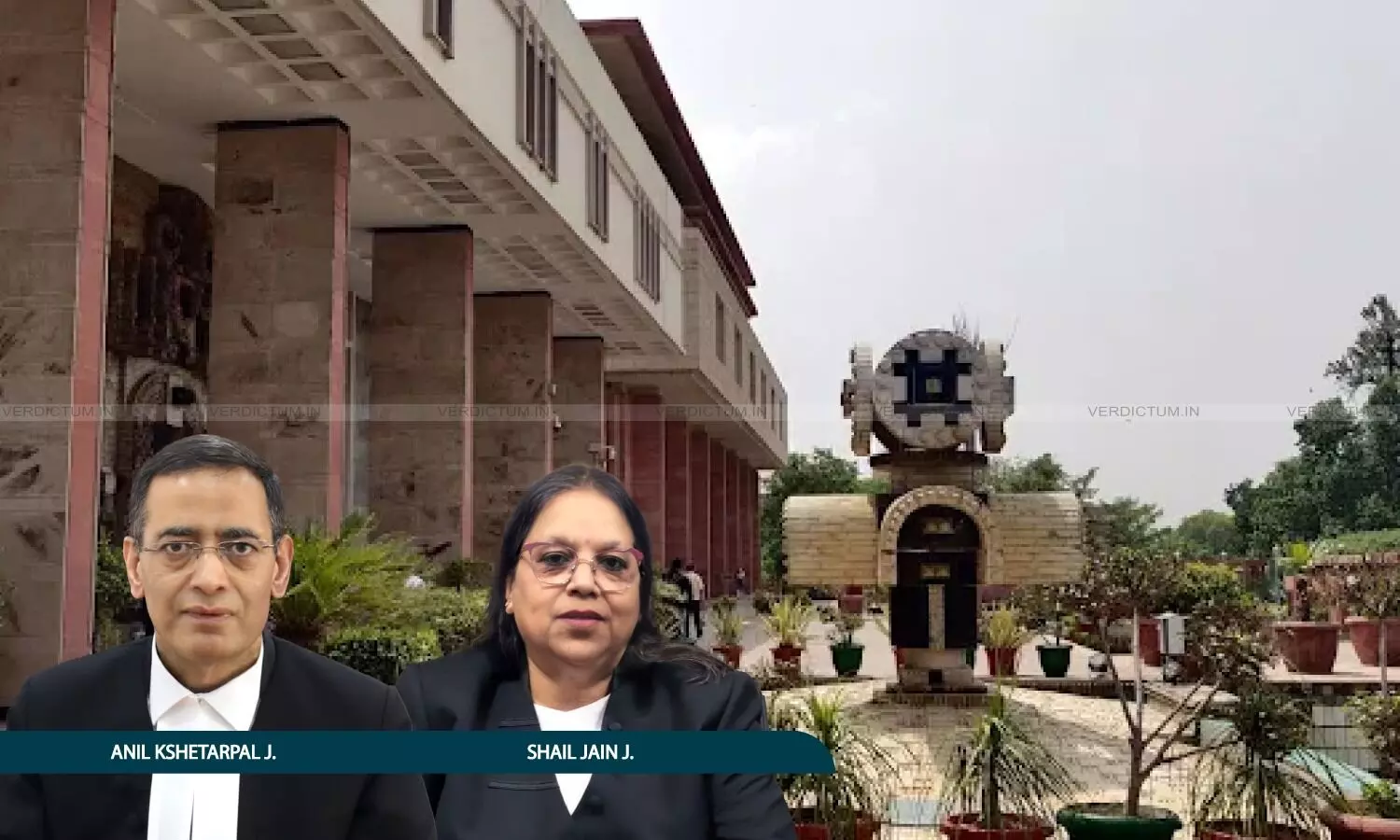
Justice Anil Kshetarpal, Justice Shail Jain, Delhi High Court
₹227 Cr GST Penalty Dispute| Pre-Deposit Amendment Effective Oct 1, 2025, Not Applicable to Appeals Arising From Older SCNs: Delhi High Court
 |
|The Court relegated 629 entities to statutory appellate remedy, leaves question of Section 122 CGST Act penalty on non-taxable persons open pending Supreme Court judgment.
The Delhi High Court has held that the amended pre-deposit requirement under the substituted proviso to Section 107(6) of the CGST Act, which came into force on 1 October 2025, cannot be applied to appeals arising from adjudication proceedings initiated through show cause notices issued before that date, meaning that the pre-deposit conditions governing such appeals will be those that prevailed on the date the underlying show cause notice was issued, regardless of when the final order came to be passed.
The Court, accordingly, declined to interfere under Article 226 of the Constitution of India with a batch of writ petitions arising from a common GST investigation spanning 629 firms and entities, holding that jurisdictional and evidentiary challenges to penalty proceedings under Section 122 of the CGST Act, even where the lead petitioner's liability runs to approximately ₹227.72 crore, do not disclose the kind of patent or self-evident absence of jurisdiction that would justify bypassing the statutory appellate remedy under Section 107.
A Division Bench of Justice Anil Kshetarpal and Justice Shail Jain observed, “Insofar as the requirement of pre-deposit is concerned, the Appeals arising from the SCNs issued prior to 01.10.2025 shall be governed by Section 107(6) as it stood on the respective dates of issuance of the SCNs, in terms of Gaurav Jain(supra). The Appeals shall not be rejected by applying the substituted proviso to Section 107(6) merely because the Orders-in-Original were passed after 01.10.2025”.
Advocate Pradeep Singh Rawat appeared for the petitioner and Harpreet Singh, SSC appeared for the respondent.
The principal batch arose from a DGGI investigation into allegations of issuing invoices without actual supply of goods and fraudulent availment or passing on of Input Tax Credit (ITC), primarily in the iron and steel trading sector.
Following searches and recording of statements, a common show cause notice dated June 30, 2025 was issued under Section 122 of the CGST Act to the lead petitioner and connected entities for FY 2018-19 to FY 2024-25, proposing approximately ₹45.55 crore in liability against the lead petitioner.
Following adjudication, the Order-in-Original dated December 26, 2025 increased the liability, with the consequential DRC-07 reflecting approximately ₹227.72 crore. The petitioners attributed this to cumulative penalties under multiple clauses of Section 122(1) for the same alleged conduct. A connected petition arose from a separate show cause notice dated September 24, 2025 and Order-in-Original dated March 24, 2026, imposing approximately ₹1.63 crore under Section 122(1A).
The petitioners challenged the proceedings primarily on the ground that the issuing officers lacked jurisdiction under Section 122, as no proper officer had been specifically assigned the function before the Board Circular dated October 27, 2025, which, they argued, could not retrospectively validate earlier notices.
They also alleged denial of cross-examination, non-supply of documents, lack of effective personal hearing, retrospective application of Section 122(1A) to periods before January 1, 2021, inconsistent findings in parallel proceedings, and that the amended Section 107(6) pre-deposit requirement rendered the appellate remedy illusory. The Union of India and GST authorities opposed the petitions on maintainability, contending that the disputed factual and legal issues should be examined by the statutory Appellate Authority under Section 107.
On the competence of the issuing officer, the Court examined Sections 2(91), 3 and 5 of the CGST Act, along with Notification Nos. 14/2017-Central Tax and 02/2017-Central Tax. It held that it could not, at this stage, conclude that absence of a function-specific assignment under Section 2(91) rendered an otherwise empowered officer without authority. The Board Circular dated October 27, 2025 was, at most, clarificatory.
“On a conjoint reading of the aforesaid provisions and the two notifications, this Court is unable to hold, at this stage, that in the absence of a specific assignment under Section 2(91), an officer of central tax otherwise empowered under Sections 3 and 5 of the CGST Act is, as a matter of law, denuded of authority to initiate proceedings in respect of a contravention for which the Act confers jurisdiction upon an officer of the requisite rank. Notification No.14 specifically invests the officers of DGGI with the powers exercisable by central tax officers of the corresponding rank, while Notification No.02 assigns various functions under the Act to the specified classes of officers. The question whether these provisions, read together, constitute sufficient conferment of authority in respect of the proceedings in question, therefore, cannot be answered merely on the basis of the subsequent Circular dated 27.10.2025”, it noted.
On whether Section 122(1) permits penalty against a person who is not a “taxable person,” the Court noted the different language of Section 122(1), applicable to a “taxable person,” and Section 122(1A), applicable to “any person.” It declined to decide the issue as it is pending before the Supreme Court in Mukesh Kumar Garg v. Union of India & Ors. SLP(C) No.18178/2025, and had similarly been left open in Arun Kumar Jain v. Additional Commissioner, CGST, Delhi West 2026:DHC:6609-DB.
“…The question involves the construction of the statutory scheme, the effect of Notification Nos.02 and 14, the subsequent Circular dated 27.10.2025 and, in the appropriate cases, the interrelationship between the proceedings under Sections 73 or 74 of the CGST Act and the consequential penalties under Section 122. These are matters which can be urged before and examined by the statutory Appellate Authority under Section 107, which is competent to consider both questions of fact and law”, it noted further.
The Court accordingly disposed of the writ petitions, granting liberty to pursue the statutory appellate remedy and directing the Appellate Authority to consider all grounds, including the questions left open by the judgment, uninfluenced by the High Court’s observations.
Cause Title: Rohit Garg v. Union of India & Ors. (Neutral Citation: 2026:DHC:7502-DB)
Appearances:
Petitioners: Pradeep Singh Rawat, Lalit Mohan Pant, Abhinav Kalra, Advocates.
Respondent: Harpreet Singh, SSC, Iqbal Singh Bedi and Latin Kumar Gaur, Advocates.