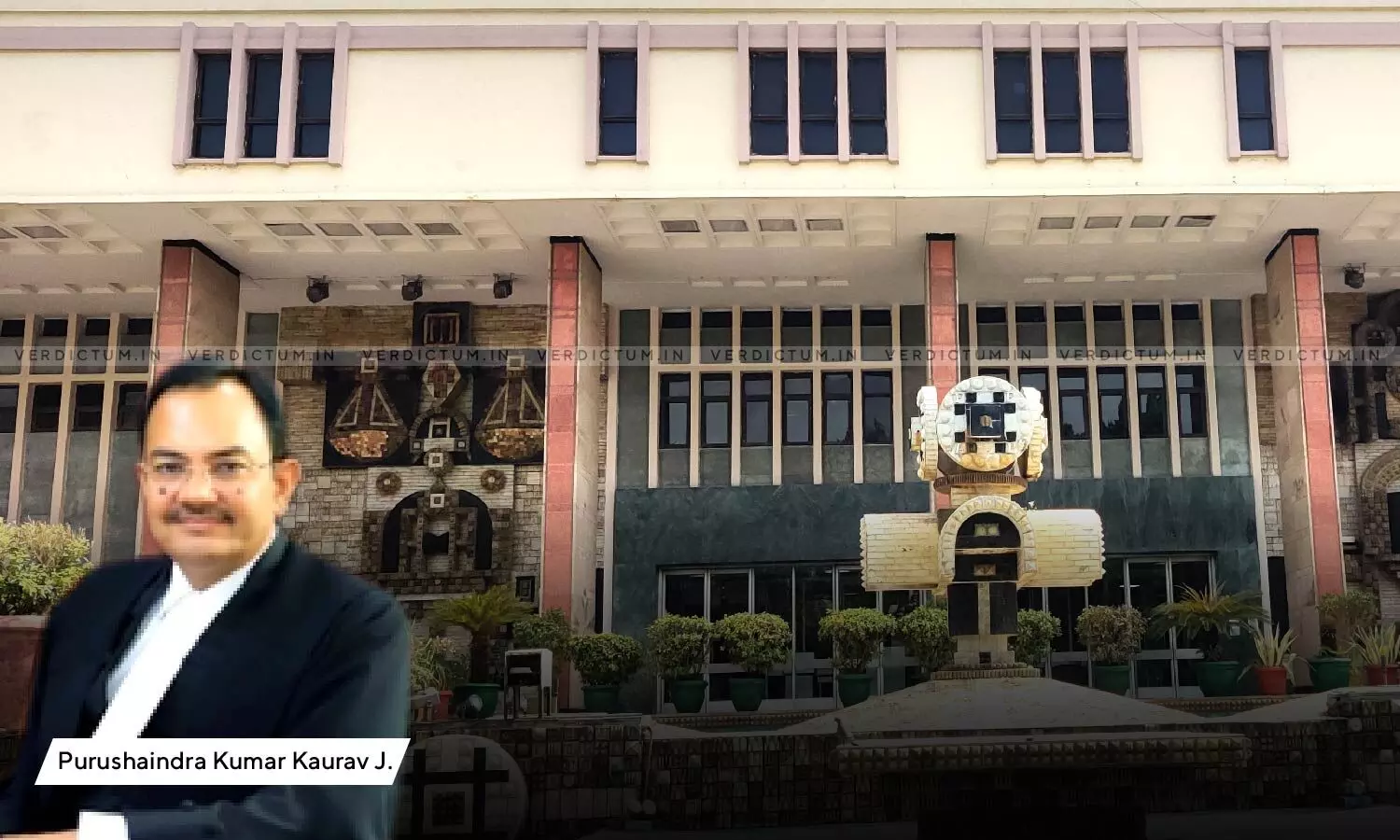
Justice Purushaindra Kumar Kaurav, Delhi High Court
Daughter-In-Law Cannot Insist On Residing In Senior Citizens’ Property Where Ill-Treatment Is Established & Alternate Accommodation Offered: Delhi High Court
 |
|The Court held that rights under the DV Act must be balanced with protections under the Senior Citizens Act, and continued occupation cannot be insisted upon where senior citizens offer reasonable alternate accommodation.
The Delhi High Court has held that a daughter-in-law cannot insist on continued occupation of property owned by senior citizens where allegations of ill-treatment stand established, particularly when reasonable alternate accommodation is being offered.
The Court was hearing a writ petition challenging eviction orders passed by the Maintenance Tribunal and affirmed by the Appellate Authority under the Maintenance and Welfare of Parents and Senior Citizens Act, 2007.
A Bench of Justice Purushaindra Kumar Kaurav observed, “so long as the senior citizens are ready to offer reasonable accommodation, there should not be any justification for insistence of continued occupation of their house by the petitioner who has been found to have meted out ill treatment.”
Advocates Manish Jha, along with Neha Mishra, appeared for the petitioner; Advocate Shehnaz Ali appeared for the respondents.
Background
The petitioner, the daughter-in-law of the respondent senior citizens, challenged orders directing her eviction from a residential property owned by the senior citizens.
The eviction was ordered by the Maintenance Tribunal under Rule 22(3) of the Delhi Maintenance and Welfare of Senior Citizens Rules, 2009, on the ground that the petitioner had subjected the senior citizens to ill-treatment.
The petitioner contended that the property constituted her matrimonial home and that her right to residence under the Protection of Women from Domestic Violence Act, 2005, had not been adequately considered.
It was further submitted that her minor child, suffering from autism spectrum disorder and intellectual disability, required continuity of residence for educational and medical purposes.
The respondents, on the other hand, contended that the petitioner had alternative accommodation available and that they were willing to provide reasonable rental support, and that continued occupation of their property was unjustified in light of the ill-treatment established.
Court’s Observation
The Court noted that both the Maintenance Tribunal and the Appellate Authority had recorded concurrent findings of fact that the petitioner had subjected the senior citizens to harassment and ill-treatment. It observed that such findings did not warrant interference in writ jurisdiction in the absence of perversity.
Referring to the statutory framework, the Court reiterated that senior citizens are entitled to seek eviction from their property in cases of non-maintenance and ill-treatment under the relevant rules framed under the 2007 Act.
The Court then examined the interplay between the Senior Citizens Act and the DV Act, relying upon the Supreme Court’s decision in S. Vanitha v. Deputy Commissioner, Bengaluru Urban District (2021), which mandates that competing rights under both enactments must be harmonised.
It observed that while a daughter-in-law may have a right to residence in a shared household, such a right does not extend to insisting on residence in a specific property owned exclusively by in-laws, particularly where alternative accommodation is available.
In this context, the Court noted that “the right under the DV Act is a right to secure residence, not necessarily a right to insist upon residence in a specific property belonging exclusively to in-laws.”
The Court further held that the competing rights of the parties must be balanced in a manner that protects the dignity and peaceful enjoyment of property by senior citizens while ensuring that the daughter-in-law is not rendered homeless.
It emphasised that permitting continued occupation of the property in such circumstances would defeat the object of the Senior Citizens Act, which is intended to provide speedy and effective relief to elderly persons facing harassment.
Conclusion
The Court upheld the eviction order passed by the authorities and directed that the petitioner vacate the property within sixty days.
At the same time, the Court directed the respondent senior citizens to provide alternate accommodation by paying ₹30,000 per month as rent along with ₹5,000 towards maintenance expenses, with an advance deposit of six months’ rent to be made within one month.
It was further directed that the respondents shall continue to pay ₹35,000 per month thereafter, and in case of default, the petitioner would be at liberty to seek restoration of possession.
The Court also restrained the respondents from creating third-party rights in the property without permission of the Court.
Cause Title: Ritika Kalra v. Government of NCT of Delhi & Ors. (Neutral Citation: 2026:DHC:3704)