Needs Consistent Monitoring: Delhi High Court Constitutes Committee To Oversee Rehabilitation & Relocation Of Jhuggi Jhopri Dwellers
 |
|The Court held that relocation must be meaningful and consistent with the right to live with dignity under Article 21, while permitting eviction after rehabilitation arrangements are put in place.
The Delhi High Court has constituted a Monitoring Committee to consistently monitor and supervise the rehabilitation of dwellers of B.R. Camp, Masjid Camp and DID Colony Jhuggi Jhopri bastis, who are to be relocated to DUSIB Colony at Savda Ghevra.
The Court was hearing three intra-court appeals filed by Jhuggi Jhopri dwellers challenging the judgment and order of a Single Judge dismissing their writ petitions against eviction and relocation, while issuing directions for compliance with the Delhi Slum & JJ Rehabilitation and Relocation Policy, 2015 and related protocol.
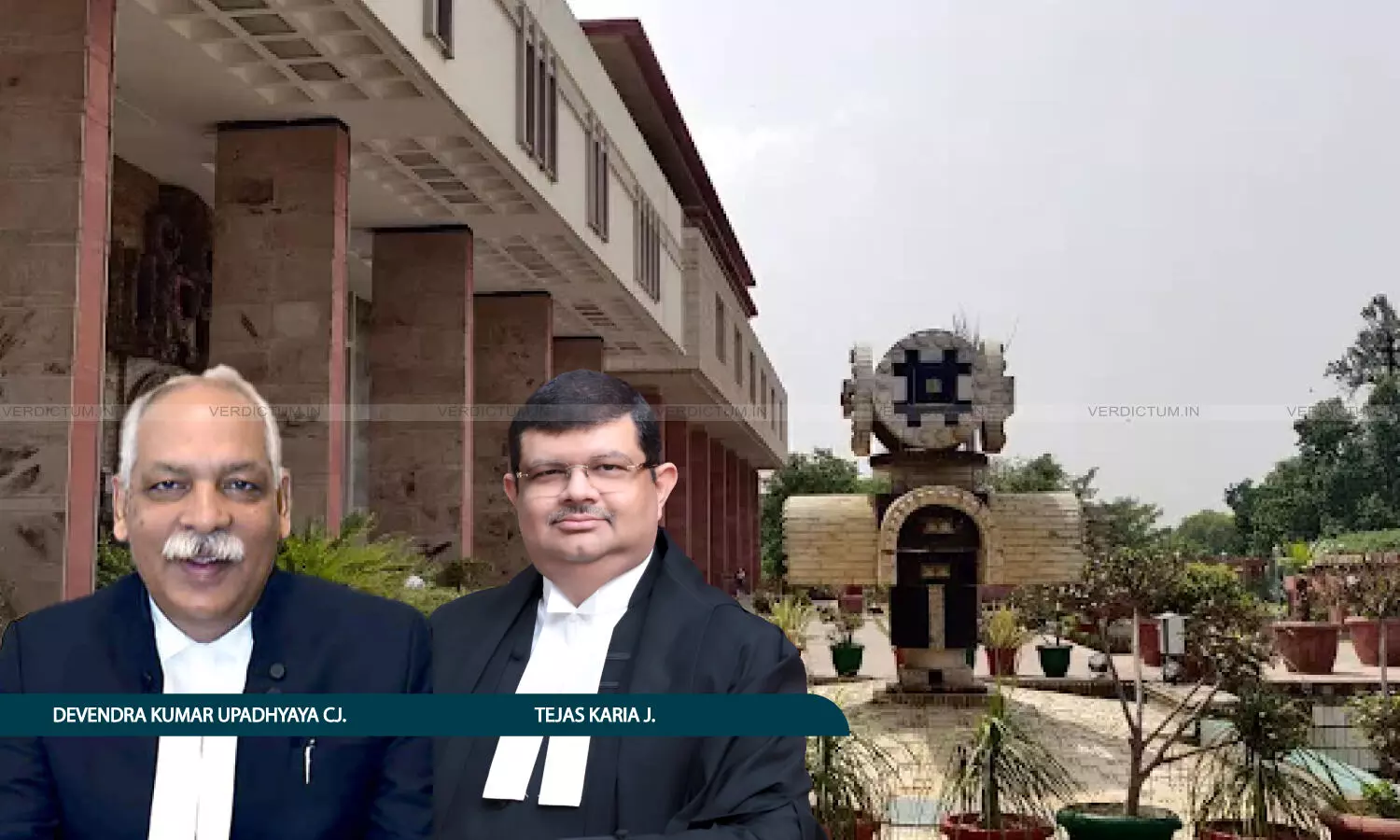
A Bench of Chief Justice Devendra Kumar Upadhyaya and Justice Tejas Karia observed: “The process of rehabilitation, to ensure that dwellers of Jhuggi Jhopri bastis are able to lead a meaningful life after their relocation, needs to be consistently monitored and supervised.”
Senior Advocate N. Hariharan appeared for the appellant groups. Additional Solicitor General Chetan Sharma, Central Government Standing Counsel Archana Gaur, Standing Counsel Anand Prakash and Advocate Anuj Chaturvedi appeared for the respondents.
Background
The appeals concerned dwellers of B.R. Camp, Masjid Camp and DID Colony, which the Court recorded as Jhuggi Jhopri bastis under the Delhi Urban Shelter Improvement Board Act, 2010. Around 717 dwelling units were sought to be relocated and rehabilitated upon clearance of the land.
The dwellers had challenged eviction notices before the Single Judge. During those proceedings, a rehabilitation scheme was framed and the respondents proposed relocation to flats at DUSIB Colony, Savda Ghevra. The Single Judge found no illegality in the relocation process but issued directions on amenities, education, travel, water, sanitation and related facilities.
Before the Division Bench, the appellants argued that the eviction and relocation process violated the Rehabilitation Policy, 2015 and the Draft Protocol notified by DUSIB, including the requirement of rehabilitation within five kilometres where possible. The respondents submitted that the land was urgently required, that the scheme had been approved through the High-Powered Committee and DUSIB, and that all dwellers would be rehabilitated without payment, irrespective of eligibility.
Court’s Observations
The Court rejected the contention that relocation beyond five kilometres itself violated the Rehabilitation Policy, 2015.
The Court observed: “Clause 2(a)(iii) of the Rehabilitation Policy, 2015 itself permits that relocation can be even beyond 05 kilometres with prior approval of DUSIB. Since the site of relocating the dwelling units of Jhuggi Jhopri bastis in this case has duly been approved by DUSIB in its meeting held on 09.04.2026, in our opinion it cannot be said that relocation site has been chosen in violation of Clause 2(a)(iii) of the Rehabilitation Policy, 2015.”
The Court also held that the process was not invalid merely because the joint survey was conducted by the Land Owning Agency with DDA rather than DUSIB, since every dwelling unit was being relocated.
The Court noted: “such alleged flaw will not vitiate the process of eviction and rehabilitation of the appellants for the reason that no prejudice is going to be caused to any of the dwellers of these three Jhuggi Jhopri bastis as every single dwelling unit irrespective of the fact whether such dwelling unit fulfils the eligibility criteria for rehabilitation and relocation, has been permitted to be relocated and rehabilitated”.
Referring to Sudama Singh v. Government of Delhi (2010), Ajay Maken and Others v. Union of India and Others (2019), and Sukanya Shantha v. Union of India and Others (2024), the Court reiterated that rehabilitation must be tied to dignity under Article 21.
The Court held: “relocation of dwellers of the Jhuggi Jhopri bastis and their rehabilitation has to be necessarily in a manner which will make these dwellers realise their right to live with dignity as explained by Hon‟ble Supreme Court in various judgments, including the judgment in Sukanya Shantha (supra).”
It further recorded that concerns had been raised regarding transport, education, electricity, sewage, healthcare and security at the relocation site, and that statements and affidavits were filed on behalf of the authorities on these amenities.
The Court said that although efforts were being made to provide amenities, further directions were required to ensure that the facilities were actually made available.
The Court observed: “some efforts have been/are being made on behalf of the respondents to provide adequate amenities to facilitate rehabilitation of dwellers of these three Jhuggi Jhopri bastis, however, appropriate orders/directions were required to be passed for ensuring that such facilities are made available in appropriate measure to the dwellers, so that they can realise their right of rehabilitation and right to live with dignity.”
Accordingly, the Court constituted a Monitoring Committee headed by retired Delhi Higher Judicial Services officer Man Mohan Sharma, with officers nominated by DUSIB, DDA, the Ministry of Housing and Urban Affairs, Delhi Jal Board, Directorate of Education and Directorate of Health Services.
The Court directed: “A Monitoring Committee, comprising of (i) Sh. Man Mohan Sharma, a retired Delhi Higher Judicial Services Officer, as its Chairperson, (ii) a high ranking officer to be nominated by Chief Executive Officer, DUSIB, (iii) a high ranking officer to be nominated by the Vice Chairman, DDA, (iv) an officer of the rank of Joint Secretary in the Ministry of Housing and Urban Affairs, Government of India, (v) a high ranking officer to be nominated by Chief Executive Officer, Delhi Jal Board, (vi) an officer of the rank of Deputy Director to be nominated by Director of Education, GNCTD and (vii) an officer of the rank of Additional Director, Directorate of Health Services to be nominated by the Secretary, Department of Health and Family Welfare, GNCTD, is constituted which shall consistently monitor and supervise rehabilitation of the dwellers of B.R. Camp, Masjid Camp and DID Colony Jhuggi Jhopri bastis.”
The Court further held: “It will be within the powers of the Monitoring Committee to issue such directions to all the agencies concerned, which may be required and deemed fit for the purposes of rehabilitating the dwellers of Jhuggi Jhopri bastis in a meaningful manner, especially keeping in view the undertakings given by the respondents and the directions issued by this Court”.
Conclusion
The High Court modified the Single Judge’s judgment and order to the extent of issuing further directions. It directed the respondents to honour their undertakings and comply with earlier directions, granted six weeks for the appellants to vacate their dwelling units and be settled at Savda Ghevra, directed DUSIB to facilitate transportation of household belongings, and constituted the Monitoring Committee for six months, extendable by two months if required. The appeals and pending applications were disposed of with no order as to costs.
Cause Title: Rakesh Bansal and Ors v. Union of India and Ors (Neutral Citation: 2026:DHC:7196-DB)
Appearances
Appellants: Senior Advocate N. Hariharan with Advocates Varun Singh, Parijat, Punya Rekha Angara, Aman Akhtar, Vasundhara Raj Tyagi, Arjan Singh Mandla, Apoorv Kumar, Benila, Atif Raza, Vivek Jain, Javed Ahmad, Aakriti Aditya and Urvashi Chauhan; Advocates Pankaj Sinha, Tariq Adub, Garima, Kulwinder Sehjpal and Sunil Tiwari; Advocates Kuldeep Kumar and Neelam Akhtar
Respondents: Additional Solicitor General Chetan Sharma with Central Government Standing Counsel Ashish K. Dixit and Advocates Umar Hashmi, Ayush Kumar, Amit Gupta, Shubham Sharma, Naman, Iqra Sheikh, Nishant and Aakash Tyagi; Central Government Standing Counsel Archana Gaur with Government Pleader Akash Gupta and Advocates Shreyansh Gupta, Rajat Sharma, Ridhima Gaur and Deepu Kumar; Advocates Syed Abdul Haseeb and Muhammad Aamir Khan with Government Pleader Nasreen Khatoon; Standing Counsel Anand Prakash with Advocates Varsha Arya and Pratham Saini; Advocates Anuj Chaturvedi, Yashita Jain and Sneha Tanwar; Advocate Mananjay Mishra