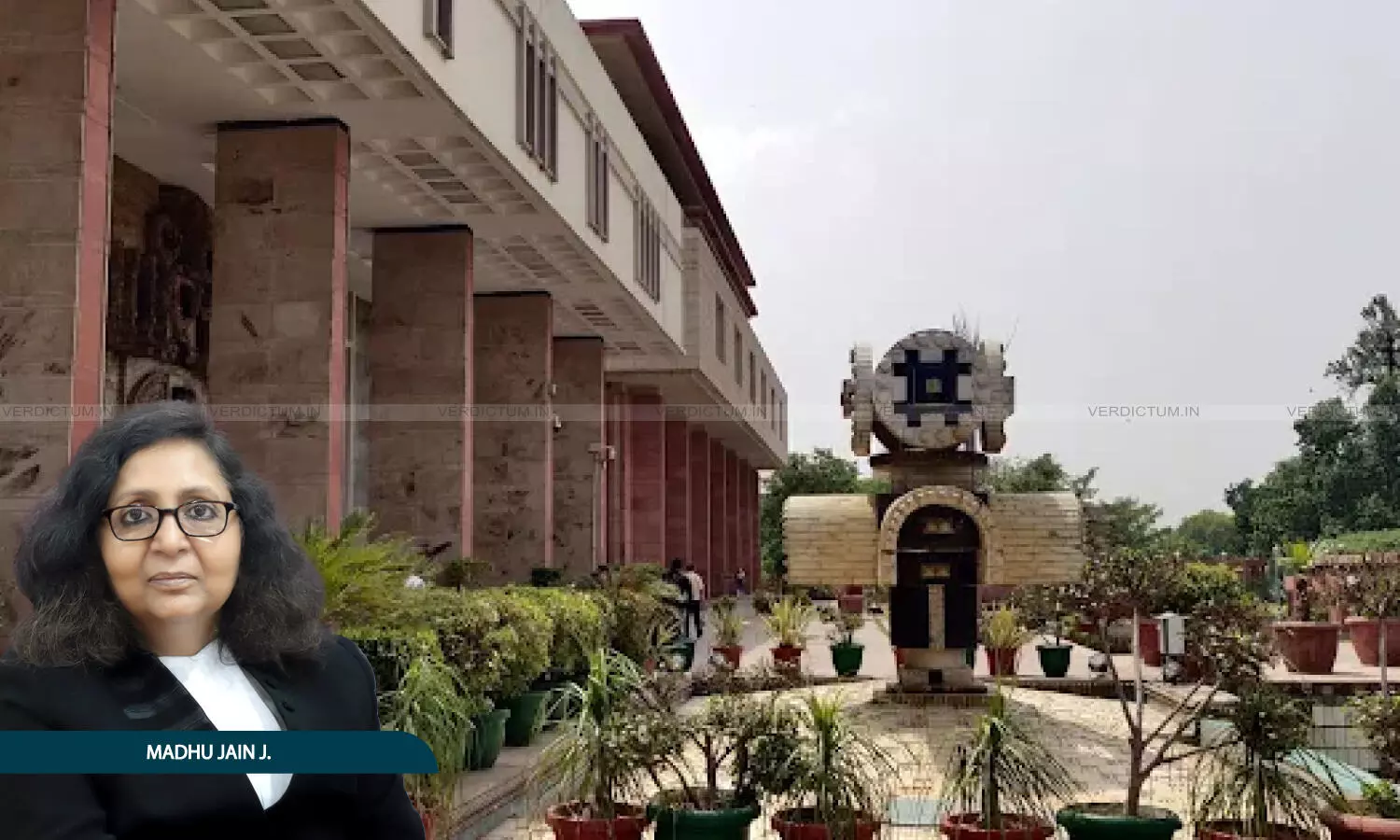
Justice Madhu Jain, Delhi High Court
DNA Report Does Not Determine Whether Relationship Was Consensual Or Not: Delhi High Court Upholds Acquittal In Rape Case
 |
|The Court held that the prosecutrix's testimony must independently inspire confidence even where statutory presumption under Section 114A Evidence Act applies.
The Delhi High Court has held that a DNA report establishing the paternity of a child born to the prosecutrix, while conclusively proving the fact of sexual intercourse, does not by itself establish the absence of consent necessary to sustain a conviction for rape. The Court held that even where the statutory presumption under Section 114A of the Indian Evidence Act is triggered, requiring the accused to rebut the presumption of non-consent once intercourse is proved, the prosecutrix's testimony must still independently inspire confidence and withstand scrutiny for material inconsistencies before a conviction can follow.
Dismissing the prosecutrix's appeal against acquittal, the Court reiterated the settled principle governing appellate interference with acquittals, holding that where the trial court's view is a reasonably possible one based on the evidence, an appellate court cannot substitute it merely because another view is equally plausible, even in cases involving grave allegations of sexual assault.
A Bench of Justice Madhu Jain observed, “There is no dispute that the DNA report, Ex. P-7, establishes that the accused is the biological father of the child born to the prosecutrix. The said evidence is undoubtedly significant as it establishes the fact of sexual intercourse between the parties. However, the DNA report by itself does not establish the circumstances in which such intercourse took place, nor does it determine whether the relationship was consensual or nonconsensual. The question before the learned Trial Court was therefore not merely whether the accused and the prosecutrix had sexual relations, but whether the prosecution had established the offence punishable under Section 376(2)(n) IPC”.
Advocate Jitendra Kumar Tiwari appeared for the appellant Ajay Vikram Singh, Additional Public Prosecutor appeared for the respondent.
The prosecutrix alleged that the respondent, known to her family, established physical relations with her from 2017 onwards through threats, inducements and, on one occasion, by administering an intoxicant, resulting in repeated non-consensual sexual acts including unnatural intercourse. She gave birth to a child in June 2019, and a subsequent DNA examination confirmed the respondent as the biological father. She disclosed the alleged incidents to her husband and family, leading to registration of an FIR in March 2021 under Sections 376, 377 and 506 IPC, with Section 509 IPC and Section 328 IPC added later based on further allegations.
The Trial Court framed charges under Sections 328, 376(2)(n), 377, 506 and 509 IPC. During trial, the prosecution examined the prosecutrix, her husband and two Investigating Officers. The respondent, in his statement under Section 313 CrPC, admitted to physical relations but claimed the relationship was consensual and within the knowledge of the prosecutrix's husband.
By a judgment dated October 07, 2024, the Additional Sessions Judge, Dwarka Courts, acquitted the respondent of all charges, citing inconsistencies in the prosecutrix's testimony, delay in reporting, and the possibility that the relationship was consensual. The prosecutrix appealed under Section 419 BNSS.
The Court identified specific material inconsistencies in the prosecutrix's account, including contradictory versions of how an intoxicant was allegedly administered, her state of consciousness during the first incident, and the circumstances in which her husband learned of the pregnancy.
The Court further noted that allegations of threats through nude photographs and videos received no corroboration from forensic examination of the respondent's phone. Considering the inconsistencies cumulatively rather than in isolation, the Court concluded that the strengthened presumption of innocence in favour of the accused consequently operates in his favour.
The appeal was dismissed, and the judgment of acquittal was upheld in its entirety. A copy of the order was directed to be sent to the Trial Court for information and compliance.
Cause Title: KXXXXX v. State Govt. of NCT of Delhi & Anr. (Neutral Citation: 2026:DHC:7451)
Appearances:
Appellant: Jitendra Kumar Tiwari and Abhishek Chaudhary, Advocates.
Respondent: Ajay Vikram Singh, Additional Public Prosecutor.