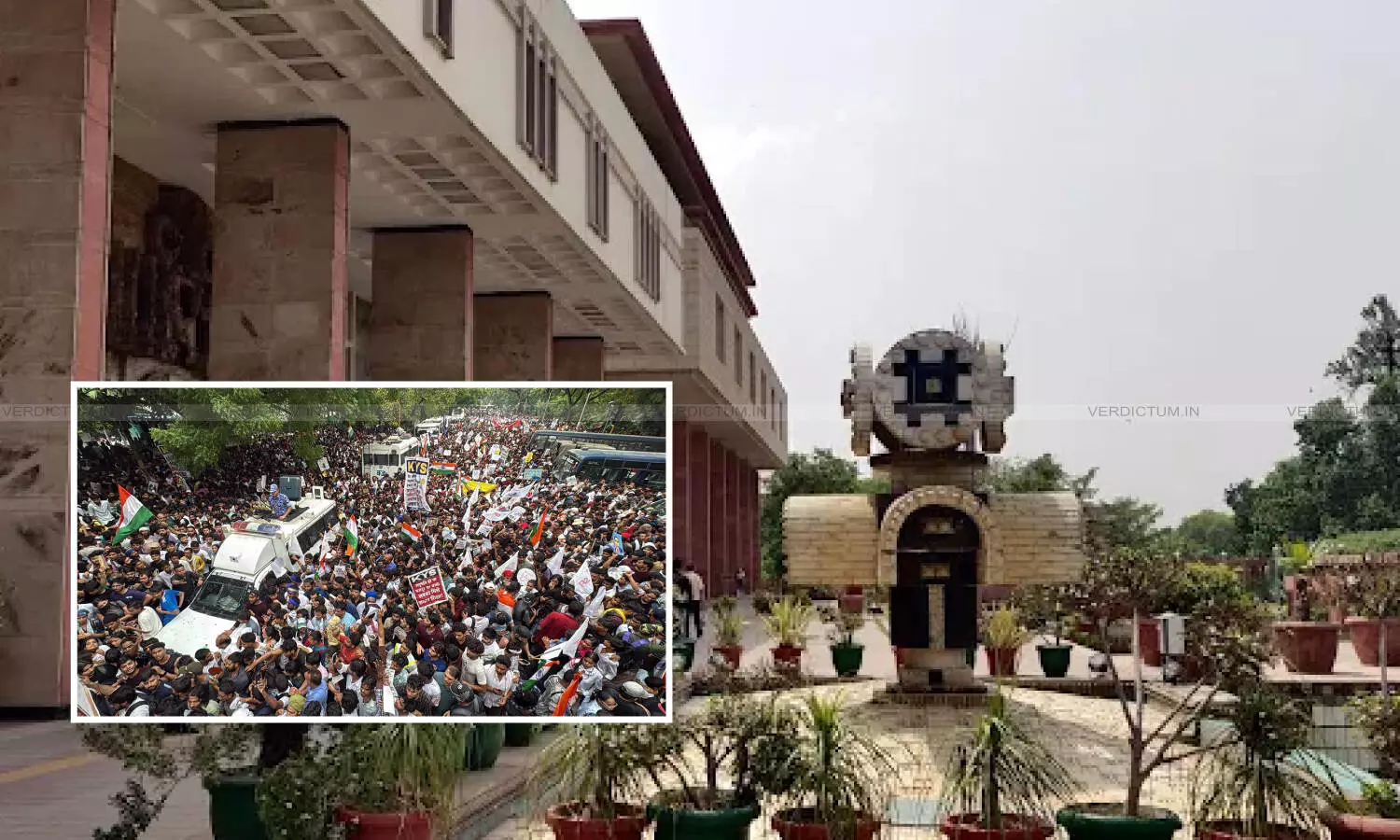
Breaking: High Court Seeks Delhi Police's Response On Action Against Jantar Mantar Protestors, Orders Preservation Of CCTV Footage
 |
|The Delhi High Court directed authorities to preserve CCTV footage and file a response within four weeks regarding alleged police excessive force at Jantar Mantar.
The Delhi High Court issued notice to the Delhi Police and the Union of India in a Public Interest Litigation (PIL) alleging excessive use of force by the Delhi Police during the Cockroach Janta Party’s protest march at Jantar Mantar, New Delhi.
Rejecting the state's contention that affected individuals should independently approach a magistrate, the Court noted that systemic police excesses during a public demonstration cannot be treated as isolated incidents, and listed the matter for further hearing on September 11.
A Division Bench comprising Chief Justice Devendra Kumar Upadhyaya and Justice Tejas Karia said, "Issue notice... Let a counter affidavit be filed within four weeks. In the meantime,... We direct that the relevant records in relation to the incident, including CCTV footage and videography, shall be preserved in accordance with the SOP in place issued by the Union of India... List on September 11."
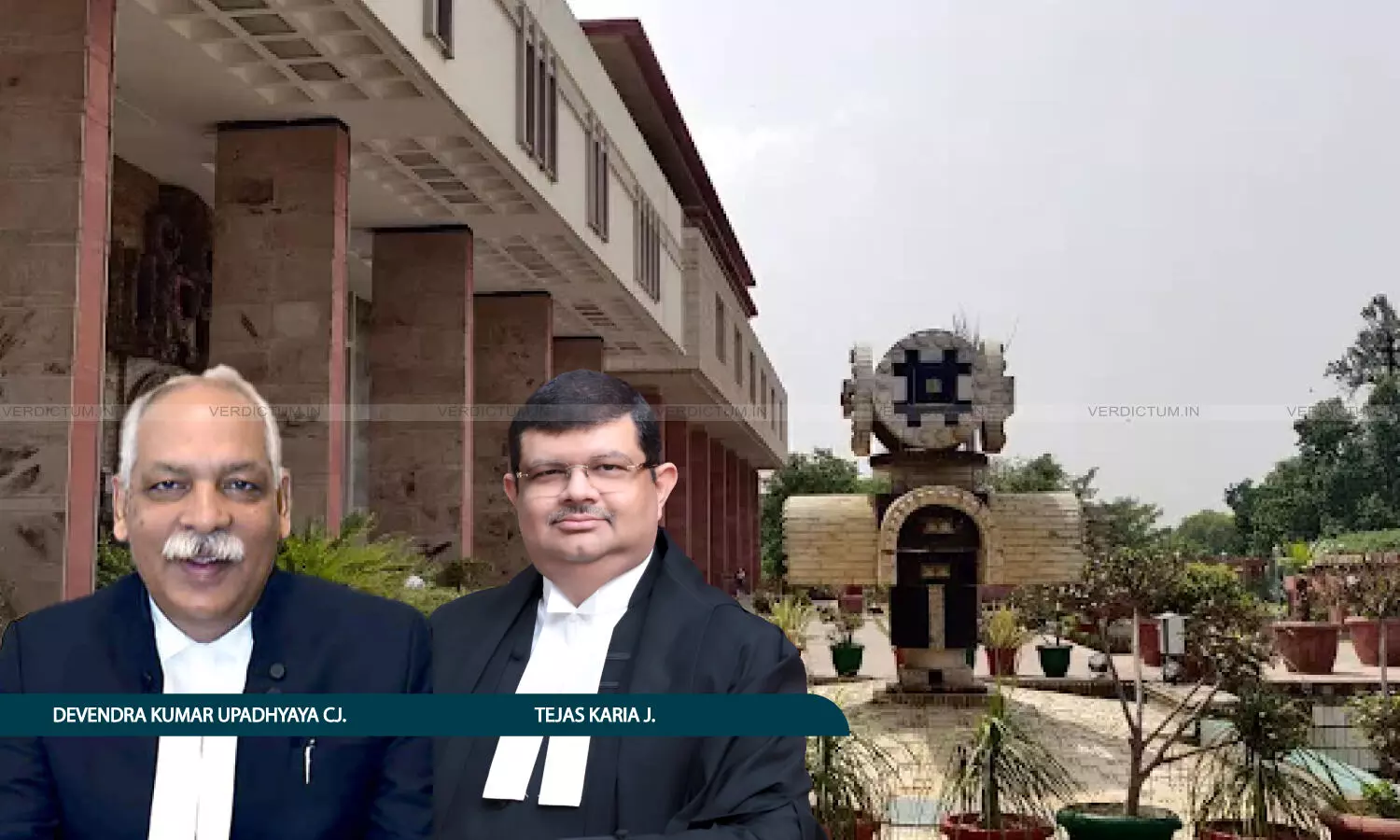
Senior Advocates N. Hariharan, Vikas Singh, and Gopal Sankaranarayanan appeared on behalf of the petitioners, while ASG SV Raju appeared for the Respondents.
Senior Advocate N. Hariharan submitted that the demonstrators were peacefully exercising their fundamental rights guaranteed under the Constitution of India, specifically the right to freedom of speech, expression, and peaceful assembly without arms. He contended that the student protesters were equally protected under the ambit of Article 21, asserting that any arbitrary state action must be tested against the touchstone of Article 14.
He highlighted that while the state retained the authority to channelise and regulate public movements, the law enforcement authorities resorted to unimaginable and excessive force against the peaceful gathering.
Hariharan submitted that a series of video recordings demonstrated the excessive nature of the police crackdown. He highlighted that law enforcement authorities used lathis fitted with nails, electric batons, and pellets against the young demonstrators, questioning whether peaceful citizens exercising their rights deserved such heavy-handed treatment.
Hariharan submitted that the assembly had a lawful object, as the students had gathered merely to ventilate their grievances regarding the NEET examination irregularities. He pointed out that no prohibitory order under Section 144 of the Code of Criminal Procedure (CrPC) had been issued or published prohibiting such assembly. He argued that even assuming arguendo the crowd had become unmanageable, standard crowd-control protocols required law enforcement to issue prior warnings—such as blowing whistles—before resorting to force, a procedural necessity adhered to even during colonial rule. He characterized the police action as purely retributive and unprovoked.
Hariharan further submitted that female students were subjected to molestation and severe physical abuse, including the use of tasers and batons directed at private parts, describing the conduct as ghastly and akin to herding cattle. He stated that over 90 students sustained injuries during the crackdown. He clarified that while any individual who caused harm to police personnel should face due process, the identifiable police officers involved in the atrocities must be booked under an FIR.
Hariharan urged the Court to order an independent judicial inquiry or constitute a Special Investigation Team (SIT) to ensure an impartial probe, while also laying down a strict code of conduct for police handling of peaceful assemblies.
Senior Advocate Gopal Sankaranarayanan submitted that he had personally examined over 130 videos of the incident to demonstrate the systemic illegality of the operation. He highlighted that numerous individuals involved in the crackdown were either in plain clothes or in uniform without mandatory name tags, and were seen wielding non-standard weapons not authorized for use by the Delhi Police.
Drawing the Court's attention to specific visual evidence, he cited a video depicting Additional DCP Sandeep Lamba unprovokedly slapping a woman demonstrator across the face while walking past her, and urged the Bench to summon the officer directly to face judicial scrutiny.
Concluding his submissions on the scope of fundamental rights and police powers, Senior Advocate Sankaranarayanan placed reliance on the landmark judgment of the Supreme Court in the Ramlila Maidan Incident case, reiterating that the right to peaceful protest and night-time assembly cannot be arbitrarily curtailed by state force.
He pointed out that the video evidence depicted tear gas canisters being thrown indiscriminately at vulnerable groups, including mothers and young children. Highlighting the brutality of the assault, he drew the Bench's attention to footage showing a plainclothes officer—attired in a t-shirt, jeans, and helmet—wielding a lathi embedded with nails. He further described a video wherein a police personnel deliberately tripped a fleeing protester, following which four officers aggressively set upon the fallen demonstrator.
Senior Advocate Vikas Singh submitted that public notifications had indicated a proposed march towards the Parliament on July 20, leading up to which no violent incidents were reported until July 19. He pointed out that as information spread across the public domain, the assembly swelled significantly on July 20. He further submitted that police forces targeted and attacked this gathered crowd, which comprised young students and children from diverse walks of life, including the son of Senior Advocate Hegde.
Singh pointed out that there was no record or indication in the public domain to suggest that the assembled crowd had turned violent at any point. He drew the Court's attention to video evidence showing individuals in civil attire seated at the venue who, alongside police personnel, launched an attack on the peaceful protesters. He further pointed out that several police officers deployed at the protest site were deliberately operating without their name badges.
Per contra, as regards the first plea, ASG SV Raju submitted that Sonam Wangchuk and his wife have not filed any complaint and have not raised arguments.
Addressing the prayers for relief, the ASG submitted that the petitions were liable to be dismissed if they rested solely on unverified statements without preserved footage. He asserted that so-called peaceful demonstrations were often hijacked by anti-social elements, as evidenced in the present case where the gathering did not remain peaceful. He informed the Bench that public property, including police vehicles, was damaged, several officers were injured, and a formal FIR was registered after the crowd turned unruly, compelling the police to intervene.
"As far as the crowd is concerned, there are videos which show that the crowd was indulging in stone throwing...there was a truck lying there with stones and bricks at the place of incident...there were elements in the mob which might have resorted to this", he said.
He contended that members of an unlawful assembly were collectively responsible for such actions and alleged that the PILs were motivated by a desire for publicity. The ASG argued that if individual demonstrators had genuine grievances, the appropriate legal remedy was to approach the concerned Magistrate with specific facts rather than invoking the writ jurisdiction of the High Court.
The Chief Justice asked ASG Raju, "Is it a case of some isolated individual incidents? Perhaps no...this is number one. Number two, if it was an unlawful assembly, there is a law how to deal with it. There is a judgment of the SC in Ramlila Ground and there is another judgment...if these issues are being raised in this plea, how can you say that every individual should go and log an FIR?...Has it been an isolated individual incident, maybe ten or twenty numbers, the situation would have been different. You would have been correct in in in asking them to approach the magistrate or the police station itself first, and then in view of Sakiri Vasu or even they could have launched a private complaint under the old produce of Section 200...but this is not such an incident as is being asserted by them."
Addressing concerns regarding evidence, the Bench stated that it would pass directions for the preservation of all relevant CCTV footage. In response, ASG Raju submitted that police authorities would take appropriate action in accordance with law if any cognizable offence were brought to their notice.
Rebutting this stance, the Court cited the Supreme Court's precedent in the Anita Thakur case, highlighting that remedies for state excesses and public wrongs are well-maintainable under public law remedy before constitutional courts.
Concluding the session, the Bench directed the authorities to file their reply affidavits without making any conclusive observations, while instructing them to preserve all relevant records as per standard operating procedures.
In another plea, which specifically pertained to the forceful removal of climate activist Sonam Wangchuk from Jantar Mantar, the Division Bench declined to entertain the PIL on this specific count.
The Court observed that a separate petition had already been instituted by Wangchuk's wife regarding the very same incident, and the consequential appeal stood disposed of to the satisfaction of the parties involved. The Bench remarked that if any further grievances remained, the petitioner was at liberty to approach the appropriate executive authorities.
When counsel for the petitioner argued that the matter involved broader public interest rather than a purely private dispute, the Bench clarified that the prayer was confined to a solitary incident for which the family had already pursued legal recourse. Refusing the plea to directly order a Special Investigation Team (SIT) probe at the instance of a third-party petitioner, the Bench noted that an SIT could only be constituted after an FIR was formally registered under the Code.
The Court further pointed out that under the new criminal procedure framework—specifically referring to Section 173 of the Bharatiya Nagarik Suraksha Sanhita (BNSS)—a preliminary inquiry is conducted prior to the registration of an FIR upon receiving a complaint. Observing that nothing survived in the prayer regarding Wangchuk's removal in light of the earlier judicial proceedings concluded by his wife, the Bench directed the petitioner to avail alternative statutory remedies under the law.
Recently, the Supreme Court has refused to entertain an oral mentioning regarding the ongoing NEET-UG protests at Jantar Mantar, New Delhi, when an advocate sought urgent judicial intervention over alleged police high-handedness and examination irregularities.
Cause Title: Shakeel Abbas v. Union of India and Ors. and other connected matters [W.P.(CRL.) 2127/2026]