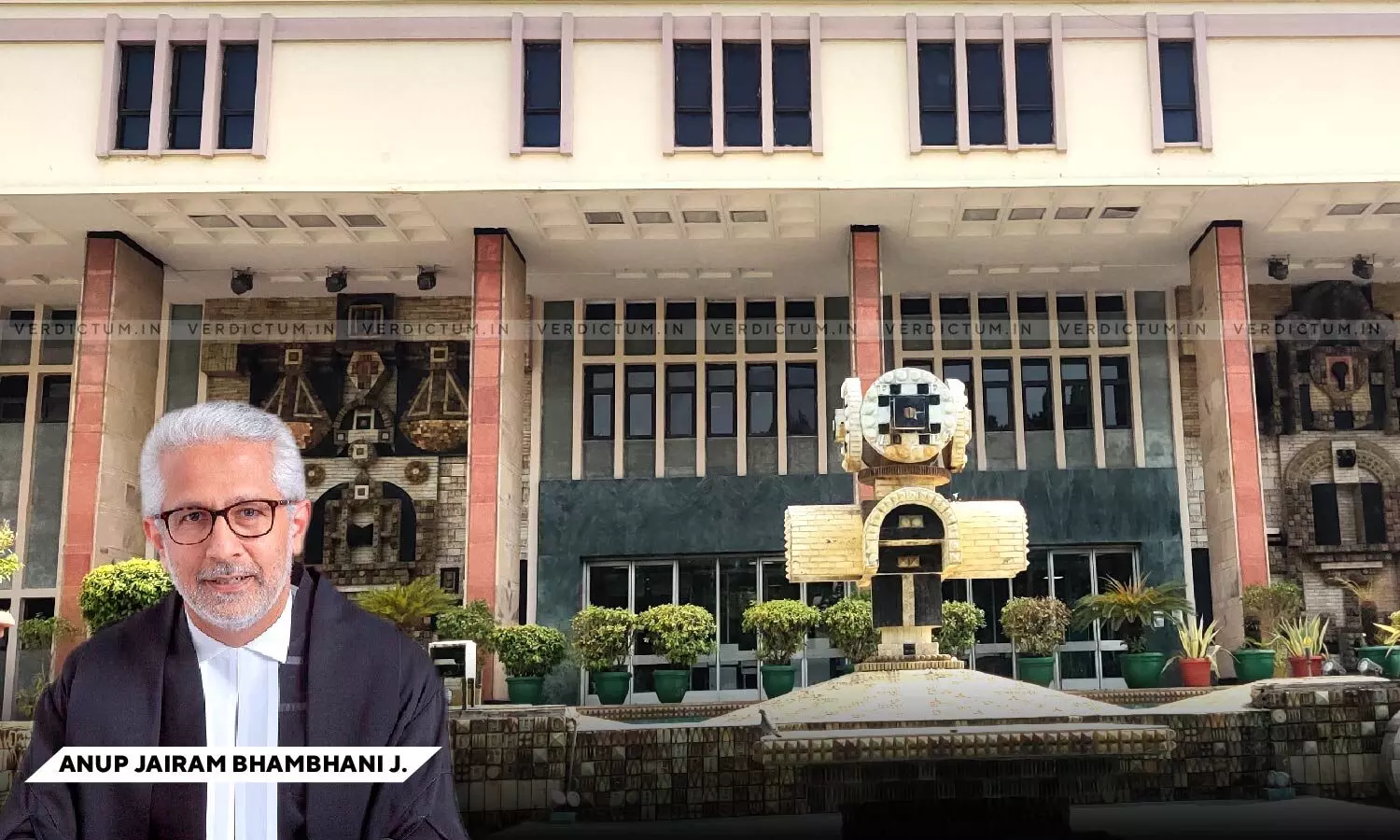
Justice Anup Jairam Bhambhani, Delhi High Court
Principles Of Territorial Jurisdiction Cannot Be Diluted Due To Internet: Delhi High Court Refers Issues On Online Trade Mark Infringement To Larger Bench
 |
|The Court amid conflicting decisions on online Trade Mark infringement, internet accessibility and corporate residence, referred key jurisdictional questions to larger Bench.
The Delhi High Court has referred key jurisdictional questions to a Larger Bench, observing that the advent of the internet cannot dilute the foundational principles of territorial jurisdiction to a degree where corporations could file suits across arbitrary locations without establishing a genuine cause of action. Expanding upon the potential for forum-shopping, the Court highlighted the necessity of harmonizing Section 20 of the Code of Civil Procedure (CPC) with Section 134 of the Trade Marks Act, 1999, and Section 62 of the Copyright Act, 1957.
The Court emphasized that clear jurisdictional boundaries are imperative to prevent entities from bypassing the primary forum where their principal office is located and where the substantive cause of action has accrued. It noted that conflicting decisions regarding online trademark infringement and corporate residence have created severe uncertainty in determining territorial jurisdiction.
A Bench comprising Justice A. J. Bhambhani observed, “…by reason of the advent of the internet and the accessibility of goods at any remote location via the world-wide-web, the principles of law in relation to territorial jurisdiction of courts cannot be so diluted or be made so vague that a corporation could sue in just about any location within the country (without any reference to where the cause of action may have arisen, whether in whole or in part). That would throw the very concept of territorial jurisdiction of courts to the winds”.
“...this court is of the view that the question would appropriately merit consideration by a Larger Bench…In the interests of certainty and consistency in the law, this court considers it appropriate to refer the following questions for the consideration and determination by a Larger Bench”, it further noted.
Senior Advocates Amit Sibal, Swathi Sukumar appeared for the plaintiff and Senior Advocate Chander M. Lall appeared for the defendant.
Finding that the questions arise daily in intellectual property litigation, the Bench referred the following questions to a Larger Bench:
- Whether IP suits are governed solely by section 20 CPC; by section 134 of the Trade Marks Act; or section 62 of the Copyright Act, or by an interplay of all those provisions and if so, how.
- Whether a corporate plaintiff must sue only where its principal or registered office is situate when a part of the cause of action has arisen there.
- What jurisdictional rule should govern online transactions in IP disputes in light of the conflicting approaches taken in Banyan Tree, World Wrestling Entertainment and Kohinoor Seed Fields.
In the matter, the plaintiff, Hindustan Unilever Limited, instituted a commercial suit seeking a permanent injunction against the defendant, Kwick Living (I) Private Limited. The suit challenged the defendant's advertisement campaign styled as "War on What's Hidden," which was broadcast across social media platforms, hoardings, and the defendant's website. The plaintiff alleged that the campaign disparaged its well-known products, 'Vim' and 'Surf Excel'.
Upon issuance of summons, the defendant raised a preliminary objection regarding the territorial jurisdiction of the Delhi High Court, noting that both the plaintiff and defendant have their registered offices in Mumbai.
The plaintiff countered by asserting jurisdiction under Section 20(c) of the CPC, Section 134(2) of the Trade Marks Act, and Section 62(2) of the Copyright Act, claiming part cause of action in Delhi due to online accessibility, commercial targeting, and maintaining a corporate office in Delhi. Judgment was reserved exclusively on the preliminary aspect of territorial jurisdiction.
The Court undertook a detailed comparative analysis of binding precedents, noting an unresolved friction between the Supreme Court’s decision in Indian Performing Rights Society Ltd. v. Sanjay Dalia (2015) 10 SCC 161 and subsequent rulings.
While Sanjay Dalia and Ultra Home Construction hold that if a cause of action arises where the principal office is located, the plaintiff must sue there and cannot drag the defendant to a distant subordinate office forum, cases like Burger King, Kohinoor Seed Fields, and Nilesh Girkar suggest broader accessibility, online transactional capability, or nationwide digital broadcast could independently trigger jurisdiction under Section 20(c) CPC. Furthermore, the conflict between the stringent "purposeful availment" test in Banyan Tree and the expansive e-commerce marketplace test in Kohinoor Seed Fields remains unresolved.
Accordingly, the Bench directed the Registry to place the judgment before the Hon’ble Chief Justice within one week for appropriate Bench constitution to consider the referred issues.
Cause Title: Hindustan Unilever Limited v. Kwick Living (I) Private Limited (Neutral Citation: 2026:DHC:7198)
Appearances:
Plaintiff: Amit Sibal, Sr. Adv., Swathi Sukumar, Sr. Adv., Saikrishna Rajagopal, Sidharth Chopra, Nitin Sharma, Sneha Jain, Vivek Ayyagari, Abhinav Bhalla, Saksham Dhingra, and Smriti Nair, Advocates.
Defendant: Chander M. Lall, Sr. Adv., Shwetasree Majumder, Prithvi Singh, Jahnvi Chadha, Rohan Krishna Seth, Devyani Nath, Krtin Bhasin, Ritwik Marwaha, Vanshika Singh, and Annanya Mehan, Advocates.