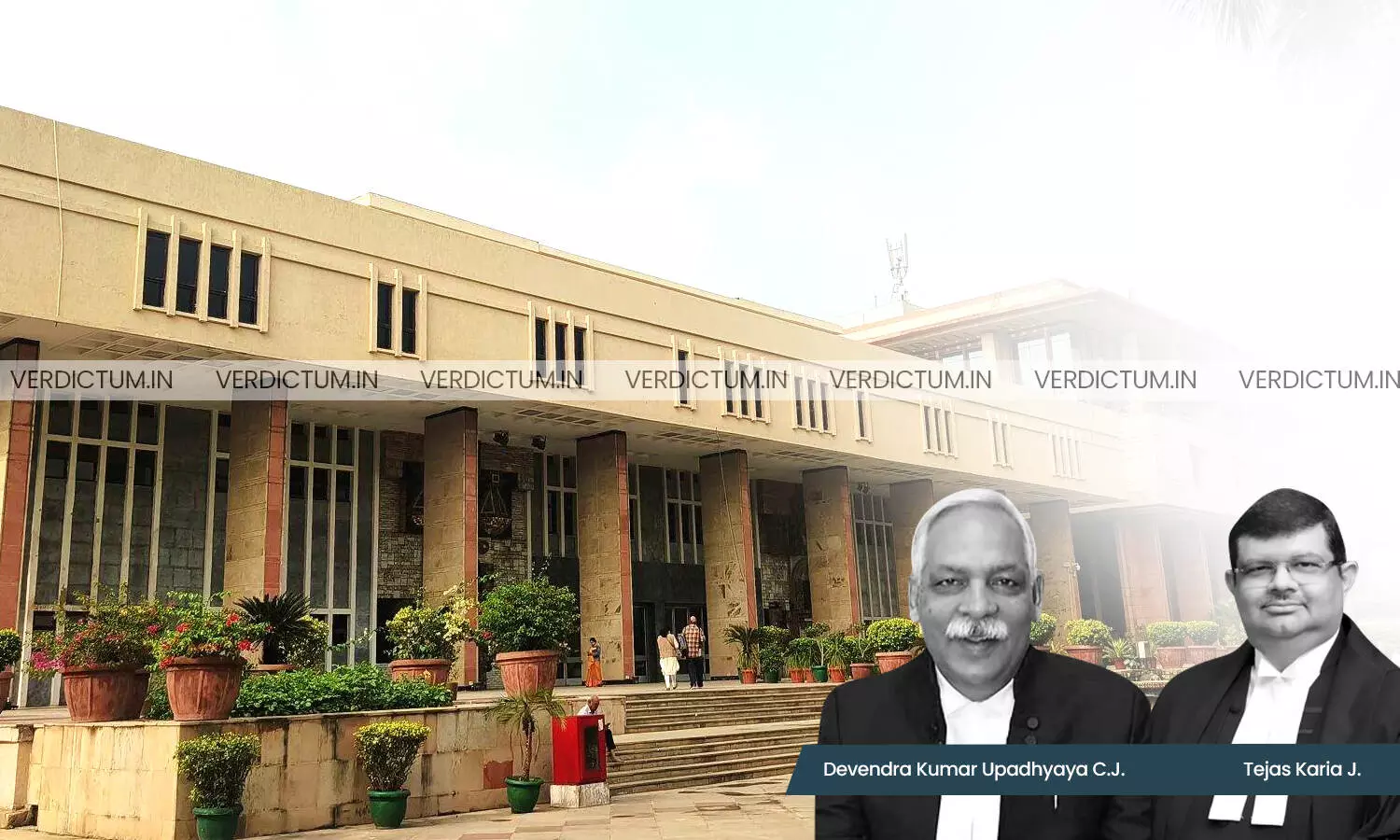
Chief Justice Devendra Kumar Upadhyaya, Justice Tejas Karia, Delhi High Court
Foreign Regulator’s Aircraft Classification Or International Arrangements Can't Override DGCA’s Domestic Licensing Framework: Delhi High Court
 |
|The High Court also held that more than 90 hours logged by each student pilot on the Pipistrel could not count towards the 200-hour aeroplane-experience requirement for a Commercial Pilot Licence.
The Delhi High Court has held that a foreign aviation regulator’s classification of an aircraft under its own regulatory framework does not bind the Directorate General of Civil Aviation while exercising its independent domestic licensing functions.
It further held that neither the DGCA-EASA Working Arrangement nor Article 33 of the Chicago Convention required the DGCA to disregard the Aircraft Rules, 1937 or the applicable Civil Aviation Requirements.
The Court was hearing an intra-court appeal against a Single Judge’s refusal to interfere with the DGCA communication classifying the Pipistrel aircraft in the Government Aviation Training Institute’s fleet as Light Sport Aircraft and the rejection of the student pilots’ licence applications.
A Bench of Chief Justice Devendra Kumar Upadhyaya and Justice Tejas Karia observed: “We find no merit in the submission that the communications issued by EASA on 02.08.2023 and 27.05.2025, or the Working Arrangement, obliged the DGCA to treat the Pipistrel as a ‘Normal’ category aircraft for domestic licensing purposes. EASA’s description of the aircraft under the European regulatory framework, however categorical, governs the position under that framework and does not bind the DGCA in the exercise of its independent statutory functions under the Act, the Rules and the CAR.
The Bench added: Article 33 of the Chicago Convention, which contemplates recognition of certificates of airworthiness issued by other contracting States, does not require a contracting State to suspend or disregard its domestic regulatory framework governing the licensing of Pilots. The distinction in nomenclature between ‘Light Sport Aeroplane’ as used in the European specifications and ‘Light Sport Aircraft’ as used in the Rules and the CAR is, in the present context, one of terminology and not of substance. It does not, therefore, establish that the DGCA’s classification was contrary to law.”
Senior Advocate Amit Rawal appeared for the appellant. Senior Panel Counsel Anjana Gosain and Government Pleader Govil Upadhyaya appeared for the respondents.
Background
The appellant had been selected by the Government of Odisha to develop the Government Aviation Training Institute into an aviation academy. An agreement was executed for the development, operation and management of the institute.
The European Union Aviation Safety Agency granted type certification to the Pipistrel aircraft using Certification Specifications for Light Sport Aeroplanes, or CS-LSA, as the certification basis. The DGCA accepted the type certification, permitted the import of two aircraft and issued Certificates of Airworthiness recording their category as “Normal” and subdivision as “Passengers”. It also approved their maintenance plan and inclusion in the institute’s training manuals.
A subsequent DGCA list of approved flying training organisations described both aircraft as Light Sport Aircraft. The institute objected, contending that the CS-LSA certification basis was distinct from the aircraft’s airworthiness category and that its European certification and subsisting Certificates of Airworthiness required it to be treated as a “Normal” category aircraft.
EASA informed the DGCA that the Pipistrel was categorised as “Normal” under the European regulatory framework and that the use of CS-LSA as the certification basis should not cause confusion. It requested the DGCA to correct the categorisation reflected on its website.
Three student pilots who had trained at the institute later applied for Commercial Pilot Licences. The DGCA rejected their applications because each had acquired more than 90 hours of the claimed flying experience on the Pipistrel and consequently lacked 200 hours of reckonable aeroplane experience.
The appellant, the institute and the student pilots challenged the classification and rejection orders. The Single Judge declined interference, finding that the DGCA had validly exercised its statutory functions and that aircraft classification and pilot licensing involved technical and public-safety considerations within the regulator’s domain.
In appeal, the appellant relied on EASA’s communications, the Working Arrangement, the Chicago Convention and the valid Certificates of Airworthiness. It also alleged violations of natural justice, legitimate expectation and Articles 14, 19(1)(g) and 21 of the Constitution.
The DGCA maintained that EASA’s classification operated within the European framework and could not displace India’s licensing rules. It submitted that the Certificates of Airworthiness concerned the aircraft’s operational fitness, while the eligibility of flying experience for a pilot licence was governed independently by Schedule II to the Aircraft Rules, 1937.
Court’s Observations
The Court rejected the contention that CS-LSA was merely a technical certification specification having no bearing on the aircraft’s treatment under the domestic licensing framework.
Although EASA described the Pipistrel as “Normal” under the European framework, its Type Certificate Data Sheet recorded CS-LSA as the certification basis. The DGCA was entitled to consider that basis while determining the licensing consequences of flying experience acquired on the aircraft.
The Bench explained: “In accepting the Type Certification under CAR Section 6, Series A, Part II, the DGCA was entitled to take into account the certification basis recorded in the TCDS. It was this certification basis, rather than the description of the aircraft as ‘Normal’ in the aforesaid communication, which the DGCA was entitled to consider while determining the regulatory consequences under the domestic licensing framework. We are, therefore, unable to accept the Appellant’s contention that the DGCA was precluded from treating CS-LSA as relevant for determining how flying experience acquired on the Pipistrel was to be reckoned under the Rules.”
The Court held that a Certificate of Airworthiness establishes an aircraft’s fitness to operate safely. It does not determine whether flying experience acquired on the aircraft can be counted towards a particular pilot licence.
The DGCA had neither cancelled the Pipistrel aircraft’s Certificates of Airworthiness nor replaced them with Special Certificates of Airworthiness. The procedural safeguards governing cancellation, revocation or replacement were consequently not attracted.
The Court observed: “A CoA concerns the airworthiness of an aircraft, namely its fitness to operate safely. It is distinct from the question whether flying experience acquired on that aircraft may be reckoned for the purposes of obtaining a Pilot’s licence, which is governed independently by Schedule II to the Rules.”
The Court also rejected reliance on Paragraph 3.4(2)(c) of Civil Aviation Requirements, Section 2, Series F, Part XXIII. That provision excluded from the Light Sport Aircraft category an aircraft holding a Certificate of Airworthiness issued by a foreign civil aviation authority, whereas the Pipistrel aircraft held domestic certificates issued by the DGCA.
The Court held that the DGCA-EASA Working Arrangement dealt with acceptance of type certificates, compliance with the certification basis and environmental protection requirements. It did not regulate or restrict the DGCA’s licensing powers under Schedule II to the Aircraft Rules, 1937.
Article 33 of the Convention on International Civil Aviation, 1944 concerned recognition of airworthiness certificates issued by contracting States. It did not require India to suspend or disregard its domestic framework for licensing pilots.
The Bench added: “Clause 5.3 of the Working Arrangement confines itself to compliance with the certification basis and environmental protection requirements. Neither provision purports to regulate or restrict the DGCA’s licensing functions under Schedule II to the Rules. Any such interpretation would impermissibly enlarge the scope of the Working Arrangement.”
The Court further held that the difference between “Light Sport Aeroplane” in the European specifications and “Light Sport Aircraft” in the Indian framework was terminological, not substantive, in the context of the dispute.
The appellant relied on the DGCA’s earlier approval of maintenance plans and training manuals, grant of flying training organisation status, extension of aircraft ratings and endorsement of the Pipistrel on another pilot’s licence.
The Court found that these administrative actions could not prevent the DGCA from correctly applying its statutory framework or compel it to continue an erroneous position.
The Bench observed: “It is well settled that there can be no estoppel against the exercise of a statutory function. An erroneous or inadvertent administrative act cannot create a vested right compelling the authority to perpetuate such error, particularly in matters concerning public safety and licensing standards.”
The institute could not claim ignorance of the DGCA’s position because it had been informed that CS-LSA was the certification basis. The later list of approved flying training organisations had also expressly described both Pipistrel aircraft as Light Sport Aircraft before the students’ applications were rejected.
The appellant disputed the stall-speed parameter considered by the DGCA under Rule 3(33AA) of the Aircraft Rules, 1937. The Court held that determining the relevant parameter was a specialised technical exercise entrusted to the aviation regulator.
The Court observed: “The determination of the applicable stall speed parameter for the purposes of Rule 3(33AA) is a technical matter falling squarely within the specialised domain of the DGCA. The material placed on record does not establish that the parameter adopted by the DGCA was perverse, mala fide, or vitiated by an error apparent on the face of the record.”
Judicial interference would have been warranted only if the DGCA’s decision was manifestly arbitrary, perverse, mala fide or contrary to the governing statutory framework. The Court found that none of these grounds had been established.
The Court rejected the allegation that the classification communication had been issued without notice or an opportunity of hearing. It noted that the institute had repeatedly corresponded with the DGCA and the Ministry of Civil Aviation, attended a meeting with officials and placed its objections before an expert committee.
The Bench remarked: “At each stage, GATI had the opportunity to place its objections, factual position and legal submissions before the DGCA. Those objections were considered before the Communication was issued. In these circumstances, it cannot be said that GATI was denied notice or an opportunity of hearing.”
The communication was therefore treated as the DGCA’s response to objections raised by the institute rather than an isolated decision taken without its participation.
The Court rejected the plea that the DGCA’s earlier representations and conduct created a legitimate expectation that the Pipistrel would be treated as “Normal” for all licensing purposes.
The Bench underscored: “Even where a legitimate expectation is established, it cannot fetter the duty of a regulatory authority to correctly apply licensing and safety standards. Such expectation must yield to the public interest underlying the regulatory framework, particularly where the competence of prospective commercial Pilots is concerned.”
The Court found no discriminatory or arbitrary treatment under Article 14 of the Constitution. It held that Articles 19(1)(g) and 21 were also not independently attracted in the absence of established arbitrariness.
Section ‘J’ of Schedule II to the Aircraft Rules, 1937 requires a Commercial Pilot Licence applicant to establish 200 hours of flying experience on aeroplanes. Each student pilot had acquired more than 90 hours of the claimed experience on the Pipistrel.
Once the aircraft was treated as a Light Sport Aircraft, those hours could not be counted towards the prescribed aeroplane-experience requirement. The valid Certificates of Airworthiness did not change the licensing character of the experience.
The Court clarified: “The only limited exception is contained in Paragraph No. 1(e)(v) of Section ‘E’ of Schedule II, which permits a maximum of 20 hours of solo flying experience on an LSA to be reckoned towards the requirements for a Private Pilot Licence, and not towards a CPL.”
The student pilots therefore lacked the requisite 200 hours of reckonable experience, and the rejection of their applications was upheld.
The Court noted that the Government of Odisha’s termination of the agreement governing the aviation institute was under challenge in separate proceedings. It clarified that the observations in its judgment would not affect the merits of that dispute.
Conclusion
The Delhi High Court upheld the DGCA’s classification of the Pipistrel VIRUS SW 121 as a Light Sport Aircraft for domestic licensing purposes and sustained the rejection of the three Commercial Pilot Licence applications.
It affirmed the Single Judge’s judgment and dismissed the intra-court appeal. The pending applications were disposed of without any order as to costs. The separate proceedings concerning termination of the institute’s governing agreement were left to be decided independently.
Cause Title: Global Avianautics Limited v. Directorate General of Civil Aviation & Others (Neutral Citation: 2026:DHC:7460-DB)
Appearances
Appellant: Senior Advocate Amit Rawal; Advocates Prateek Rathee, Bajaj and Rishika
Respondents: Senior Panel Counsel Anjana Gosain; Government Pleader Govil Upadhyaya; Advocate Akansha Choudhary; Assistant Director Saurabh Kumar