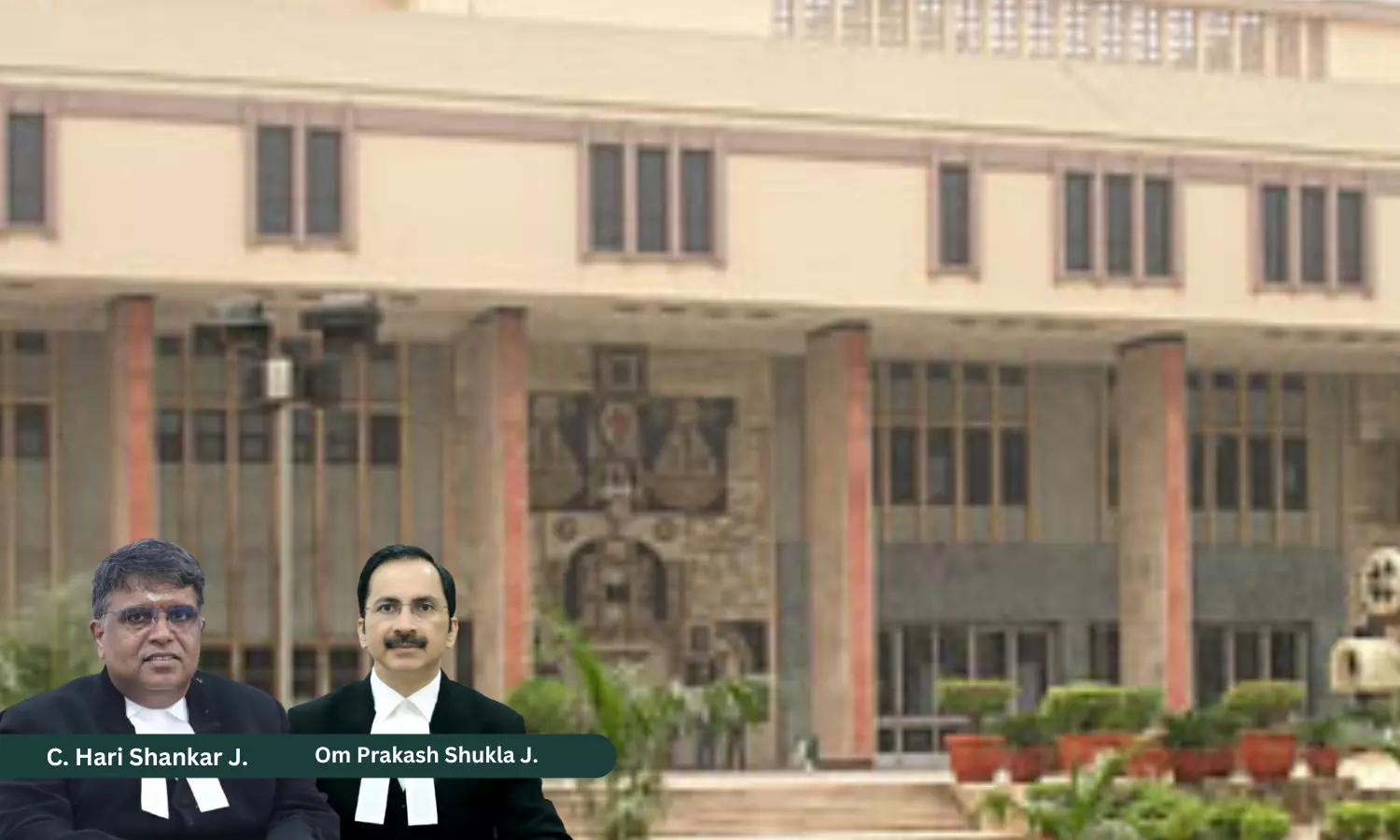
Justice C. Hari Shankar, Justice Om Prakash Shukla, Delhi High Court
Classic Case Of Misuse Of Section 33 Arbitration Act To Gain Time For Challenging Award: Delhi High Court Imposes ₹5L Costs On DMRC
 |
|The Court held that a formal Section 33 request, even if outside the provision’s proper scope, postpones limitation under Section 34(3) until its disposal if it is filed within the prescribed period and with notice to the other side.
The Delhi High Court has imposed ₹5 lakh costs on Delhi Metro Rail Corporation Ltd. after finding that its application under Section 33 of the Arbitration and Conciliation Act, 1996 was a misuse of the provision, filed to obtain time for launching a substantive challenge to an arbitral award.
The High Court, however, set aside the Single Judge’s order dismissing DMRC’s Section 34 petition as time-barred.
The Court was hearing an appeal against a Single Judge’s judgment dismissing DMRC’s petition under Section 34 of the Arbitration and Conciliation Act as barred by limitation, in a dispute arising from an arbitral award passed in favour of HCC Samsung JV.
A Bench of Justice C. Hari Shankar and Justice Om Prakash Shukla observed: “It is not possible for us to believe that an organization such as the appellant did not know the fundamentals of Section 33 and what is permitted thereunder. This, therefore, is a classic case of misuse of Section 33, perhaps with a view to obtain breathing space to launch the challenge to the substantive award.”
Senior Advocate Parag P. Tripathi appeared for DMRC; Senior Advocate Dayan Krishnan appeared for HCC Samsung JV.
Background
The dispute arose from a civil works contract between DMRC and HCC Samsung JV. After the respondent raised claims for compensation on account of variations and delay in completion of work, the dispute was referred to a three-member Arbitral Tribunal. A majority award was passed in favour of the respondent, followed by a dissenting award by the third arbitrator.
DMRC then filed an application before the Arbitral Tribunal under Section 33, purportedly seeking correction of the award. The application questioned findings on claims relating to cross-passages, extended stay costs, minimum wages and computation of amounts awarded.
The Arbitral Tribunal rejected the Section 33 application. DMRC thereafter filed a Section 34 petition challenging the award. The respondent objected that the petition was time-barred, while DMRC contended that limitation had to be reckoned from the date on which the Section 33 application was rejected. The Single Judge accepted the respondent’s objection, holding that the Section 33 application was not a genuine correction application and could not extend limitation.
Court’s Observations
The Court found that DMRC’s Section 33 application did not seek correction of clerical or typographical errors. Instead, it challenged the substance of the arbitral findings.
The Court observed: “It is plain that the Section 33 application was not for correcting any clerical or typographical errors in the award, but sought a wholesale review of the findings of the learned Arbitral Tribunal. The perceived ‘errors’ which the application sought to underscore related to the merits of the disputes between the parties and questioned the wisdom of the majority award with respect to substantive findings returned on merits as well as alleged computational discrepancies.”
The Bench further recorded its conclusion on the purpose of the application: “We have, therefore, no manner of doubt, in our minds, that the application was filed merely to obtain extension of time to file the substantive challenge under Section 34.”
The Court noted that the issue was covered by Geojit Financial Services Ltd. v. Sandeep Gurav (2025) and National Highways Authority of India v. T. Younis (2026). It held that where a formal Section 33 application is filed within time and with notice to the other side, limitation under Section 34(3) begins from the date of its disposal.
The Court held: “Where an application was filed, then, irrespective of the merits of the application, and even if the application was a mere sham and therefore not maintainable at all, the decisions in Geojit and T. Younis make it clear that the period of limitation for the purposes of the Section 34(3) would commence only from the date when the application is disposed of.”
The Bench added that the Single Judge’s approach would require rewriting Section 34(3), which the Supreme Court had held to be impermissible.
The Single Judge had relied on State of Arunachal Pradesh v. Damani Construction Co. (2007). The Division Bench held that the later Supreme Court decisions in Geojit and T. Younis had distinguished Damani on the ground that it involved no formal Section 33 application but only a letter to the arbitrator.
The Court observed: “The Supreme Court has, however, in T. Younis, clearly held that in a case where the Section 33 application is found to be a sham, the Court can and must award punitive costs. The Section 34 petition cannot, however, be dismissed as time barred, ignoring the time spent in disposing of the Section 33 application, howsoever frivolous it might have been.”
It accordingly held that the Single Judge’s judgment, which followed Damani, could not be sustained in view of Geojit and T. Younis.
The Court separately examined the nature of DMRC’s Section 33 application and found that it was completely lacking in bona fides.
The Bench observed: “By no stretch of imagination can it be said that the application was mistakenly filed, under a bona fide assumption that it fell within the parameters of Section 33. The application does not seek correction of any clerical or typographical error in the arbitral award. Instead, it seeks to point out various perceived errors in the award of understanding the contractual provisions, computing the amounts involved and such like.”
The Court further held that the application went beyond even the ordinary understanding of review jurisdiction and substantially sought re-adjudication of the dispute.
The Court held that the case was fit for punitive costs in line with T. Younis, but also took into account that DMRC is a public sector undertaking.
The Court observed: “We are of the opinion that this is an eminently fit case for awarding punitive costs as suggested by the Supreme Court in T. Younis. At the same time, we bear in mind the fact that the appellant is a public sector undertaking and that, therefore, the ultimate impact of the costs we may award would be on the public exchequer.”
Conclusion
The High Court set aside the Single Judge’s judgment and held that DMRC’s Section 34 petition could not have been rejected as barred by limitation. At the same time, it imposed costs of ₹5 lakh on DMRC for misuse of Section 33. The amount is to be paid to HCC Samsung JV within twelve weeks from the pronouncement of the judgment. The appeal was disposed of in these terms.
Cause Title: Delhi Metro Rail Corporation Ltd. v. HCC Samsung JV (Neutral Citation: 2026:DHC:6743-DB)
Appearances
Appellant: Senior Advocate Parag P. Tripathi with Advocates Tarun Johri, Vishwajeet Tyagi and Rini Mehra
Respondent: Senior Advocate Dayan Krishnan with Advocates Kartik Yadav, Parinay T. Vasandani, Siddhant Kaushik, Shriyanshi Pathak, Yugandhara Pawar Jha and Abhimanyu Arya