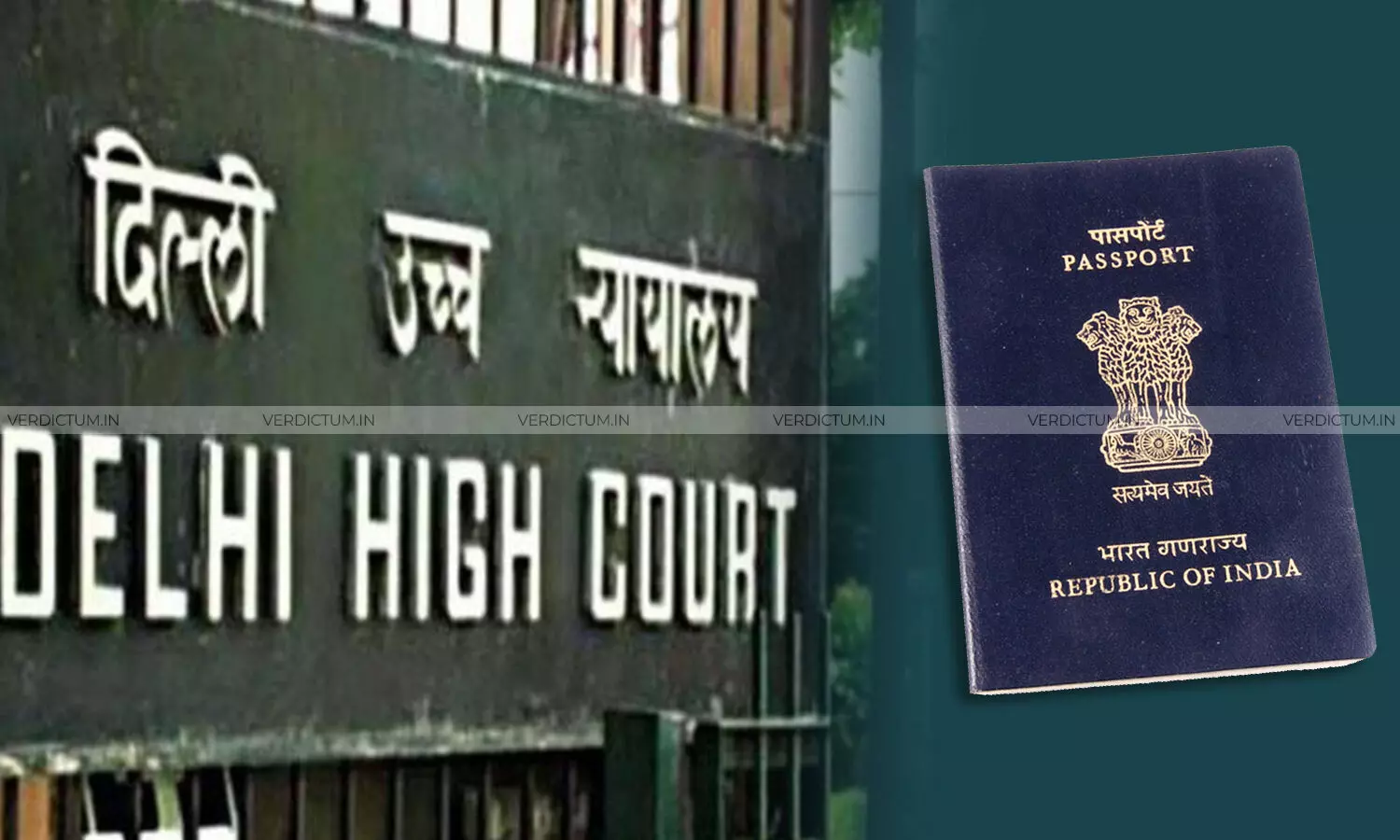
Adverse PVR Relevant Factor, But Must Meet Natural Justice Standards: Delhi High Court Remands Student’s Passport Application For Fresh Hearing
 |
|The Court held that the Police Verification Report (PVR) is a relevant component of statutory inquiry under Section 6(2) of the Passports Act, but set aside appellate rejection for want of a hearing under Rule 16.
The Delhi High Court has held that while a Passport Authority is entitled to rely on an adverse Police Verification Report while refusing a passport under Section 6(2)(b) of the Passports Act, 1967, such reliance must conform to statutory procedure and natural justice. The Court accordingly set aside an appellate order rejecting a student's passport renewal application and remanded the matter for fresh consideration.
The Court clarified that the requirement of hearing becomes particularly relevant where an adverse Police Verification Report forms the principal basis for refusal and the applicant disputes the material underlying it. It directed the appellate authority to decide the appeal afresh after affording the petitioner an opportunity of hearing under Rule 16 of the Passports Rules, 1980, while declining to examine the merits of the adverse report itself, leaving that question open.
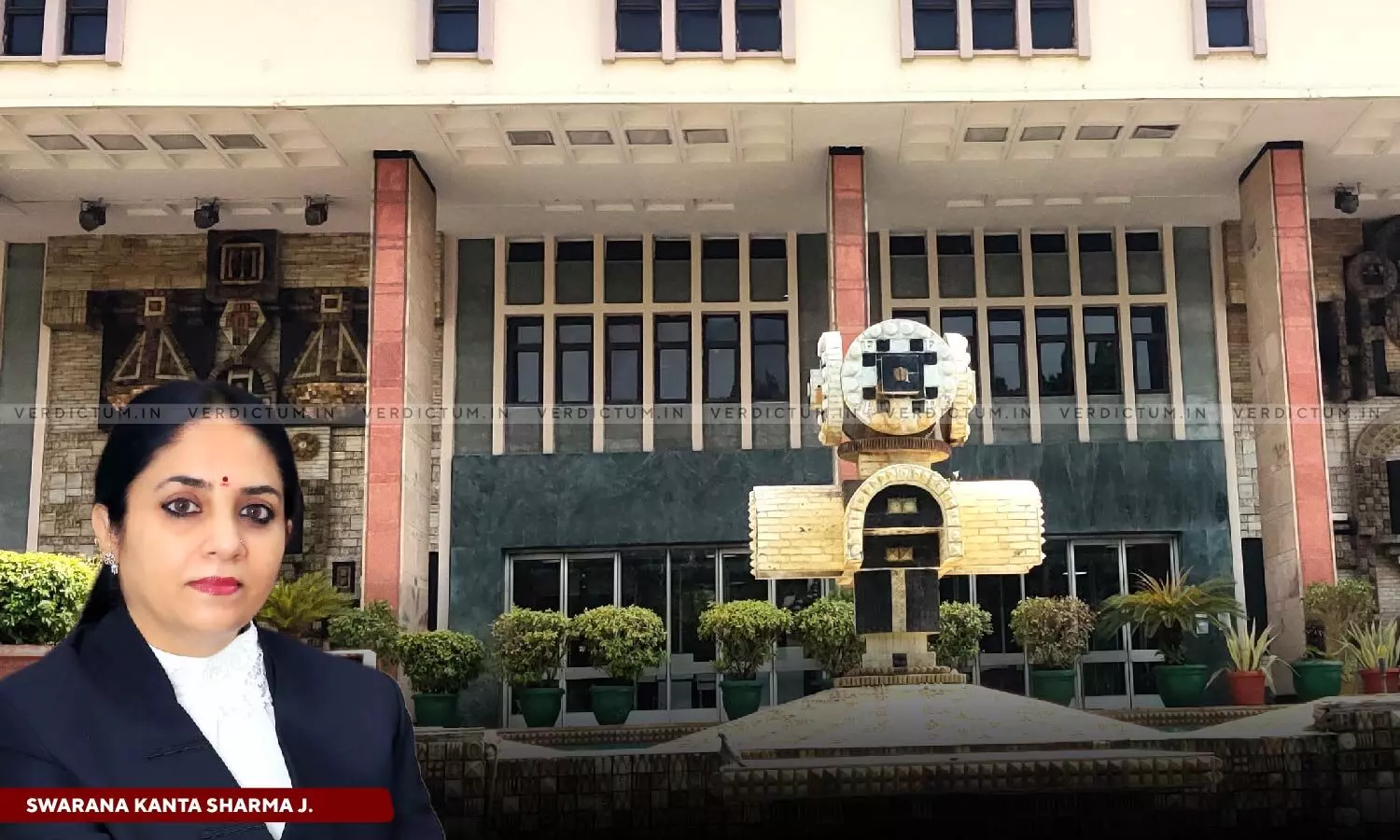
A Bench of Dr. Justice Swarana Kanta Sharma observed, “…while the Passport Authority is required to independently apply its mind to the application and the material available before it, such independent consideration cannot imply that the Passport Authority is required to disregard or undertake afresh the factual verification carried out by the concerned police authorities. The Police Verification Report is a relevant and material component of the inquiry contemplated under Section 5 of the Passports Act and, where the same contains an adverse finding on matters falling within Section 6(2), the Passport Authority is entitled to take such report into consideration while determining whether the passport ought to be issued or renewed”.
“…The Passport Authority is, therefore, entitled to take into consideration the Police Verification Report while forming its opinion on an application for issuance or renewal of a passport. Thus, the mere fact that the Passport Authority has relied upon an adverse Police Verification Report cannot, by itself, be a ground to fault the decision-making process. At the same time, such reliance has to be in accordance with the statutory procedure and the principles of natural justice governing the decision”, the Bench said.
Advocate Prasanna S. appeared for the petitioner and Rohan Jaitley, CGSC appeared for the respondent.
The petitioner, an Indian citizen studying at Australian National University, Canberra, applied to renew his passport on February 1, 2024. After eighteen months of inaction, he filed a writ petition, leading the High Court to direct the authorities to consider issuing a short-validity passport within three weeks.
Instead of complying, the High Commission of India, Canberra, refused the application on December 11, 2025 under Section 6(2)(b) of the Passports Act, relying on an adverse Jammu & Kashmir Police verification report marked "Not Recommended". The Chief Passport Officer subsequently rejected his statutory appeal on March 10, 2026.
The petitioner challenged the refusal, arguing that the undisclosed adverse report lacked material linking him to activities prejudicial to national sovereignty or security. He further contended that the appeal was decided without a hearing, violating mandatory statutory procedure, natural justice principles, and an explicit court directive in his earlier petition. The respondents maintained that police verification is an essential part of the Section 5 statutory inquiry and that the adverse report mandated refusal under Section 6(2).
The Court noted that the inquiry contemplated under Section 5(2) does not exclude reliance on Police Verification Reports, since police authorities are ordinarily best placed to verify an applicant's antecedents. It held that Sections 5 and 6 use the word "shall," meaning that once a ground under Section 6(2) is found attracted, the Passport Authority cannot disregard the statutory mandate merely because the applicant seeks renewal. However, this substantive mandate does not dispense with procedural safeguards, particularly the opportunity of representation contemplated under Rule 16 before an appeal is finally decided.
“Section 6(2) of the Passports Act further provides that a passport shall be refused where the grounds mentioned in the said provision are satisfied, including where the issuance of such passport would not be in the interests of the sovereignty and integrity of India, the security of India, friendly relations of India with any foreign country or the interests of the general public. In this statutory framework, the Police Verification Report cannot be treated as not relevant to the decision-making process of the Passport Authority. The police authorities, being responsible for maintaining records and conducting verification within their jurisdiction, are ordinarily the appropriate authority to ascertain the antecedents and other relevant particulars of an applicant residing or having resided in a particular area”, the Bench further said.
The Court accordingly remanded the appeal for fresh decision, directing that the hearing be conducted through video-conferencing given the petitioner's residence abroad, and that a fresh order be passed within ten weeks.
Cause Title: Asaf Ali Lone v. Joint Secretary (PSP) Chief Passport Officer & Ors. (Neutral Citation: 2026:DHC:7542)
Appearances:
Petitioner: Prasanna S., John Smite, Injila Muslim Zaidi, Maamidi Ashish Reddy, Prasanna B. and Ishita Tulsyan, Advocates.
Respondent: Rohan Jaitley, CGSC, Akshay Sharma, Dev Pratap Shahi, Varun Pratap Singh, Yogya Bhatia, Advocates.