Supreme Court Cancels Bail of Advocate Accused Of Using Fake Degree, Frames Guidelines on Disclosure of Criminal Antecedents in Bail Pleas
 |
|Noting that the Allahabad High Court ignored material evidence, multiple FIRs and forged LL.B. allegations, the bench laid down guidelines
The Supreme Court in a significant judgment highlighting the integrity of the legal profession, has set aside the bail granted to an accused who allegedly forged an LL.B. degree and projected himself as an advocate before courts, holding that the High Court’s order was “legally unsustainable” and vitiated by non-application of mind.
In addition, the Court laid down an illustrative and recommendatory disclosure framework to ensure full and candid transparency in bail proceedings. It suggested that bail applications should clearly disclose case particulars (FIR details, offences and maximum punishment), custody status, stage of trial, complete criminal antecedents, history of previous bail applications, and any coercive processes such as non-bailable warrants or proclamation orders. Clarifying that the framework is facilitative and not mandatory, the Court left it open to subordinate courts to adopt or adapt the format in accordance with procedural requirements and case-specific circumstances.
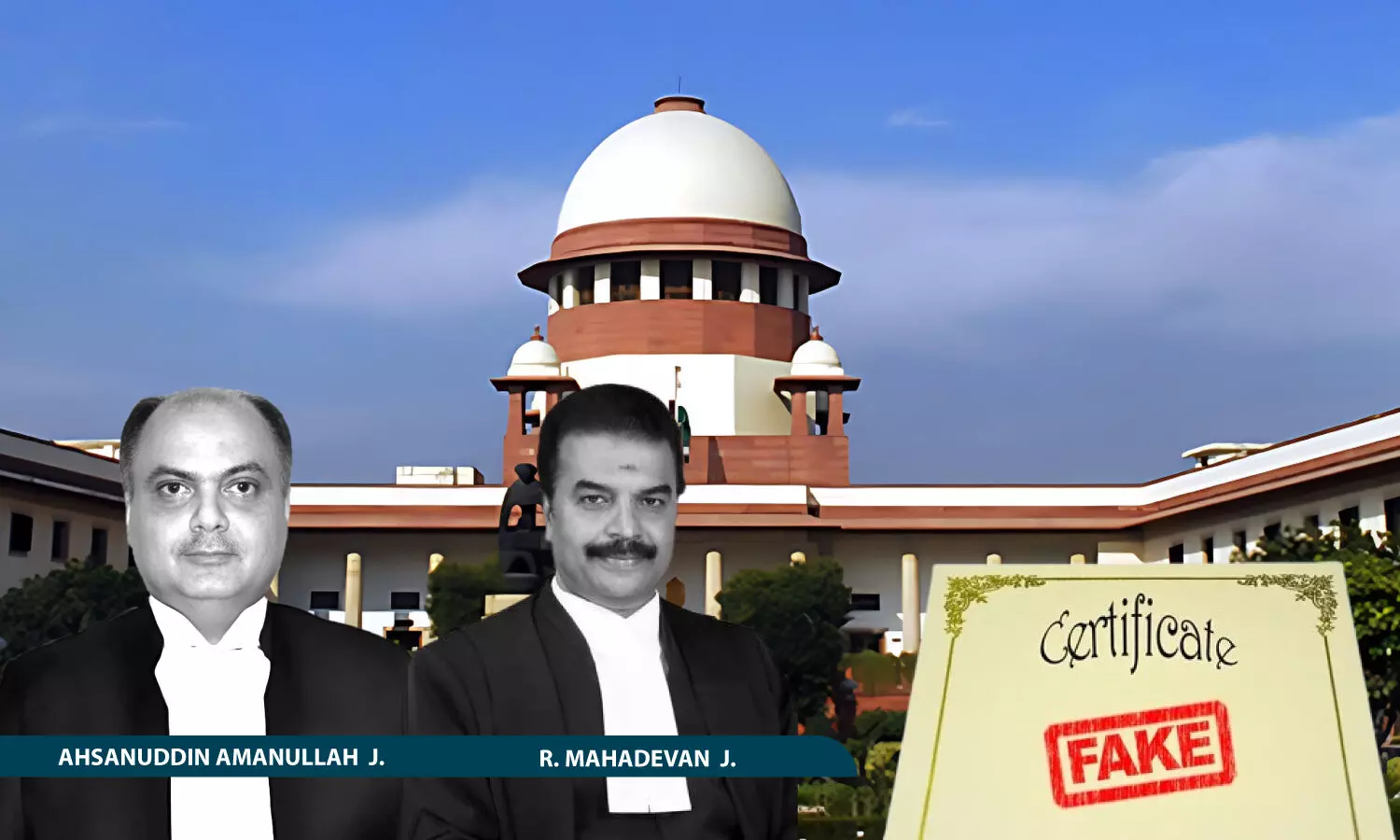
Justice Ahsanuddin Amanullah and Justice R. Mahadevan observed, “...this Court is of the view that every petitioner or applicant seeking bail, at any stage of proceedings, is under an obligation to disclose all material particulars, including criminal antecedents and the existence of any coercive processes such as issuance of non-bailable warrants, declaration as a proclaimed offender, or similar proceedings, duly supported by an affidavit, so as to promote uniformity, transparency and integrity in bail adjudication”.
“…where a bail order is demonstrated to be legally untenable or fundamentally perverse, interference by the appellate court is not an exception, but a judicial imperative. Such interference does not trench upon the sanctity of personal liberty; rather, it subserves the rule of law by ensuring that discretionary relief is granted in conformity with settled legal standards and that the administration of criminal justice is not undermined by arbitrary or capricious orders”, the bench further noted.
Advocate Shreevardhan Dhoot appeared for the appellant and Advocate Mumtaz Javed Shaikh appeared for the respondent.
In the present matter, an FIR was registered in Uttar Pradesh alleging a large-scale racket involving fabrication and circulation of forged law degrees and academic certificates. The accused was alleged to have relied on a fake LL.B. degree purportedly issued by an institution claimed to be affiliated with Veer Bahadur Singh Purvanchal University.
However, official communications from the University and the concerned college categorically stated that no such affiliation existed and that no law course was conducted by the institution.
Furthermore, despite the materials, the Allahabad High Court granted bail, primarily accepting the defence that the FIR was motivated by a family property dispute.
Pursuant to which, the Supreme Court observing that the High Court had relied on documents whose genuineness was itself under challenge and failed to consider vital materials on record, found the approach flawed.
The court also took note of multiple FIRs registered against the accused across different States, many involving allegations of forgery and educational fraud. It held that suppression of such criminal antecedents in bail proceedings amounted to a serious abuse of process and materially vitiated the exercise of judicial discretion.
“In the present case, Respondent No. 2 deliberately concealed his criminal antecedents before the High Court, both in the petition for quashing FIR as well as in successive bail applications. Even before this Court, only partial disclosure was made in the counter-affidavit, despite the existence of multiple criminal cases on record. This conduct cannot be viewed as an isolated lapse but reflects a growing and disturbing trend of accused persons securing discretionary relief by suppressing material facts”, the bench had further noted.
Thus, reiterating the distinction between cancellation of bail for post-release conduct and appellate scrutiny of an unjustified bail order, the Court emphasised that a bail order can be annulled where it ignores relevant factors such as gravity of offence, criminal history, and societal impact.
On the plea for transfer of investigation to a special agency, the Court declined intervention, noting that the chargesheet had already been filed and no exceptional circumstances demonstrating bias or mala fides were made out. It further observed that issues concerning forged law degrees and enrolment of advocates are already under scrutiny pursuant to earlier directions and a nationwide verification exercise supervised by the Court.
With the bail order set aside, the Court reaffirmed that while personal liberty is a constitutional value, judicial discretion in granting bail must be exercised within the disciplined framework of settled legal principles, especially where allegations strike at the credibility of the justice delivery system itself.
Cause Title: Zeba Khan v. State Of U.P. & Ors. [Neutral Citation: 2026 INSC 144]
Appearances:
Appellant: Shreevardhan Dhoot, Sachin Sarda, Amrit Rathi, Anannya Wal, Arnav Doshi, Kush Taneja, Aryan Mehta, Syed Ahmed N.Q., Abhinav K. Mutyalwar, Parth Johri, Arjun Aggarwal, Alabhya Dhamija, AOR, Advocates.
Respondents: Ruchira Goel, AOR, Ejaz Maqbool, AOR, Mumtaz Javed Shaikh, Nishant Sanjay Kumar Singh, Pranav Kumar Srivastva, Devendra Kumar Gupta, Vandana, Mohd Arafat Ahmad, Mohd Shafat Ahmad, Sadashiv, AOR, Radhika Gautam, AOR, Rajat Kapoor, Dr. Arvind S. Avhad, AOR, Advocates.
Click here to read/download the Judgment