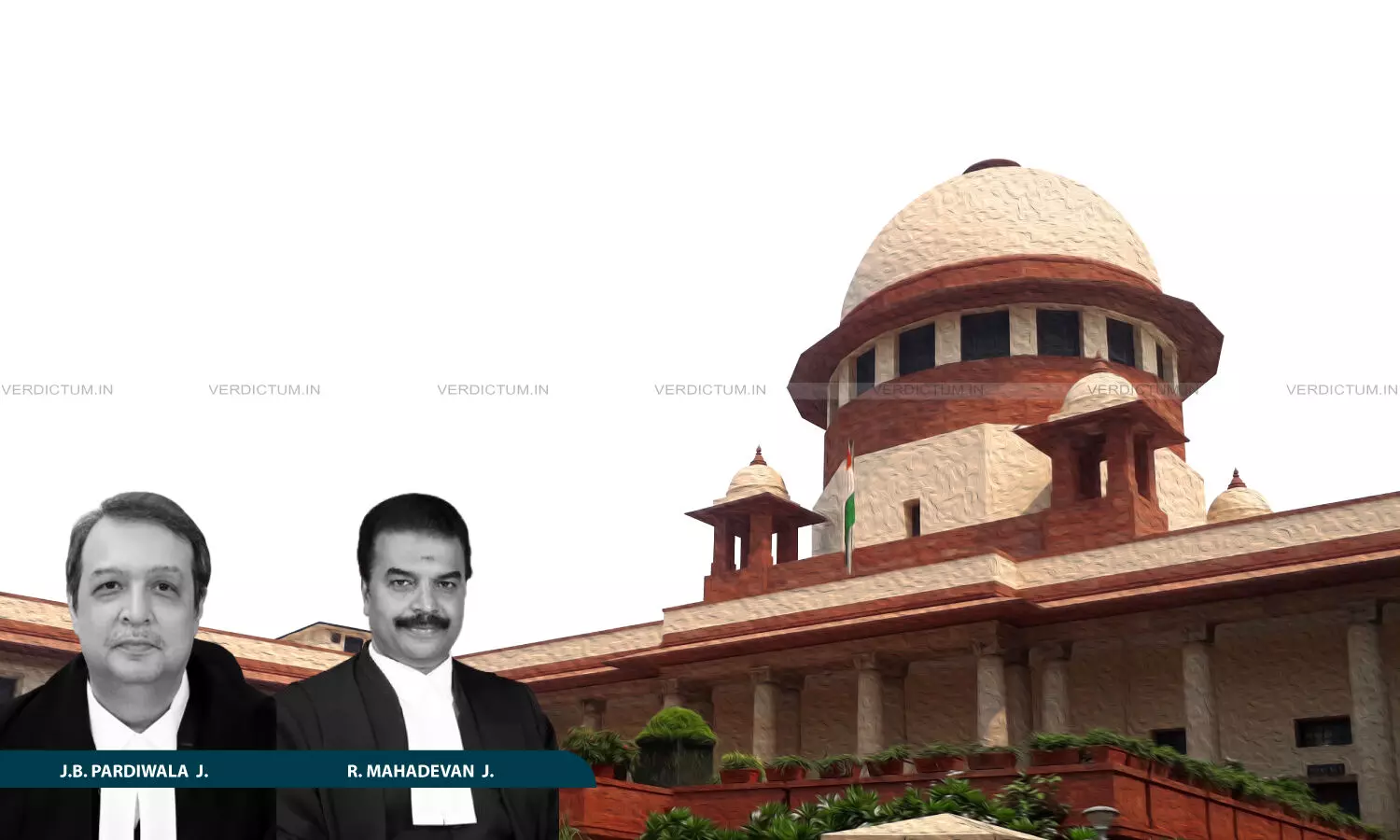
Justice J.B. Pardiwala, Justice R. Mahadevan, Supreme Court
Stem Cell Therapy For Autism Not Recognised As Sound Medical Practice; Cannot Be Used As Routine Clinical Service: Supreme Court
 |
|The Apex Court held that therapeutic use of stem cells for Autism Spectrum Disorder (ASD) is not recognised as a sound medical practice based on current scientific knowledge, and therefore cannot be offered as a clinical service outside an approved and monitored research or clinical trial setting.
The Supreme Court has held that stem cell therapy for Autism Spectrum Disorder (ASD), in the absence of established scientific evidence demonstrating safety and efficacy, does not meet the reasonable standard of medical care and cannot be offered as a routine clinical service.
The Apex Court was hearing a public interest writ petition (PIL) raising concerns over the widespread promotion and administration of stem cell therapies for ASD by clinics across the country, despite the absence of proven clinical efficacy and regulatory approval.
A Bench of Justice J.B. Pardiwala and Justice R. Mahadevan held that “since therapeutic use of stem cells in ASD is not recognised as a sound and relevant medical practice as per the knowledge available at present, the medical practitioners who offer the same as a clinical service, outside of an approved and monitored research/clinical trial, fail to meet the reasonable standard of care owed by them towards their patients.”
Hence, the Bench further held, “until there is further research which establishes this as a sound and relevant medical practice, stem cell ‘therapies’ for ASD cannot be offered by medical practitioners as a clinical service, outside an approved and monitored clinical trial/research setting”.
Background
The petition raised concerns regarding the promotion and administration of stem cell therapies for ASD by several clinics in India, alleging that such practices were being carried out despite stem cell therapy remaining at an experimental stage for this condition.
The petitioners contended that individuals diagnosed with ASD and their caregivers were being induced to undergo costly and unproven procedures, often in the hope of a cure, without the safeguards available in regulated clinical trials. It was asserted that such therapies were being administered in violation of the existing regulatory framework under the Drugs and Cosmetics Act, 1940, the New Drugs and Clinical Trial Rules, 2019, and the National Guidelines for Stem Cell Research, 2017.
During the pendency of the proceedings, multiple regulatory and institutional developments took place, including recommendations by the Ethics and Medical Registration Board (EMRB) of the National Medical Commission (NMC), publications by the Indian Council of Medical Research (ICMR), and decisions by the Ministry of Health and Family Welfare. These materials were placed before the Court and formed a central part of its analysis.
The Court was required to determine whether stem cell therapies for ASD could be lawfully offered as a routine healthcare service, and if not, whether they could be administered only within a regulated research or clinical trial framework.
Court’s Observation
Standard Of Care Owed By Medical Practitioners
The Court examined settled principles governing medical negligence and the standard of care, including precedents such as Indian Medical Association v. V.P. Shantha, Jacob Mathew v. State of Punjab, Kusum Sharma v. Batra Hospital, and M.A. Biviji v. Sunita. The Court reiterated that medical practitioners are required to act in accordance with practices accepted by a competent body of medical professionals, judged in light of prevailing scientific knowledge.
The Court held that a medical practitioner cannot meet the reasonable standard of care if an intervention lacks credible scientific evidence of safety and efficacy or is expressly not recommended by authoritative medical and regulatory bodies.
Status Of Scientific Evidence On Stem Cell Therapy For ASD
The Court examined the National Guidelines for Stem Cell Research, 2017, and the Evidence-Based Status of Stem Cell Therapy for Human Diseases, 2021, published by the ICMR and the Department of Health Research. These documents consistently indicated that stem cell therapy for ASD lacks sufficient scientific evidence and is not recommended as standard or routine treatment.
The Court noted that the scientific literature reflects wide variation in stem cell types and routes of administration in experimental settings, underscoring the absence of uniform, validated clinical protocols.
EMRB And National Medical Commission Recommendations
The Court placed significant reliance on the recommendations dated 06.12.2022 issued by the Ethics and Medical Registration Board of the National Medical Commission. The EMRB, after reviewing available scientific evidence, had concluded that there is insufficient and inadequate scientific evidence on the efficacy of stem cell therapy in ASD, and that Stem cell therapy is not recommended as a treatment for ASD in clinical practice.
The Court noted that these recommendations were approved by the National Medical Commission and thus constituted authoritative professional guidance governing ethical medical practice in India.
Whether Stem Cell Therapy For ASD Is A Sound And Relevant Medical Practice
Applying the standard of care principles, the Court held that stem cell therapy for ASD cannot be regarded as a sound and relevant medical practice in light of the absence of conclusive evidence of safety and efficacy, uniform national and international guidelines advising against its clinical use, and the EMRB and NMC characterising such use as professional misconduct.
The Court held that offering stem cell therapy for ASD as a routine clinical service fails to meet the reasonable standard of care owed by medical practitioners.
Distinction Between Clinical Service And Clinical Trials
The Court clarified that while stem cell therapies for ASD cannot be offered as routine clinical services, this does not preclude research in approved and monitored clinical trial settings. The Court emphasised that experimental treatments may only be administered within regulated clinical trials, subject to ethical approvals and statutory safeguards.
The Court further observed that patient consent or autonomy cannot justify offering unproven therapies as clinical services where such therapies are not recognised as sound medical practice.
Conclusion
The Supreme Court held that stem cell “therapies” for ASD cannot be offered as routine clinical services and may only be administered within approved and monitored research or clinical trial settings.
The Court directed that the matter shall be treated as part-heard. The Registry was directed to list the matter again after four weeks before the same Bench for the purpose of considering submissions to be made by the Secretary, Ministry of Health and Family Welfare, in compliance with the judgment.
The Court recorded that upon clarity of the Union Government’s stance, final directions would thereafter be issued.
The Registry was also directed to circulate one copy each of the judgment to all High Courts and to the Secretary, Ministry of Health and Family Welfare.
Cause Title: Yash Charitable Trust & Ors v. Union of India & Ors (Neutral Citation:2026 INSC 96)
Appearances
Petitioners: Siddharth Nath, Advocate, Prateek K Chadha, AOR, Asjad Hussain, Advocate, Anunay Chowdhary, Advocate, Sreekar Aechuri, Advocate, Aniket Chauhaan, Advocate
Respondents: Aishwarya Bhati, Additional Solicitor General, Sudarshan Lamba, AOR, Ketan Paul, Advocate, Ashok Panigrahi, Advocate, Piyush Beriwal, Advocate, Pratyush Shrivastava, Advocate
Shivika Mehra, Advocate with Others