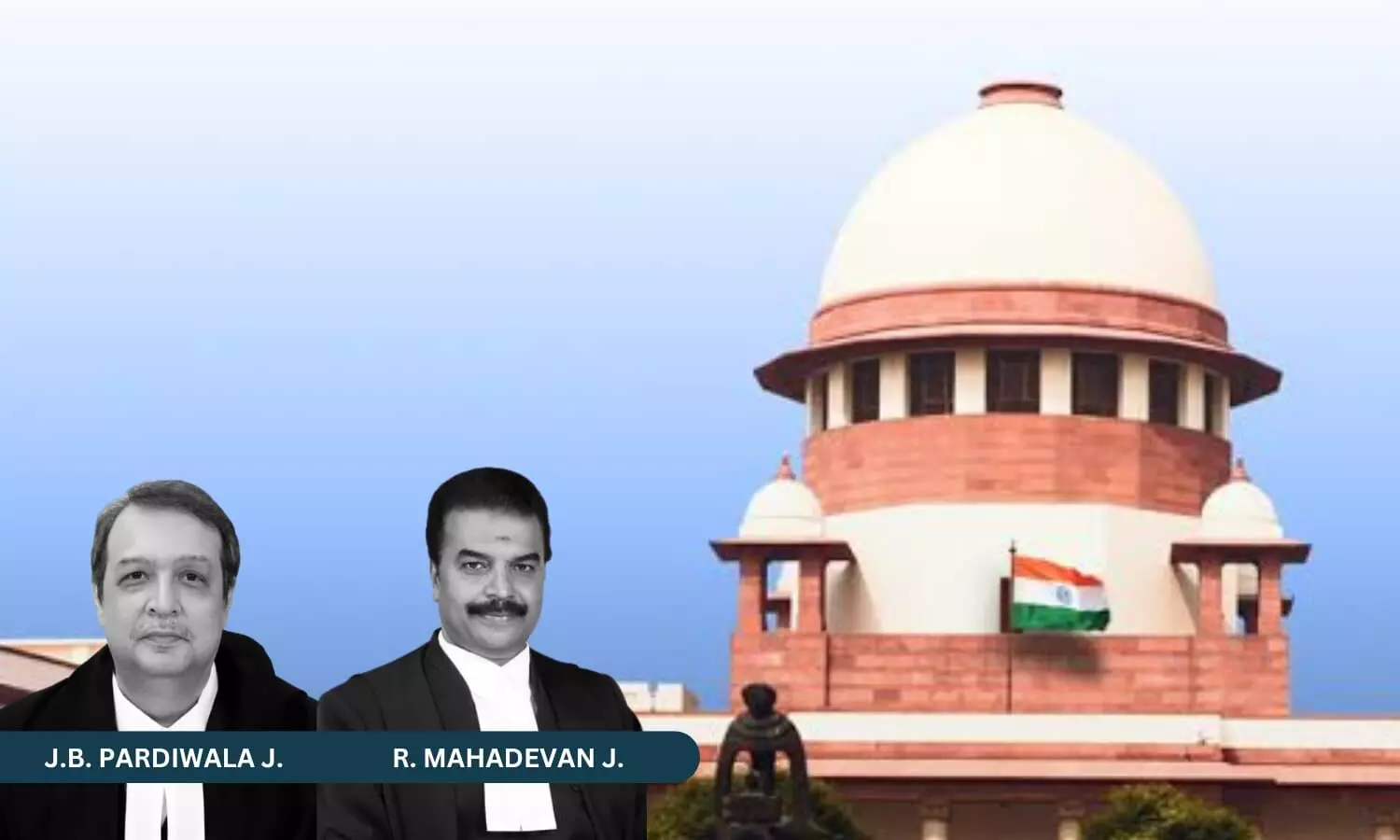
Justice J.B. Pardiwala, Justice R. Mahadevan, Supreme Court
Supreme Court Urges Union To Enact Legislation To Regulate Stem Cell Therapy For Autism; Calls For National Regulatory Authority
 |
|The Apex Court observed that prolonged executive inaction has allowed unproven stem cell “therapies” for Autism Spectrum Disorder (ASD) to proliferate, leading families to incur high financial costs and exposing children to unregulated and unsupported medical practices.
The Supreme Court has urged the Union Government to strengthen the regulatory framework governing stem cell research and therapeutic use for Autism Spectrum Disorder (ASD), and issued suggestions for the creation of a dedicated regulatory authority to ensure effective oversight, prevent misuse of regulatory gaps, and curb the commercialisation of unproven stem cell interventions.
The Court held that the absence of timely and effective regulatory intervention by the Union has contributed to the unchecked promotion and administration of unproven stem cell therapies for Autism Spectrum Disorder, resulting in parents and guardians being driven towards unregulated treatments at high personal and financial cost.
The Apex Court was hearing a public interest writ petition (PIL) raising concerns over commercialisation of stem cell “therapy” for ASD, despite the lack of sound scientific evidence establishing its safety and efficacy.
A Bench of Justice J.B. Pardiwala and Justice R. Mahadevan took note of the regulatory vacuum and urged the Union Government to “consolidate and clarify the position of law for enabling better implementation of the same in this regard at the earliest and insist on the creation of a dedicated authority for the regulatory oversight of stem cell research all across the country”.
The Bench further suggested “the enactment of legislation that may clarify several issues that plague the research in stem cells”.
Background
The PIL highlighted that despite the issuance of National Guidelines for Stem Cell Research, 2017, and the existence of oversight mechanisms under the Drugs and Cosmetics Act, the New Drugs and Clinical Trials Rules, 2019, and ethical guidelines, enforcement has remained inconsistent and fragmented.
The petitioners contended that the lack of a clear, consolidated regulatory pathway has allowed certain clinics to exploit ambiguity in law to commercially promote stem cell procedures for ASD, even though such use has not been approved as standard medical care.
The Court noted that various statutory bodies and expert committees had repeatedly clarified that stem cell therapy for ASD remains experimental and is not supported by sufficient scientific evidence to justify its use as routine treatment. Despite this, clinics continued to offer such interventions, citing regulatory gaps and a lack of decisive executive action.
Court’s Observation
The Supreme Court observed that the Union’s inaction to undertake suitable and timely intervention had materially contributed to the worsening of the situation, resulting in parents and guardians turning to unproven stem cell interventions as alternatives to established and approved therapies.
The Court noted that such inaction created an environment in which clinics continued to recommend and perform stem cell therapy as a routine clinical service, in flagrant violation of the existing statutory mandate and ethical framework.
The Court held that ambiguity and fragmentation in the regulatory regime had enabled commercial interests to capitalise on public uncertainty and parental distress, particularly in the context of Autism Spectrum Disorder, where families often seek any possible intervention in the absence of a definitive cure.
After examining the National Guidelines for Stem Cell Research, 2017 and the National Ethical Guidelines for Biomedical and Health Research, the Court found that although oversight mechanisms exist, the present regulatory framework is inadequate and far from ideal to address the complex challenges posed by stem cell research and its therapeutic use.
The Court emphasised that stem cell research and its therapeutic applications require proper regulation backed by a clear legislative mandate. It was observed that the existing scheme under the New Drugs and Clinical Trials Rules, 2019 and professional conduct regulations does not provide a comprehensive or dedicated regulatory pathway tailored to stem cell therapies.
The Court stressed that there must be a dedicated regulatory pathway for stem cell research and therapeutic use, including for ASD, along with a specialised monitoring authority. It held that ambiguity in law should not be permitted to result in a lack of public awareness, which can then be exploited for commercialisation and profit.
The Court called upon the Ministry of Health and Family Welfare to reconsider the present regulatory position and to clearly specify both the regulatory mechanism and the authority responsible for exercising regulatory oversight over biomedical and health research on stem cells involving human participants.
The Court further suggested consolidation of existing rules, regulations, and guidelines governing stem cell research and clinical trials into a clearer statutory framework to remove uncertainty and ensure uniform oversight across the country.
It also suggested the enactment of legislation to clearly define stem cells and their derivatives, prescribe a structured procedure for approval of clinical trials, and accord clearer statutory recognition to existing frameworks such as the National Guidelines for Stem Cell Research, 2017 and the National Ethical Guidelines.
The Court also suggested strengthening safeguards for human subjects through enhanced disclosure and informed consent protocols, particularly where unproven therapies are involved. It observed that participation in experimental therapies should be voluntary, free of charge, and supported by higher standards of informed consent, with provision for interim compensation in cases of injury or death.
The Court further suggested prescribing reasonable timelines for licensing and approval, periodic inspections of clinical trial sites, and clear standards for approval and licensing of stem cell banks. The Court also suggested that the law should provide for penalties, including imprisonment, in cases where violations endanger patient health.
Finally, the Court suggested the creation of a dedicated regulatory authority with clearly defined oversight powers and recommended the reconstitution of the NAC-SCRT to ensure proper, coherent, and nationwide monitoring and regulation of stem cell research.
Conclusion
In conclusion, the Supreme Court urged the Union to take immediate steps to consolidate and clarify the legal and regulatory framework governing stem cell research and therapy, particularly in relation to ASD.
The Court directed that the matter shall be treated as part-heard. The Registry was directed to list the matter again after four weeks before the same Bench for the purpose of considering submissions to be made by the Secretary, Ministry of Health and Family Welfare, in compliance with the judgment.
The Court recorded that upon clarity of the Union Government’s stance, final directions would thereafter be issued.
The Registry was also directed to circulate one copy each of the judgment to all High Courts and to the Secretary, Ministry of Health and Family Welfare.
Cause Title: Yash Charitable Trust & Ors v. Union of India & Ors (Neutral Citation:2026 INSC 96)
Appearances
Petitioners: Siddharth Nath, Advocate, Prateek K Chadha, AOR, Asjad Hussain, Advocate, Anunay Chowdhary, Advocate, Sreekar Aechuri, Advocate, Aniket Chauhaan, Advocate
Respondents: Aishwarya Bhati, Additional Solicitor General, Sudarshan Lamba, AOR, Ketan Paul, Advocate, Ashok Panigrahi, Advocate, Piyush Beriwal, Advocate, Pratyush Shrivastava, Advocate
Shivika Mehra, Advocate with Others