Trust Deficit Exists On Both Sides: Apex Court Declines To Interfere With Large-Scale Transfer Of IAS, IPS Officers In West Bengal
 |
|The Bench kept the question of law open regarding the Election Commission’s statutory powers but refused to stall administrative transfers just days before the upcoming elections.
The Supreme Court has dismissed a challenge against the Election Commission of India’s (ECI) decision to transfer over 1,100 civil and police officers in West Bengal, upholding a previous ruling by the Calcutta High Court.
The Court observed that while the petitioner raised "substantial questions of law" regarding the necessity of state consultation under the Representation of the People Act, 1951, the Court would not intervene at this late stage with elections imminent.
While CJI Kant noted a growing "trust deficit" between constitutional institutions and state machinery, the Court ultimately ruled that the ECI’s exercise of power under Article 324 was part of a pan-India effort to ensure objectivity, thereby keeping the broader legal questions open for future determination.
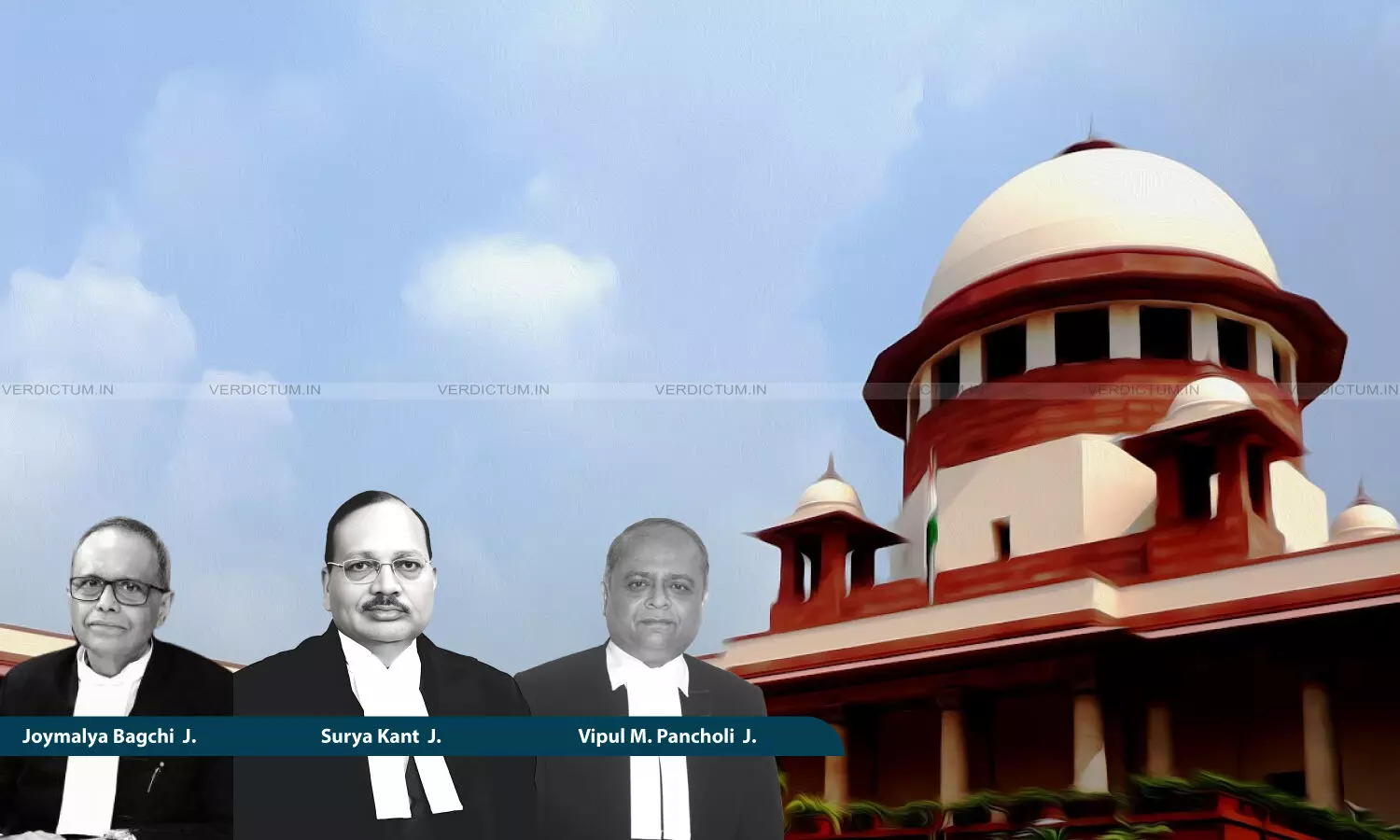
The Bench of Chief Justice Surya Kant, Justice Joymalya Bagchi and Justice Vipul M Pancholi ordered, "The petitioner has raised substantial questions of law. However, we are not intervening at this stage. The question of law is kept open."
Senior Advocate Kalyan Banerjee appeared for the Petitioner.
During the proceedings, Senior Advocate Kalyan Banerjee, appearing for the petitioner, argued that the ECI’s actions were in direct contravention of the Representation of the People Act, 1951. He contended that the power of superintendence under Article 324 does not override legislative provisions, specifically pointing out that mandatory consultations with the State Government and the Governor were bypassed. Banerjee highlighted the unprecedented nature of the transfers, including that of the Chief Secretary, suggesting that the ECI was acting beyond its statutory mandate and ignoring the state's own assessment of officer competence.
Banerjee submitted, "The whole process was in contravention of the Act itself—the 1951 Act. My Lord, Your Lordships have several times laid down the law: the power of superintendence does not take away legislative power. The power of superintendence only operates in an unoccupied field...And here, My Lord, kindly look at the statutory provisions one after another. I will show Your Lordships. Kindly see the first page, page 85. Of course, this is the '95 Act, but I wish to show Your Lordships the language."
Chief Justice Kant said, "It is not something that has happened for the first time, nor has it happened only in one state. It happens everywhere."
Banerjee replied, "No, that is the reason, My Lord, the challenge is here: the Election Commission has to act in terms of statutory provisions. They cannot act in contravention of them. I do not know about other states, My Lord, but state consultation is required. I do know that previously, up to the 2024 by-elections, consultation with the state government occurred in West Bengal. But now, that consultation with the state government has not happened...The Assistant Electoral Registrar of the Election Commission may appoint one or more persons as Assistant Electoral Registrars to assist an Electoral Registrar. That is the only power given to the Election Commission."
CJI Kant said, "The High Court has examined everything threadbare."
Banerjee responded, "No, the High Court has not answered the legal questions at all. I am directed to refer to your emails dated the 19th on the subject above and to state that the Commission has agreed to your proposal—that is the CEO's proposal, My Lord, not the state government’s recommendation. Even if Your Lordships look at Article 324, Clause 6, a request has to be made to the Governor. That has also not been done. In every state—I don’t know—up until the 2025 by-elections, it was done."
CJI Kant remarked, "The officers who have been transferred or posted are all from the West Bengal cadre. It is not as if people have been brought in from the outside. They were all your serving officers."
Banerjee said, "The High Court has mixed up the issues. The point is, My Lord, I appear for the state. The High Court has mixed up the issues regarding my position...A mandatory provision of the statute has been violated. The question is not one of prejudice or lack thereof. What has happened? You have changed the SP. You have changed the DG. You have changed everyone. The state government, based on its own assessment, made those appointments. After the changes, what happened? The Kaliachak incident occurred. The question is about competent officers. There may be many officers, but they are not all equally competent. How did the Kaliachak incident happen? Why are there law and order problems in other places? Since Your Lordship raised the question, I am responding; otherwise, I would not have said this."
CJI Kant remarked, "It all depends on when you give them the opportunity to perform. Only then can one evaluate whether they are competent or incompetent officers. In order to ensure an element of fairness and objectivity in the performance of duty, this exercise was undertaken. Now the officers are in place, and your state is going to election in a couple of days."
CJI Kant also added, "Instead of deciding an academic point, it is something we can take up at the initial stage itself. We will decide it in an appropriate case. We will keep the question of law open because we understand this kind of situation may arise. But as of now, the point is that consultation is not concurrence."
Banerjee said, "Maybe. My Lord, consultation is not concurrence, but that doesn't mean consultation should not take place. Your Lordships have seen the Governor’s case regarding the university. Consultation may not be concurrence, but that doesn't mean its absence is permitted."
CJI Kant clarified, "In the context of the appointment of judges, "consultation" has been interpreted differently only so that it draws color from the basic principle of the independence of the judiciary. That is why consultation in appointments with the Chief Justice of the High Court or the Chief Justice of India has a different meaning. In the rest of the statutes, or wherever this word "consultation" appears, you know very well—who knows better than you?—the interpretation given by the court...We will keep the question of law open. You may be right; tomorrow a situation may arise where, for example, the Election Commission of India brings in a bloc of officers from the outside. Assume that happens. But here, not a single officer outside your state is being allowed to perform. There may be an extreme situation where the court's interference is necessary."
Banerjee stated, "1,100 officers have been transferred overnight—under what assessment? One thousand! My Lord, this is the first time in West Bengal. A Chief Secretary has been transferred, and Your Lordships have recorded it in the order. The day she appeared before Your Lordships' court, an order was recorded. There is a fight between the Election Commission and the state. And who was representing the state? The Chief Secretary. For the first time in India, a Chief Secretary was transferred the very day the notification was made because she was opposing the suggestions. Is that a fault? Is it a ground for transfer? Your Lordships constituted a committee stating the DG and Chief Secretary would represent the state..."
The Court also addressed a deeper systemic issue, lamenting what it described as a "misfortune of the country"—the growing trust deficit between constitutional institutions and state governments. The Bench observed that the surrender of officers to "plum postings" and personal benefits often frustrates the objective of independent civil services, leading to a public impression that fair treatment is unobtainable.
While the Court refused to intervene in the current election cycle, it explicitly kept the question of law open, allowing the scope of the ECI's "consultation" requirements to be debated in a more appropriate, less time-sensitive case.
CJI Kant remarked, "This is the misfortune of the country: the very object of creating all india services is being frustrated. Officers often seek "plum postings" and personal benefits; they surrender completely just to secure their positions or better transfers. This creates an unfortunate impression in the mind of the general public—that they will not receive fair treatment or a fair opportunity. This impression needs to be addressed...The worst example for your state—and by "your state" I mean why did it happen—is that we have to use our judicial officers even for that. That again shows a trust deficit. The trust deficit exists on both sides. They have no trust in the officers of the state government, and the state has no trust in the officers who might be brought from outside. Therefore, there is no trust."
Banerjee responded, "This is the first time in the history of India that this has been brought about by this Election Commission. One has to accept that. Until now, not a single Chief Election Commissioner has raised this question. The fact that he is raising it for the first time—does it not create a doubt?"
Accordingly, the Court refused to interfere in the matter.
The Calcutta High Court upheld the large-scale transfer of IAS and police officers by the Election Commission of India (ECI) during the election period, dismissing a Public Interest Litigation (PIL) on the ground that no demonstrable public injury was made out.
Observing that the Commission’s power under Article 324 of the Constitution of India was not in dispute, the Court declined to interfere, holding that such administrative measures cannot be subjected to judicial review in the PIL jurisdiction in the absence of tangible harm to the public.
Rejecting allegations of bias against West Bengal, the Court observed that similar or higher numbers of officers had been transferred across multiple States as part of a pan-India exercise. It therefore found no merit in the contention that the State had been subjected to any selective or discriminatory treatment.
Cause Title: Arka Nag v. Election Commission of India & Ors. [SLP(C) No.12775/2026]