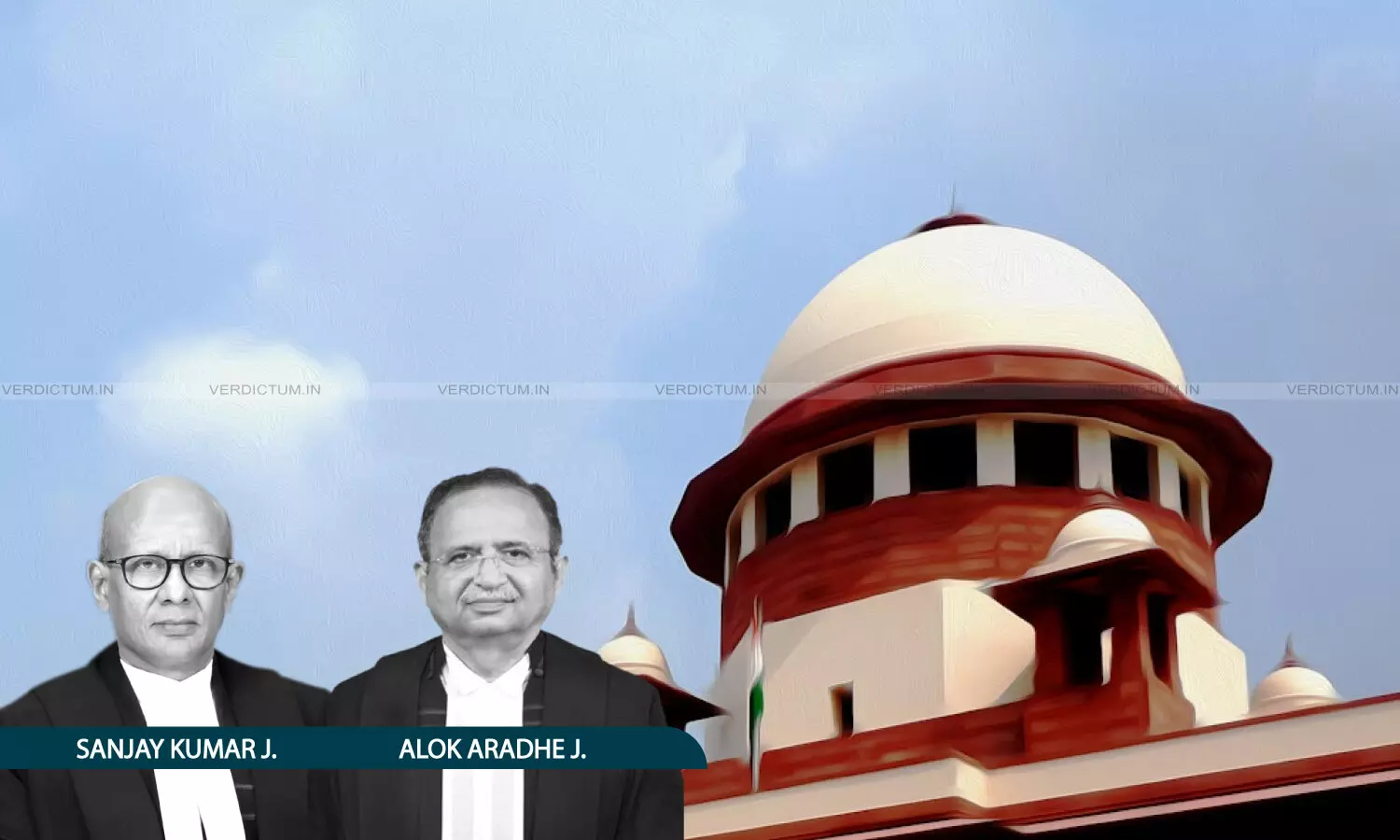
Justice Sanjay Kumar, Justice Alok Aradhe, Supreme Court
Triple Tests Govern When Multiple Offences Can Be Tried Jointly As “Same Transaction” Under CrPC/BNSS: Supreme Court Explains
 |
|The Supreme Court reiterated that the determination of whether multiple offences form part of the “same transaction” for a joint trial under the Code of Criminal Procedure must be guided by judicial tests such as unity of purpose, proximity of time and place, and continuity of action, which are not required to be cumulatively satisfied.
The Supreme Court has clarified the legal principles governing when multiple offences may be tried together as forming part of the “same transaction” under the Code of Criminal Procedure.
The Court held that the permissibility of a joint trial depends on the application of tests, which guide courts in determining whether distinct acts are sufficiently connected to be treated as one transaction for the purposes of framing charges and conducting a trial.
The Court was hearing an appeal arising out of a criminal reference answered by the Delhi High Court, which had held that each act of inducement and cheating constituted a separate transaction mandating registration of separate FIRs and filing of separate charge-sheets.
A Bench comprising Justice Sanjay Kumar and Justice Alok Aradhe, while setting aside the answers given by the High Court to two of the reference questions, observed that “precedential law has laid down triple tests, though not to be applied cumulatively, to decide when separate actions can be treated as part of the ‘same transaction’ – 1) unity of purpose and design; 2) proximity of time and place; and 3) continuity of action”.
Senior Advocate R. Basant assisted the Court as Amicus Curiae. The State (NCT of Delhi) was represented by Aishwarya Bhati, A.S.G.
Background
The proceedings arose out of an investigation conducted by the Economic Offences Wing, Delhi Police, into allegations of inducement and cheating of a large number of investors pursuant to an alleged criminal conspiracy. One FIR was registered initially, and complaints from other alleged victims were treated as statements and clubbed with the said FIR.
During the pendency of the proceedings, a reference was made by the Additional Sessions Judge to the Delhi High Court under Section 395(2) CrPC, raising questions on whether each act of deposit constituted a separate transaction requiring a distinct FIR and charge-sheet, and whether such transactions could be amalgamated for trial.
The High Court answered the reference by holding that each deposit constituted a separate transaction, mandating registration of separate FIRs and filing of separate charge-sheets.
Aggrieved, the State approached the Supreme Court.
Court’s Observation
The Supreme Court noted, at the outset, that the reference made by the Additional Sessions Judge was premature, as the investigation was still ongoing and it was not possible at that stage to conclusively determine whether the alleged offences formed part of the same transaction.
Thereafter, the Court undertook an extensive survey of precedent on the concept of “same transaction” under criminal law. It noted that the expression is not statutorily defined and that its contours have been shaped through judicial interpretation.
Referring to a series of earlier decisions, the Court reiterated that precedential law has laid down three guiding tests to determine when separate acts can be treated as part of the same transaction: (i) unity of purpose and design, (ii) proximity of time and place, and (iii) continuity of action.
The Court, however, clarified that these tests are not required to be applied cumulatively, and that the presence of one or more of these elements may suffice, depending on the factual matrix.
While highlighting that “under Sections 220(1) CrPC and 223(a) and (d) CrPC, consolidated charges can be framed against several accused persons in relation to several offences”, the Bench observed that where an offence of criminal conspiracy is alleged, followed by multiple acts of cheating in furtherance thereof, it would be permissible in law to register a single FIR and treat subsequent complaints as statements under Section 161 CrPC, subject to the ultimate determination of whether the acts form part of the same transaction.
The Court further clarified that the inference to be drawn from the charge-sheets, as filed, is left to the Magistrate concerned to consider for the purpose of deciding whether the offences fall within the ambit of Section 220(1) CrPC and Section 223(a) and (d) CrPC, while further explaining that “if the offences formed part of the same transaction, the Magistrate would be entitled to charge and try them together, as enabled by the aforestated provisions, as it would be in the larger public interest to do so”.
In such an eventuality, the Court elaborated, complainants whose complaints are treated as statements would not be left remediless. Relying on the decision in Amish Devgan vs. Union of India and others (2021), the Court noted that such complainants would be entitled to file protest petitions in the event of a closure report being filed or if the Magistrate is inclined to discharge the accused, and that the Magistrate would be bound to consider such protest petitions on merits.
On the issue of sentencing, the Court observed that the provisions of Section 71 IPC, along with Sections 31 and 325 CrPC, would govern sentencing, depending on the facts established and findings recorded, and that sentencing would follow accordingly even in cases of joint trial.
On the facts of the matter, the Apex Court held that “as a conspiracy is alleged, leading to multiple acts of cheating against different individuals, the course adopted by the Delhi Police in registering one FIR and treating the complaints received from 1851 other complainants as statements under Section 161 CrPC, was the correct course of action to have been adopted at that stage”.
Conclusion
Accordingly, the Supreme Court set aside the answers given by the Delhi High Court to questions (a) and (b) in the criminal reference. The appeal was allowed to that extent, leaving it open to the Magistrate concerned to determine, at the appropriate stage, whether the alleged offences constitute part of the same transaction and to proceed in accordance with law.
Cause Title: State NCT of Delhi v. Khimji Bhai Jadeja (Neutral Citation: 2026 INSC 25)
Appearances
Amicus Curiae: Senior Advocate R Basant
Appellants: Aishwarya Bhati, A.S.G.; Mukesh Kumar Maroria, AOR; Advocates Rekha Pandey, Priyanka Das, Vishakha, Chitrangda Rashtravara, and Shreya Jain.