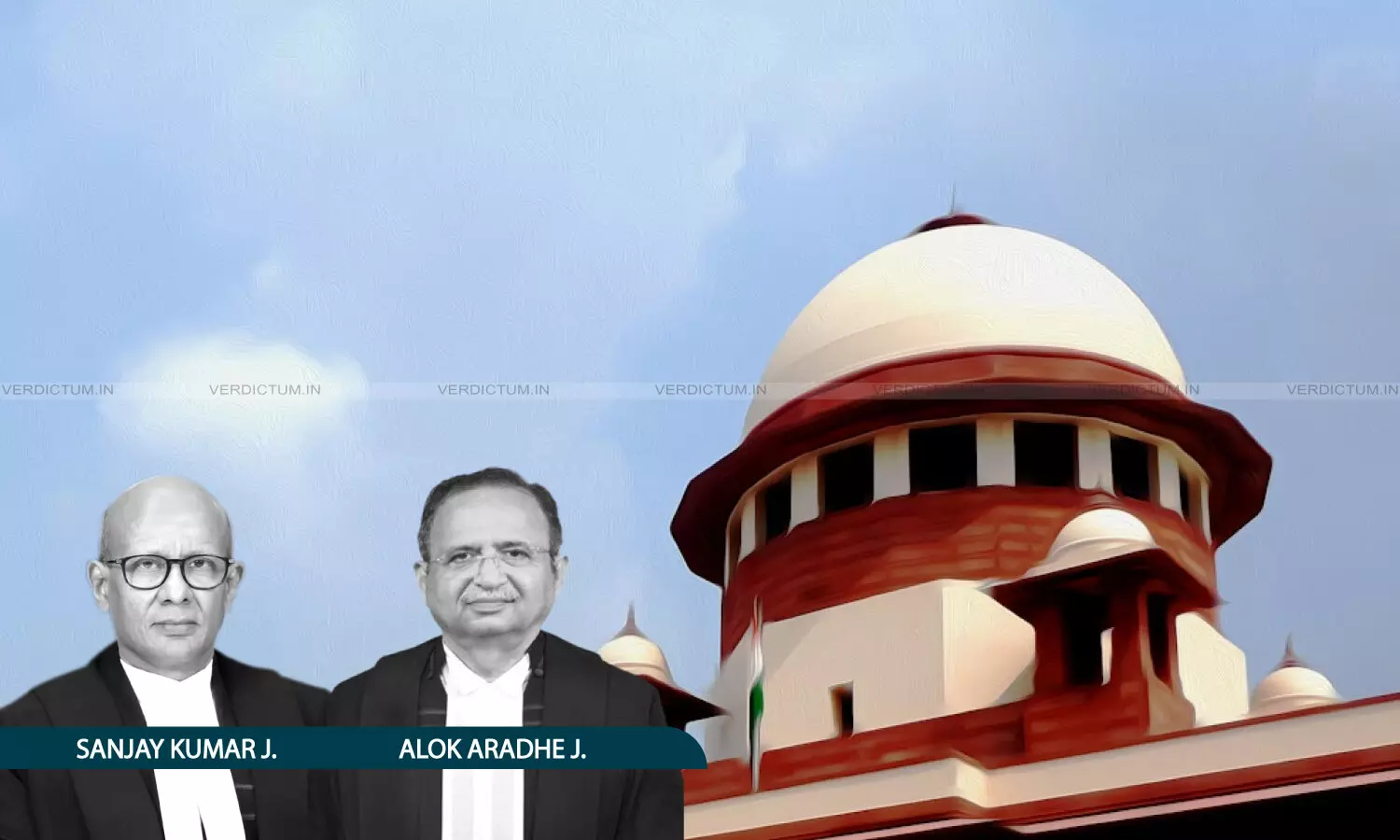
Justice Sanjay Kumar, Justice Alok Aradhe, Supreme Court
Condonation Of Delay Must Precede Act Of Taking Cognizance U/S.138 Of NI Act: Supreme Court
 |
|The Supreme Court was considering an appeal challenging the order of the Karnataka High Court passed in a Criminal Petition.
The Supreme Court has held that the Magistrate erred in taking cognisance of a complaint under Section 138 of the NI Act before the delay of two days in its presentation was condoned. The Apex Court held that the satisfaction in that regard, resulting in condonation of the delay, must precede the act of taking cognizance.
The Apex Court was considering an appeal challenging the order of the Karnataka High Court passed in a Criminal Petition.
Referring to the proviso to Section 142(1)(b) of the NI Act, the Division Bench of Justice Sanjay Kumar and Justice Alok Aradhe held, “It is manifest from the clear and unambiguous language of the above proviso that the power conferred upon the Court to take cognisance of a belated complaint is subject to the complainant first satisfying the Court that he had sufficient cause for not making the complaint within time. The satisfaction in that regard, resulting in condonation of the delay, must therefore precede the act of taking cognizance.”
Factual Background
It was alleged in the complaint that the appellant had approached the respondent and her husband seeking financial assistance to purchase a house and to meet legal necessities. They lent him a sum of ₹5,40,000. He, thereafter, issued a cheque drawn in her name for the said sum, assuring that it would be honoured upon presentation. However, the cheque was dishonoured for insufficiency of funds. She got issued a legal notice calling upon the appellant to pay the cheque amount within 15 days but the same was returned as ‘unclaimed’. However, the copy of the notice sent through courier was not returned unserved and the same amounted to deemed service. No payment was made by the appellant. She, thereupon, filed the complaint praying that the Court take cognisance of the offence punishable under Section 138 of the Negotiable Instruments Act, 1881.
The then Magistrate, after perusing the complaint and the documents, noted the presence of the complainant and took cognisance. However, the successor Magistrate noted that, though there was a delay of two days in the filing of the complaint, his predecessor-in-office had already taken cognisance of the offence. Opining that the delay of two days in the presentation of the complaint was purely bona fide, the Magistrate allowed the application, condoned the delay in the filing of the complaint, and directed the issuance of a non-bailable warrant against the appellant. The appellant approached the High Court by way of Criminal Petition seeking the quashing of the complaint but the same was rejected. Aggrieved thereby, the appellant approached the Apex Court.
Reasoning
The Bench referred to the proviso to Section 142(1)(b) of the NI Act, which states that cognisance of a complaint may be taken by the Court after the prescribed period, if the complainant satisfies the Court that he had sufficient cause for not making a complaint within such period.
The Bench explained that a proceeding instituted with limitation-linked delay before a Court of law does not actually figure as a regular matter on its file until that delay is condoned. “Therefore, the approach of the High Court in treating this crucial aspect as a mere interchangeable exercise, i.e., either to first condone the delay or to first take cognisance, is not in keeping with the mandate of the aforestated proviso. We may note that the respondent was herself responsible for this imbroglio as she had made a categorical statement in her complaint that it was filed within time, when it was not”, it stated.
The Bench thus held that the Magistrate erred in taking cognisance of the respondent’s complaint under Section 138 of the NI Act, even before the delay of two days in its presentation was condoned. “The order passed by the High Court refusing to quash the same is, thus, set aside”, it thus ordered.
Cause Title: S. Nagesh v. Shobha S. Aradhya (Neutral Citation: 2026 INSC 27)