Appeal Filed By Suspended Director In Name Of Corporate Debtor After Admission Of CIRP Contrary To IBC’s Mandate: Supreme Court
 |
|The appeal before the Supreme Court was filed by a suspended director of the corporate debtor under Section 62 of the Insolvency and Bankruptcy Code.
The Supreme Court has held that an appeal cannot be filed in the name of the corporate debtor by a suspended director claiming to be its authorised representative, once the corporate insolvency resolution process has been admitted and the interim resolution professional is named.
The appeal before the Apex Court was filed by a suspended director of Ambro Asia Private Limited (corporate debtor), Nitendra Kumar Tomer, under Section 62 of the Insolvency and Bankruptcy Code, 2016, aggrieved by the judgment of the National Company Law Appellate Tribunal.
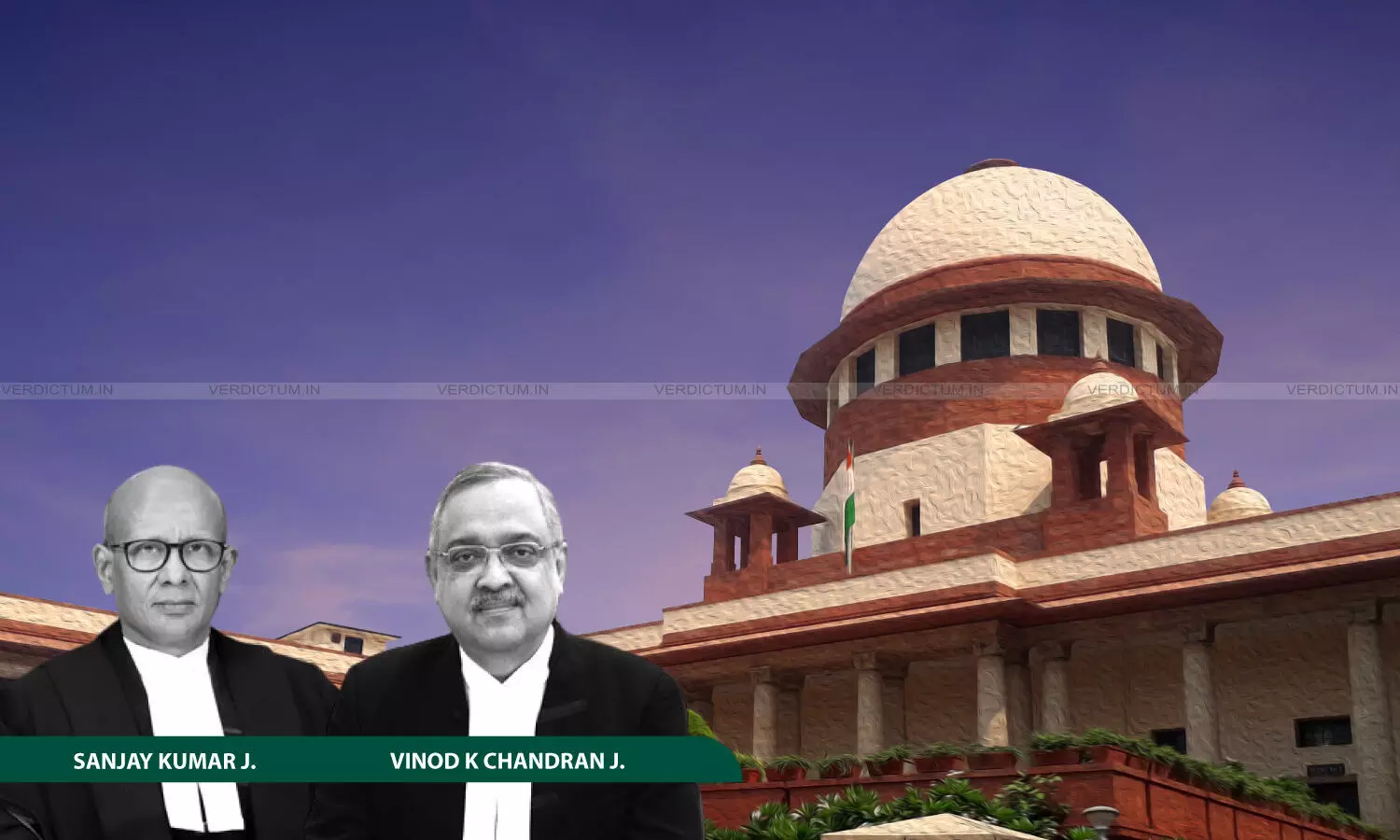
The Division Bench of Justice Sanjay Kumar and Justice K. Vinod Chandran held, “Presently, we find that the appeal, as framed and filed in the name of the corporate debtor by a suspended director claiming to be its authorized representative, was contrary to the mandate of the Code and was, therefore, not at all maintainable. Permitting it to be converted to an appeal by the suspended director at a later point of time, throwing the prescription of limitation to the winds, was a further violation of the Code. The question of rectifying or modifying a wholly incompetent appeal in violation of the mandate of the Code did not arise and the NCLAT, therefore, ought not to have extended indulgence in that regard.”
Senior Advocate Rakesh Kumar Khanna represented the Appellant, while Advocate Rahul Chitnis represented the Respondent.
Factual Background
By the impugned judgment, the NCLAT had confirmed the order of the National Company Law Tribunal, New Delhi Bench (NCLT), admitting an application filed under Section 9 of the Code by Unox S.P.A., an operational creditor (respondent). An appeal before the NCLAT had been filed in the name of the corporate debtor, Ambro Asia Private Limited, after admission of the Section 9 application by the NCLT. NCLAT deemed it appropriate to provide an opportunity to the appellant to amend the memo of appeal by filing an appropriate application and granted time. Thereafter, an application was filed seeking an amendment to the memo of appeal, and the NCLAT allowed the application, permitting the appeal to be prosecuted by Nitendra Kumar Tomer, the suspended director of the corporate debtor.
Reasoning
On a perusal of the facts of the case, the Bench was of the view that NCLAT grossly erred in permitting a wholly incompetent appeal to be converted in the manner it was done. The Bench noted that this incompetent appeal was filed as ailing the order of admission, and it was verified in the name of the corporate debtor, viz., Ambro Asia Private Limited, by Nitendra Kumar Tomer, claiming to be its director and authorised representative. However, the second respondent in the appeal was the Interim Resolution Professional, who was appointed by the NCLT, vide the admission order.
The Bench referred to Section 17(1)(a) of the Code, which provides that, from the date of appointment of the interim resolution professional, the management of the affairs of the corporate debtor shall vest in the interim resolution professional. “Once the interim resolution professional was named by the NCLT in the admission order, Section 17(1)(a) of the Code would become operative. Therefore, with effect from the date of admission in the case on hand, i.e., 18.04.2024, the management of the affairs of the corporate debtor, Ambro Asia Private Limited, stood vested in Piyush Moona, Interim Resolution Professional, and it was not open to the suspended director of the corporate debtor to file an appeal in the name of the corporate debtor, Ambro Asia Private Limited, claiming to be its director and authorized representative. The appeal as framed and filed on 24.04.2024 was, therefore, wholly incompetent. It was not merely a ‘defective’ appeal as it was not maintainable in its very inception”, it stated.
The Bench further explained that the normal period of limitation prescribed under Section 61(2) is 30 days, but the proviso thereto permits the NCLAT to condone the delay of up to 15 days, if sufficient cause is shown for not filing the appeal within the prescribed period of 30 days. As per the Bench, Nitendra Kumar Tomer, the suspended director of the corporate debtor, could have filed an appeal against the admission order only within the limitation period prescribed under Section 61(2) of the Code.
"The misconceived appeal filed by him in the name of the corporate debtor, Ambro Asia Private Limited, professing to be its director and authorized representative, was wholly incompetent and was not an appeal with a ‘curable’ defect, which could have been attended to at a later point of time. It was, therefore, not open to the said suspended director to seek modification of the cause title in this incompetent appeal”, it added.
Thus, holding that the appeal, as framed and filed, was not maintainable, being wholly incompetent, and it could not have been converted into a ‘maintainable appeal’ after expiry of the period of limitation under Section 61(2), the Bench dismissed the appeal.
Cause Title: Nitendra Kumar Tomer, Suspended Director v. Unox S.P.A. and another (Neutral Citation: 2026 INSC 356)
Appearance
Appellant: Senior Advocate Rakesh Kumar Khanna, Advocates Abhishek Swarup, Manoj Swarup, Aditya Pushkar Khanna, Arushi Jindal, Govind Kashyap, S.S. Nehra, Chetan Sharma, AOR M/s. Manoj Swarup And Co.
Respondent: Advocates Rahul Chitnis, Savinder Singh, Parth Awasthi, Barnali Mukherjee, Hersh Desai, AOR M/s. F.M. Associates