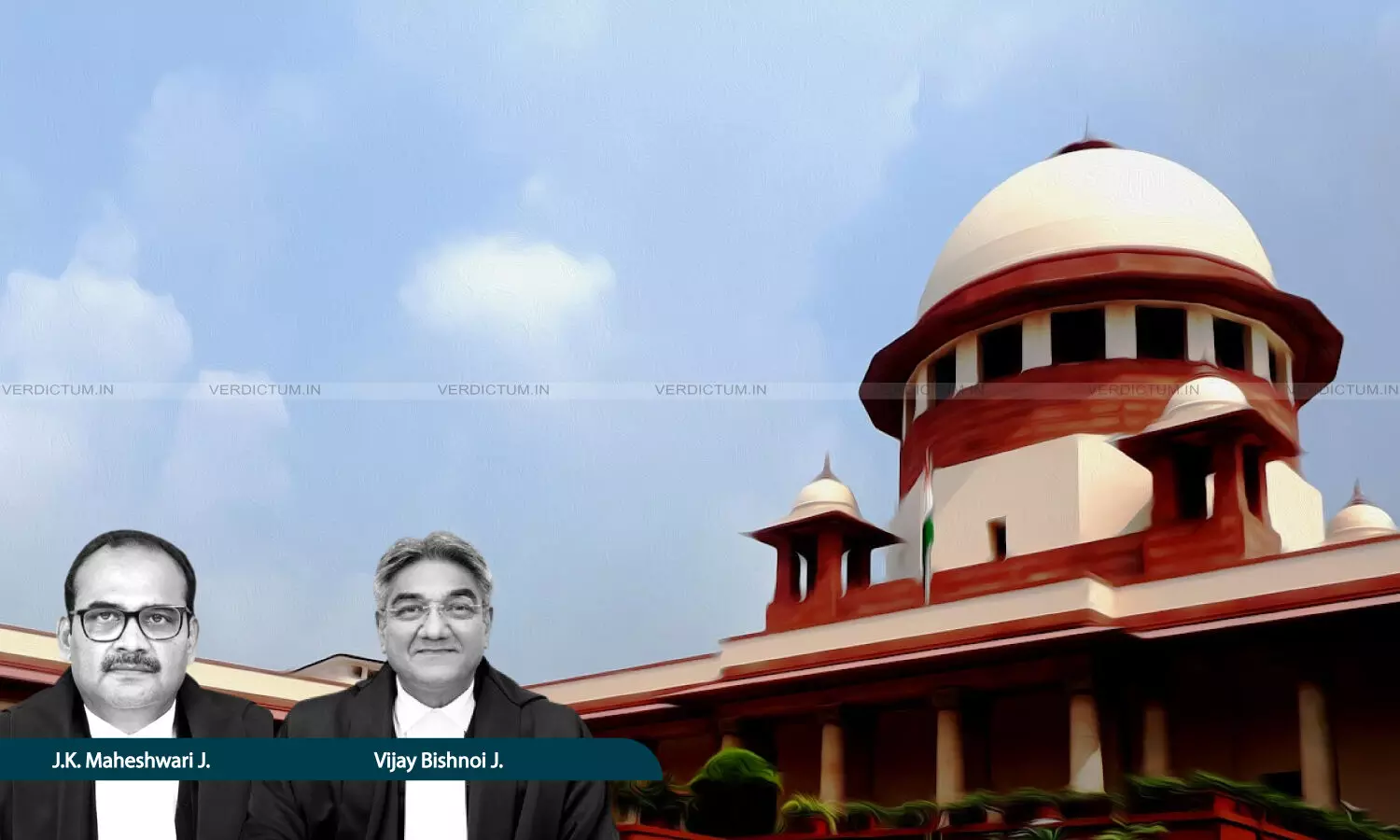
Justice J.K. Maheshwari, Justice Vijay Bishnoi, Supreme Court
“Corporation Lacked Jurisdiction Absent Board’s Decision”: Supreme Court Quashes Disciplinary Proceedings Against Retired Employee
 |
|The Apex Court held that in the absence of a conscious decision of the Board adopting the Maharashtra Civil Services (Pension) Rules, 1982, the Maharashtra State Warehousing Corporation lacked jurisdiction to institute or continue disciplinary proceedings against a retired employee or to order recovery from his retirement benefits.
The Supreme Court quashed disciplinary proceedings initiated by the Maharashtra State Warehousing Corporation against a retired employee, holding that the Corporation lacked jurisdiction to do so in the absence of any specific rule or a conscious decision of its Board adopting the Maharashtra Civil Services (Pension) Rules, 1982.
The Court was examining whether the corporation could have invoked post-retirement disciplinary powers by relying on a residuary provision in its Service Regulations, without demonstrating that the Pension Rules had been expressly adopted by its governing body.
A Bench comprising of Justice J.K. Maheshwari and Justice Vijay Bishnoi, upon examining the material placed on record observed that “the Corporation was unable to produce a conscious decision of the Board regarding adoption of Pension Rules and the circumstances explaining the situation to apply the same rules as applicable to the employees of the Government of Maharashtra to the employees of the Corporation in the matter of institution and continuance of the disciplinary proceedings post retirement”.
In light of this finding, the Apex Court further held that “the Corporation had no jurisdiction to institute the departmental proceedings against the appellant for the alleged misconduct and to direct recovery against him applying 1982 Pension Rules”.
Background
The appellant had served the Maharashtra State Warehousing Corporation for several years and retired upon attaining the age of superannuation. Nearly eleven months after his retirement, the Corporation issued a show-cause notice alleging misconduct during his service period and subsequently initiated departmental proceedings.
Following the enquiry, orders were passed directing the recovery of alleged financial loss from the appellant and withholding certain retirement dues. Aggrieved, the appellant approached the Bombay High Court, contending that the Corporation had no authority to initiate disciplinary proceedings after his retirement.
The High Court declined to adjudicate the issue on merits and disposed of the writ petition by granting liberty to the appellant to avail the appellate remedy under the Corporation’s Service Regulations, leading to the appeal before the Supreme Court.
Court’s Observation
The Supreme Court identified the central issue as whether, in the absence of a specific provision in the Maharashtra State Warehousing Corporation (Staff) Service Regulations, 1992, the Corporation could initiate and continue disciplinary proceedings against a retired employee by invoking Rule 27 of the Maharashtra Civil Services (Pension) Rules, 1982.
The Court examined Rule 110 of the 1992 Regulations, which provides that matters not specifically covered may, as far as possible, be regulated in the same manner as applicable to Government of Maharashtra employees. The Bench held that this residuary clause does not amount to an automatic adoption of the Pension Rules.
The Court analysed Rule 27 of the 1982 Pension Rules and observed that the rule “cannot be made applicable ipso facto until the Board of Directors has taken a conscious decision specifying the circumstances and making similar benevolent provision as made in 1982 Pension Rules; or having sanction of the Government as required under Rule 27(2) (b)(i) for instituting or continuing the proceedings in the contingency as specified applying the Regulations”.
Crucially, the Court noted that despite being directed to do so, the Corporation was unable to place on record any resolution, circular, or conscious decision of the Board adopting the Pension Rules or authorising their application to Corporation employees in the context of post-retirement disciplinary proceedings.
Rejecting the Corporation’s contention that long-standing practice or approval of the Service Regulations by the State Government implied adoption of the Pension Rules, the Bench held that such approval cannot substitute a specific Board decision, particularly where civil consequences follow.
Relying on settled precedents, including Bhagirathi Jena v. Board of Directors, OSFC and Girijan Cooperative Corporation Ltd. v. K. Satyanarayana Rao, the Court reiterated that in the absence of an enabling provision, disciplinary proceedings lapse upon retirement and no recovery can be effected from retirement benefits.
In light of the additional affidavit filed by the Corporation, which admitted the absence of any Board decision adopting the Pension Rules, the Court concluded that the Corporation had acted wholly without jurisdiction.
Conclusion
The Supreme Court held that the Maharashtra State Warehousing Corporation lacked authority to institute or continue disciplinary proceedings against the appellant after his retirement, as there was neither a statutory provision nor a conscious decision of the Board adopting the Maharashtra Civil Services (Pension) Rules, 1982.
Accordingly, the Court allowed the appeal, set aside the judgment of the High Court, and quashed the disciplinary proceedings initiated against the appellant. The Corporation was directed to release all retirement benefits due to the appellant within eight weeks and to refund any recovery already made. Pending applications were disposed of.
Cause Title: Kadirkhan Ahmedkhan Pathan v. Maharashtra State Warehousing Corporation & Ors.
Appearances
Appellant: Advocates Anjani Kumar Jha, AOR, Varun V. Solshe, Vivek C. Solshe
Respondent: Advocate Yash Prashant Sonavane, Ravindra Keshavrao Adsure, AOR