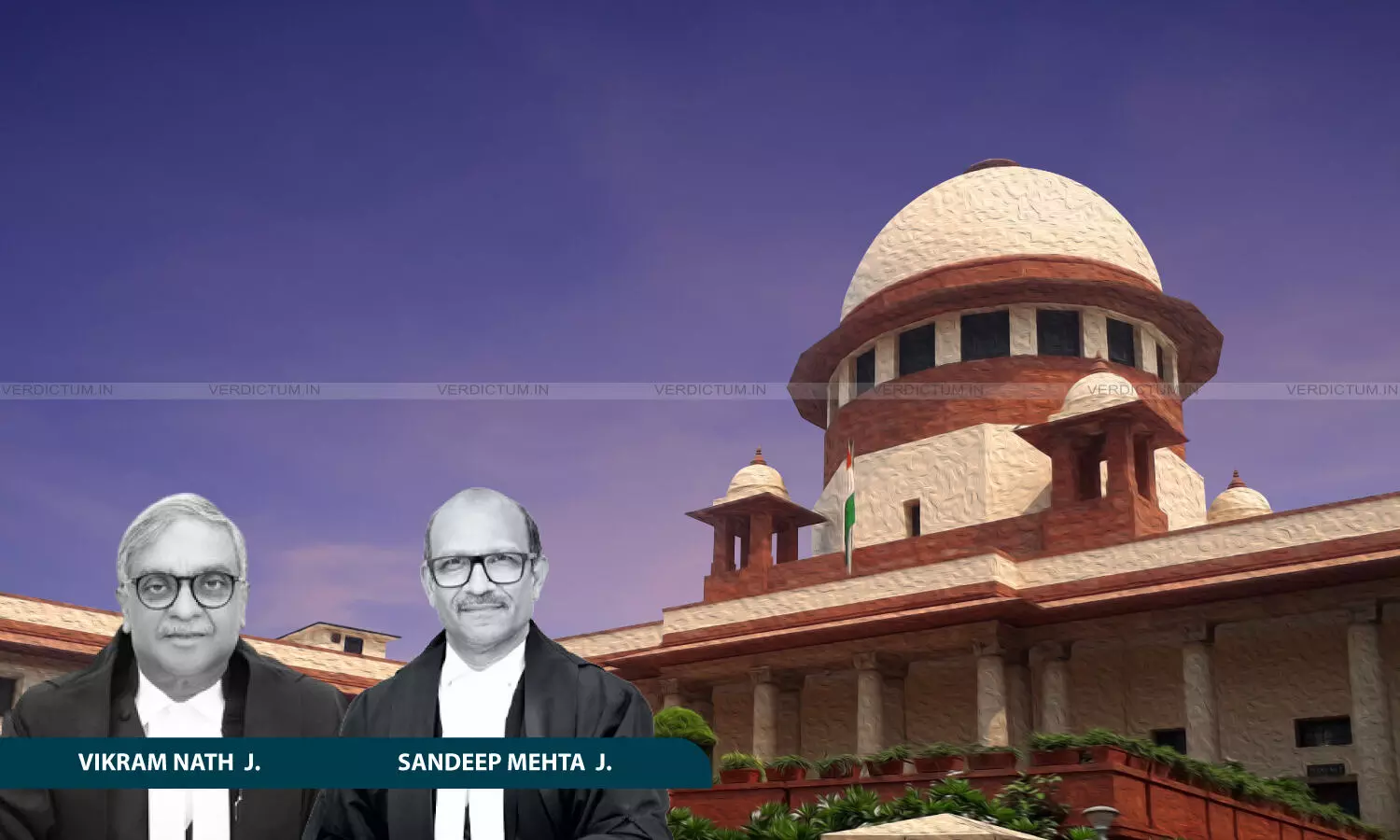
Justice Vikram Nath, Justice Sandeep Mehta, Supreme Court
Supreme Court Slams "Contractual" Tag Misuse, Orders Regularisation of Jharkhand Engineers After 10+ Years of Service
 |
|State is a lion and an employee is a lamb; Part-time employees not peripheral staff
The Supreme Court in a significant judgment on contractual public employment, has directed the Jharkhand government to regularise the services of Junior Engineers who were kept on “contractual” terms for over a decade despite working against sanctioned posts.
The Court compared the State to a lion and the employee to a lamb, highlighting the stark imbalance of power in their contractual relationship. Further said that part-time employees like the appellants are essential to the functioning of the State, not peripheral staff. The Constitution’s equality mandate therefore requires that decisions affecting their service and livelihood be fair, reasonable, and free from arbitrariness.
Accordingly, Justice Vikram Nath and Justice Sandeep Mehta observed, “…we are unable to persuade ourselves to accept the respondent-State’s contention that the mere contractual nomenclature of the appellants’ engagement denudes them of constitutional protection. The State, having availed of the appellants’ services on sanctioned posts for over a decade pursuant to a due process of selection and having consistently acknowledged their satisfactory performance, cannot, in the absence of cogent reasons or a speaking decision, abruptly discontinue such engagement by taking refuge behind formal contractual clauses. Such action is manifestly arbitrary, inconsistent with the obligation of the State to act as a model employer, and fails to withstand scrutiny under Article 14 of the Constitution”.
The State, in such a relationship, assumes the role of a metaphorical lion, endowed with overwhelming authority, resources and bargaining strength, whereas the employee, who is yet an aspirant, is reduced to the position of a metaphorical lamb, possessing little real negotiating power…where a lion contracts with a lamb, the inequality is not incidental but structural, and it is precisely this disproportion that calls for judicial sensitivity. In such situations, the conscience of Constitutional Courts must inevitably tilt in favour of protecting the lamb”, Justice Vikram Nath further said in the judgment.
The bench also warned against the growing culture of “ad-hocism,” the principle enunciated in n State of Karnataka v. Uma Devi (2006) 4 SCC 1, as in Uma Devi, Court itself drew a distinction between appointments that are “illegal” and those that are merely “irregular”, the latter being amenable to regularization upon fulfilment of the prescribed conditions.
Senior Advocates Saurabh Mishra and K. Parameshwar appeared for the petitioners, and Advocates Ruchira Gupta, Nilesh Kumar appeared for the respondents.
In the matter, the engineers were appointed in the year 2012 through a selection process against sanctioned posts in the Soil Conservation Department. Though their engagement was labelled “contractual,” it was renewed year after year. When the State indicated in the year 2023 that no further extension would be granted, the employees approached the court seeking regularisation.
The appellants then filed separate writ petitions before the Jharkhand High Court challenging the State’s action in discontinuing their long-standing contractual engagement.
All the writ petitions were heard together and dismissed by a single-judge bench through a common judgment, holding that the appellants were purely contractual employees and had no enforceable right to continuation.
Thereby being aggrieved, the appellants preferred intra-court appeals in the nature of Letters Patent Appeals before the division bench of the High Court. The Division Bench then, by separate judgments in the respective LPAs, affirmed the findings of the single-judge bench and dismissed the appeals, reiterating that the terms of contract governed the employment and that no legal right to regularisation arose.
The appellants thereafter approached the Supreme Court by filing Special Leave Petitions under Article 136 of the Constitution of India. Leave was granted and the matters were converted into Civil Appeals.
The Court considering the averments and the factual matrix emphasised that the State, as a model employer, cannot rely on unequal bargaining power to impose unfair conditions. It invoked the principle that fundamental rights cannot be waived and said contractual clauses cannot shield arbitrary State action from constitutional scrutiny. It also noted that long and continuous service created a legitimate expectation of recognition.
Thus, allowing the appeals, the Court ordered the State to forthwith regularise all the appellants against the posts they were initially appointed to, along with consequential service benefits from the date of judgment.
Cause Title: Bhola Nath v. The State Of Jharkhand & Ors. [Neutral Citation: 2026 INSC 99]
Appearance:
Appellants: Kumar Shivam, AOR, Saurabh Mishra, K. Parameshwar Senior Advocates, Pradeep Kumar Tripathi, Nishant Kumar, AOR Gaurav Prakash Pathak, Ashish Kumar, Advocates.
Respondents: Jayant Mohan, Shantanu Sagar, AOR, Ruchira Gupta, Nilesh Kumar, Adya Shree Dutta, Pooja Tripathi, Mohtisham Ali, Dorjee Ongmu Lachungpa, Areen Gulati, Aniruddha Saha, Adv.,Mangaljit Mukherji, Karma Dorjee, Anil Kumar, Gunjesh Ranjan, Prakash Kumarmangalam, Manoneet Dwivedi, Abhishek Kumar Gupta, Advocates.
Click here to read/download the Judgment