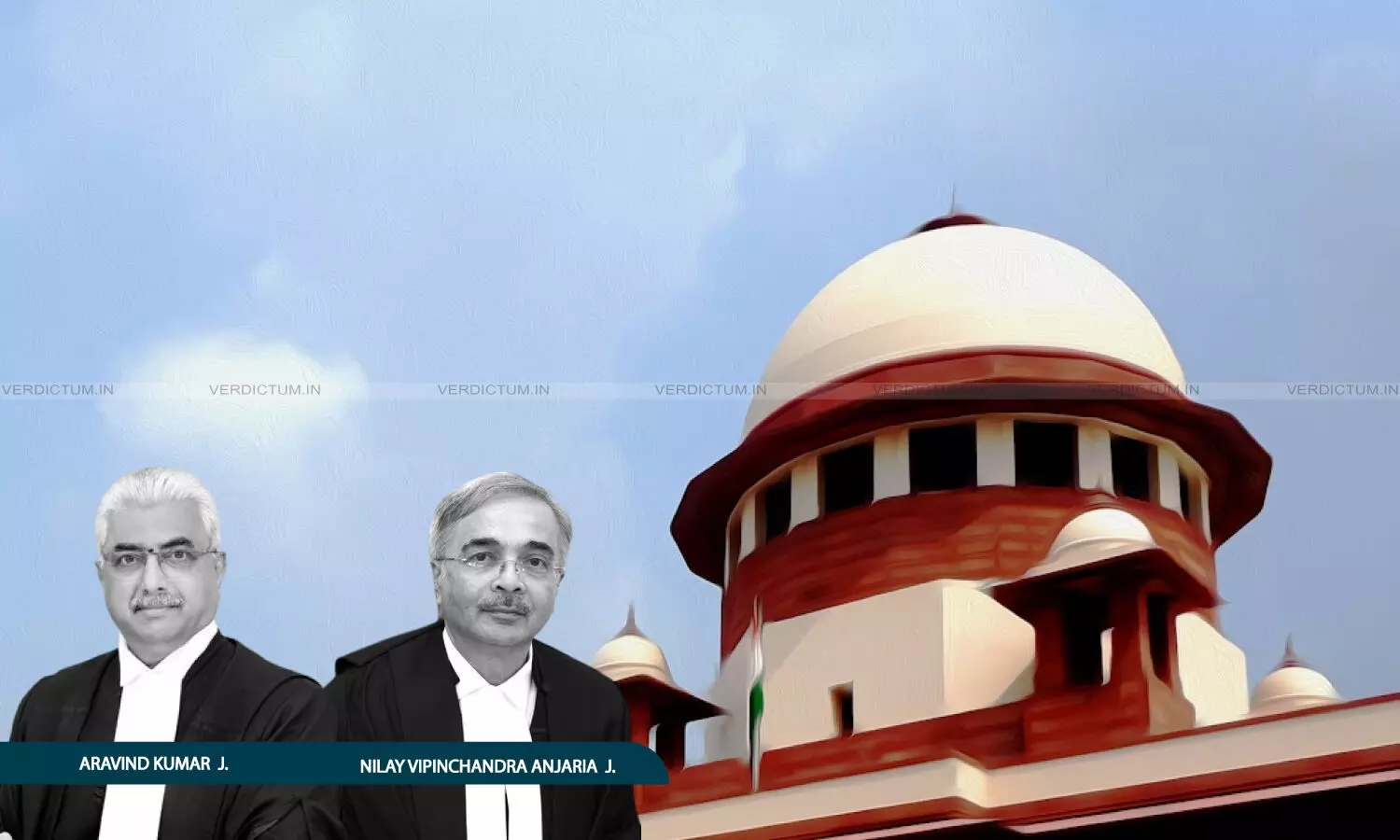
Justice Aravind Kumar, Justice N.V. Anjaria, Supreme Court
Supreme Court Grants Relief To Adani Power, Holds Customs Duty Cannot Be Levied On Electricity Supplied From Special Economic Zone
 |
|The Apex Court held that customs duty could not be levied on electrical energy generated by Adani Power Limited within a Special Economic Zone and supplied to the Domestic Tariff Area, affirming that the absence of a statutory charging event cannot be cured through exemption notifications or altered rates.
The Supreme Court has allowed an appeal filed by Adani Power Limited, holding that the levy of customs duty on electrical energy generated within a Special Economic Zone and supplied to the Domestic Tariff Area is without authority of law and contrary to the statutory scheme governing customs duties and Special Economic Zones.
The Court was hearing an appeal against a judgment of the Gujarat High Court which had declined to extend the benefit of an earlier declaration striking down such levy, on the ground that subsequent notifications imposing per-unit duties had not been specifically challenged.
A Bench comprising Justice Aravind Kumar and Justice N.V. Anjaria examined the scope of the earlier declaration of law, and held: “The Gujarat High Court’s judgment dated 15 July 2015, as a matter of law, declared that customs duty could not be levied on electrical energy cleared from the appellant’s SEZ unit to the DTA, having regard to the absence of a lawful charging event under Section 12 of the Customs Act, the limited scope of Section 25 of that Act, the parity requirement of Section 30 of the SEZ Act and the constitutional constraints of Articles 14 and 265 is squarely applicable to the judgment and order dated 28.06.2019”.
Senior Advocate P. Chidambaram represented the appellant, while Raghvendra P. Shankar, A.S.G., represented the respondents.
Background
Adani Power Limited operates a thermal power project within a notified Special Economic Zone and supplies electricity to the Domestic Tariff Area. Although goods cleared from an SEZ to the DTA are treated as imports for limited purposes, imported electrical energy is attracted to a nil rate of customs duty. Despite this, the Union Government issued notifications from 2010 onwards seeking to levy customs duty on electricity supplied from SEZs to the DTA.
These notifications were challenged before the Gujarat High Court, which held that electricity generated within India and supplied domestically could not be treated as imported goods and that no charging provision under the Customs Act authorised such a levy. The High Court struck down the duty as being without legal authority, and the Supreme Court subsequently affirmed this declaration.
Notwithstanding the above, customs authorities continued to levy and collect duty for later periods under subsequent notifications prescribing revised rates. When Adani Power sought enforcement of the earlier declaration and refund of amounts collected, a coordinate Bench of the Gujarat High Court declined relief on the ground that the later notifications had not been separately challenged, leading to the present appeal before the Supreme Court.
Court’s Observation
The Supreme Court, upon examining the material placed in the record, held that the 2015 judgment of the Gujarat High Court “was a declaration of law founded on constitutional and statutory interpretation, determining that on the then-existing legal framework no customs duty could be levied on electrical energy transmitted from an SEZ to the DTA”, while stressing that “once such a declaration of law was rendered and affirmed by this Court, it acquired binding normative force and governed all transactions resting on the same legal footing”.
The Court underscored that the High Court had conclusively held that there was no taxable event under Section 12 of the Customs Act, as electricity generated within India and supplied domestically could not be treated as “imported goods”, holding that “electrical energy generated within India and wheeled into the DTA is not, in truth, a case of import into India”.
The Court emphasised that “even after the decision rendered in 2015, there has been no change either in the law or in the relevant facts which could justify taking a view different from the one already taken”. Observing that Section 30 of the SEZ Act remained unchanged, imported electricity continued to attract a nil rate of duty, and the parity principle embedded in the SEZ framework remained intact, the Court held that merely altering the rate of duty or framing the levy prospectively “did not cure the fundamental absence of authority to tax”.
Rejecting the Union’s contention that the later notifications were not specifically impugned by the appellant, and therefore, absent a direct attack on their validity, no relief could be granted in respect of amounts paid thereunder, the Court held that “where a court of competent jurisdiction has struck down the foundation of a levy as ultra vires, that declaration renders all successive and derivative attempts to enforce the same levy equally unenforceable, unless the statutory or factual basis has materially changed”.
The Court emphasised that constitutional adjudication does not proceed on “technical formalism”, and a citizen cannot be compelled to repeatedly challenge successive instruments that merely replicate an illegality already struck down. The 2016 writ petition, the Apex Court clarified, was a sequel seeking enforcement of an existing declaration of law, not a fresh challenge.
The Apex Court further held that the Division Bench of the Gujarat High Court in 2019 acted contrary to the discipline of judicial precedent by narrowing the effect of the earlier judgment of a coordinate bench without referring the issue to a larger Bench, while stressing that “to stand by what is decided and not to disturb what is settled, is a working rule which secures stability, predictability and respect for judicial outcomes”.
Characterising the impugned notifications as a “colourable exercise of delegated power”, the Court held that “what cannot be done directly by Parliament cannot be achieved indirectly through subordinate legislation”. Altering the form or rate of the levy, the Court held, did not legitimise an otherwise unauthorised tax, while concluding that “in substance and in law, the position after 2015 remained identical to what it was before; the same illegality persisted, and the same conclusion necessarily follows”.
Conclusion
The Supreme Court concluded that the customs duty levied on electrical energy supplied by Adani Power Limited from its SEZ unit to the Domestic Tariff Area lacked authority of law. It held that the earlier declaration striking down such a levy was binding and applicable to subsequent periods in the absence of any change in the statutory framework.
The Court, accordingly, set aside the impugned judgment of the Gujarat High Court and allowed the appeal. It directed the Union of India and the concerned customs authorities to refund the amounts collected towards customs duty for the relevant period, after due verification, within a stipulated time frame, without interest.
The Court further directed that no further demands be enforced for the period covered by the appeal and clarified that its findings were confined to the existing statutory framework, leaving it open to Parliament to enact any future legislative regime. All pending applications were disposed of, with no order as to costs.
Cause Title: Adani Power Limited & Anr. v. Union of India & Ors. (Neutral Citation: 2026 INSC 1)
Appearances
Appellant: Senior Advocate P. Chidambaram, with Advocates Mahesh Agarwal, Anshuman Srivastava, Rohan Talwar, Naman Agarwal, E. C. Agrawala, AOR
Respondents: Raghvendra P. Shankar, A.S.G., with Gurmeet Singh Makker, AOR and Advocates Sharath Nambaiar, Diwakar Sharma, Satvika Thakur, B. Sunita Rao, Ishaan Sharma