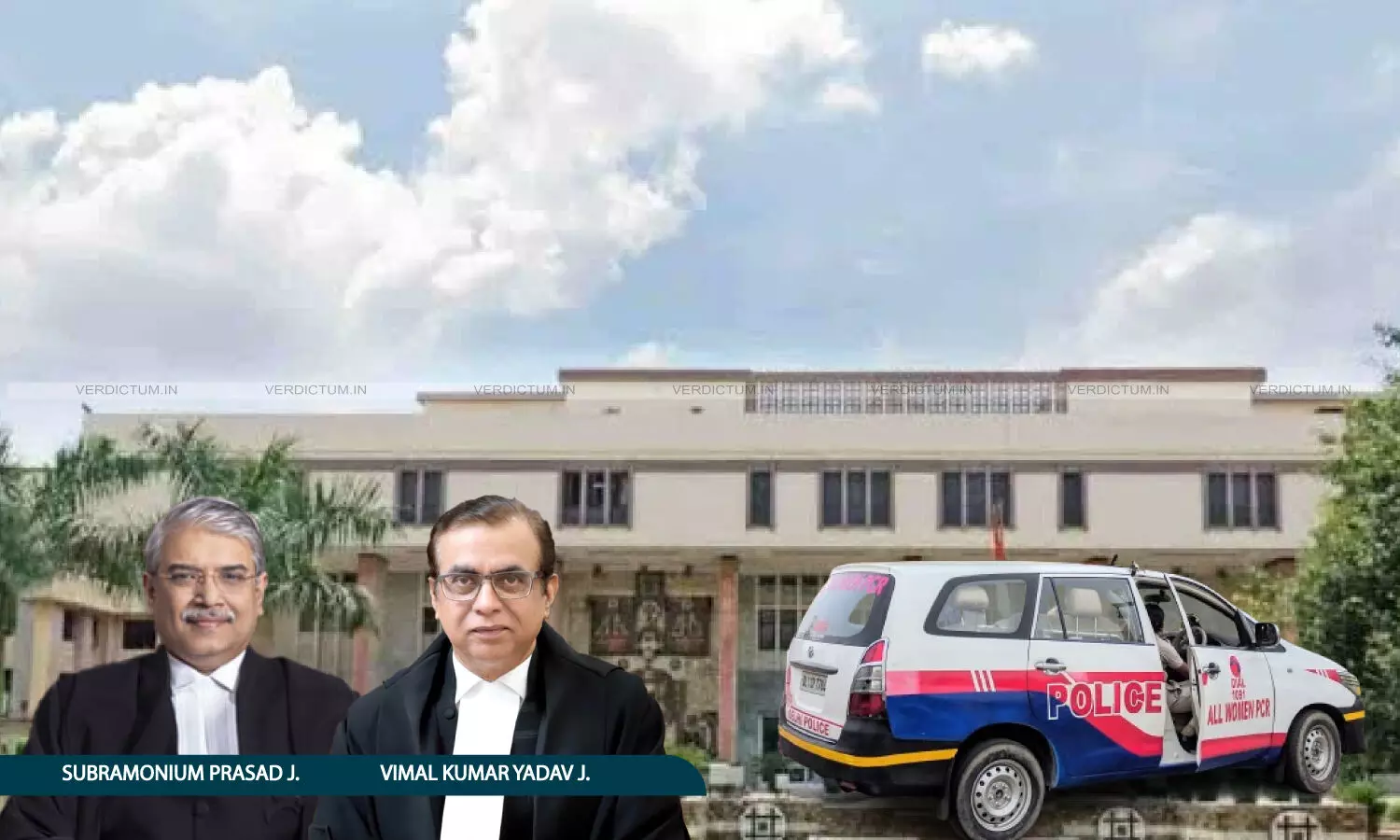
Police Control Room Central Hub Of Emergency Services Not Crime Investigation & Prevention: Delhi High Court Upholds Murder Conviction
 |
|Explaining omission through ‘tunnel vision’ theory, division bench explains how cognitive bias and memory processing led to omission in PCR message but did not dilute dying declaration naming the assailants
The Delhi High Court while blending criminal law with cognitive psychology, has upheld the conviction of two men in a 1998 murder case, holding that the Police Control Room (PCR) functions as the central hub for emergency response, dispatch, coordination, record-keeping, and operational communication, and is not tasked with investigating crimes or determining the identity of offenders, a distinction crucial to understanding the PCR officer’s omission.
In the appeal, the core issue was a wireless message sent by a PCR official stating that it was “not known” who had stabbed the victim. The defence argued that this contradicted the prosecution’s claim that the deceased victim had made a dying declaration naming the appellants while being taken to the hospital.
The Court observed that the officer may have entered a “tunnel vision mode”, focusing only on aspects relevant to his immediate duty. Citing psychological research on cognitive bias and the “Einstellung effect”, the Bench held that the omission in the wireless message could be explained by selective attention and short-term memory processing and not fabrication. The Bench concluded that the omission was a product of cognitive filtering rather than falsehood. “There is no dichotomy in his testimony,” the Court held, describing the defence argument as a mere “factoid”.
Justice Subramonium Prasad and Justice Vimal Kumar Yadav while dismissing the appeals by the two accused under Sections 302 and 120-B IPC observed, “It is a matter of common knowledge that the police control room is the central hub for police operations responsible for: (i) emergency response-acting as the public’s first point of contact for emergencies, handling calls and dispatching resources, (ii) maintaining records of operational acts such as dispatches, which are crucial for legal proceedings, (iii) connecting all police stations and ensuring proper execution of law and order, (iv) taking decisions during critical situations and directing officers on the spot, and (v) keeping track of police forces and ensuring timely communication of important events” .
“…Why the victim names the Appellants as his assailants, in case they have not perpetuated the crime? Not even an iota of fact has come over the record to decipher that the victim was made to spell the names of the Appellants as his assailants. The Appellants could not project any cue that there were reasons with Ms. Beena (PW-1) to induce Amar to make such a declaration. All these aspects indicate that the dying declaration, made by Amar, was voluntary and true”.
Advocate Bharat Dubey appeared for the appellant and Aashneet Singh, APP appeared for the respondent.
In the matter, it was contended that if the deceased had indeed named his assailants, the PCR official would have immediately recorded it in the wireless communication. The omission, they argued, demolished the prosecution’s case and exposed the alleged dying declaration as a later fabrication.
The Bench, however, disagreed and in an unusually detailed discussion on cognitive processes, the Court examined how perception, memory, and recall operate under stress. It noted that the PCR official was primarily concerned with emergency response, transporting the victim and reporting operational details, rather than investigating the identity of the assailants.
“Since HC Surender Singh (PW-30) was concerned with handling the situation, as ancillary to police function, his past experience might have led him to confirmation bias, as he had been recording the wireless message relating to transportation of the victim to the hospitals or police stations. With this tunnel vision, his brain functioned only to the aspect of recollection of certain events, necessary for performance of his duties. Duty of ascertaining identity of a criminal was not be performed by him, hence this was what to him into the narrow perspective of recording facts in that regard”, the bench noted.
Importantly, the Court found that:
-The victim was “drowsy but arousable” at the hospital, contradicting claims that he was fully unconscious.
-Multiple witnesses, including PW-1 consistently testified that victim named the two accused as his attackers.
-The PCR official’s testimony about hearing the dying declaration remained unshaken in cross-examination.
-The defence failed to confront the witness with the wireless message under Section 145 of the Evidence Act to formally prove contradiction.
The Court also rejected arguments questioning Beena’s (PW-1) conduct and the alleged delay in lodging the FIR. It held that her actions were consistent with ordinary human behaviour in a crisis. The FIR was found to have been registered promptly after Amar was declared dead at 12:30 a.m.
Therefore, holding the dying declaration credible and voluntary, the Bench affirmed the life sentences imposed by the Trial Court.
Cause Title: Mohan @ Akkar v. State [Neutral Citation: 2026:DHC:998-DB]
Appearances:
Appellant: Bharat Dubey, Shubhlaxmi Dubey, Sonia Dubey, Taniya Kapoor and Ayesha Sharif, Advocates.
Respondent: Aashneet Singh, APP, Inspector Yogesh Singh, PS Mandir Marg.