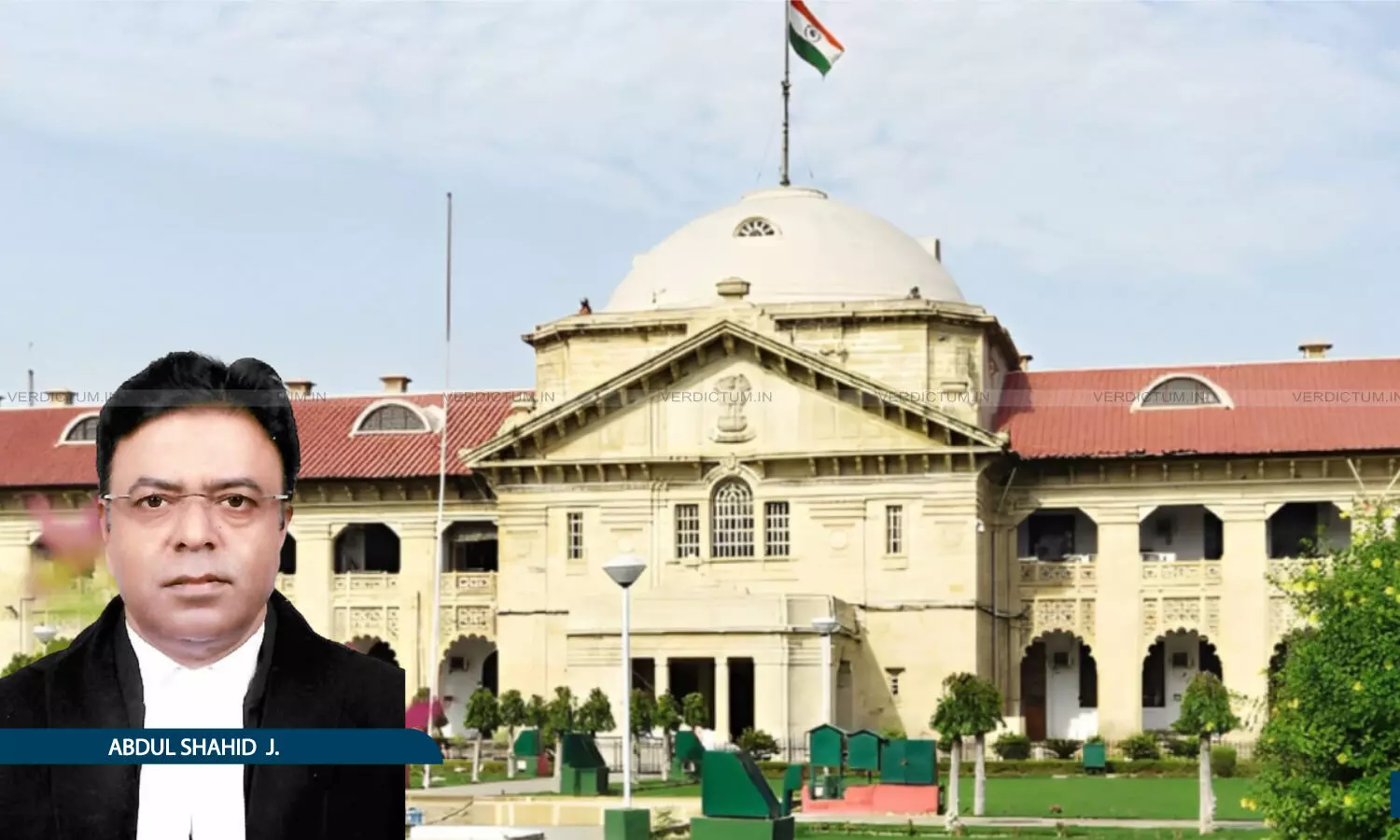
Injured Wife Is A Sterling Witness, Her Identification Of Husband As Assailant Cannot Be Doubted: Allahabad High Court
 |
|The Court held that the testimony of an injured wife, being a sterling witness, is highly reliable, and her identification of her husband as the assailant cannot be doubted, particularly when supported by surrounding circumstances.
The Allahabad High Court, while upholding the conviction in a case of attempted murder, has held that the testimony of an injured witness, particularly a wife identifying her husband as the assailant, carries great evidentiary value and cannot be doubted merely on technical grounds, especially when supported by surrounding circumstances and medical evidence.
The Court was hearing a criminal appeal challenging the judgment of conviction and sentence passed by the Additional District and Sessions Judge, Mainpuri, under Section 307 IPC.
A Single Judge Bench of Justice Abdul Shahid observed: “...the aforesaid witness is a sterling witness who has got injuries, ... the identification of her could not be doubted because the assailant is her real husband, who has also maltreated her" and accordingly held that in light of such facts and circumstances and evidence, the prosecution proved its case beyond a reasonable doubt.
Akhilesh Singh, Senior Advocate, appeared for the appellant, while the AGA appeared for the State.
Background
The case arose from an incident in which the appellant initially lodged an FIR alleging that unknown miscreants had entered his house at night and fired upon his wife, Vimla Devi, causing firearm injuries.
During the investigation, however, the injured victim stated that it was her husband—the appellant—who had fired upon her due to dowry-related disputes and strained matrimonial relations. Based on her statement, the Investigating Officer converted the case from Section 459 IPC to Section 307 IPC and filed a charge sheet against the appellant.
The defence contended that the prosecution's case rested solely on the testimony of the injured wife, with no independent witnesses supporting the case. It was further argued that there were inconsistencies between ocular and medical evidence, that the firearm was not recovered, and that the nature of the injuries did not attract Section 307 IPC. Reliance was placed on Sivamani v. State (2023) to seek modification of the conviction.
The State, on the other hand, argued that the injured witness was a “sterling witness,” whose testimony was reliable and sufficient to sustain a conviction. It was submitted that identification could not be doubted since the assailant was the husband himself, and that quality of evidence, not quantity, is determinative.
Court’s Observation
The Court undertook a comprehensive evaluation of the evidence on record, including ocular testimony, medical evidence, and surrounding circumstances.
At the outset, the Court reiterated the settled principle that the prosecution must prove its case “beyond a reasonable doubt, but not beyond all possible doubts”, relying on Yogesh Singh v. Mahabeer Singh (2016). It further held that lapses in investigation do not necessarily enure to the benefit of the accused, relying on Rakesh Kumar v. State of Haryana (2009).
The Court found that the testimony of the injured witness, Vimla Devi, was consistent, credible, and supported by medical evidence. It emphasised that an injured witness carries a built-in guarantee of presence at the scene and is unlikely to falsely implicate the real assailant. In this regard, the Court observed that "it is the quality of the witness that is the matter and not the quantity.”
The Court rejected the defence contention regarding identification, holding that in a case where the assailant is the husband and both reside in the same house, there is no scope for mistaken identity. The Court noted that the incident occurred within the house at midnight and was preceded by strained relations, dowry demands, and allegations of maltreatment.
On the issue of hostile witness, the Court held that the testimony of a hostile witness is not entirely effaced and can be relied upon to the extent it supports the prosecution, relying on Meellappa Siddappa Alakanur v. State of Karnataka (2009).
The Court also examined the argument regarding non-recovery of the firearm and absence of forensic evidence and held that such deficiencies are not fatal where the ocular evidence is reliable. It relied on State of U.P. v. Naresh (2011) and Vineet Kumar Chauhan v. State of U.P. (2008) to hold that non-recovery of a weapon or absence of a ballistic report does not discredit the prosecution's case.
Further, the Court addressed the contention regarding inconsistency between medical and ocular evidence, holding that: “in criminal trial-medical evidence- ocular evidence trustworthy-to be preferred to medical evidence.”
On the issue of motive, the Court held that in cases based on direct evidence, motive becomes immaterial, relying on Arjun Malik v. State of Bihar (1994).
The Court also rejected the defence version that unknown miscreants had committed the offence, noting that the theory was unsupported by credible evidence and was contradicted by the investigation, including the condition of the ladder allegedly used by miscreants.
The Court, while further observing that “the burden on the prosecution is only to establish its case beyond a reasonable doubt and not all doubts”, upon holistic appreciation of evidence, found that the prosecution's case was fully established and that the testimony of the injured witness inspired confidence.
Conclusion
The Court affirmed the judgment of conviction and sentence passed by the trial court under Section 307 IPC and dismissed the criminal appeal.
The appellant, who was on bail, was directed to surrender before the trial court within fifteen days to serve the remaining sentence, failing which coercive steps were directed to be taken.
Cause Title: Rameshwar Singh v. State (Neutral Citation: 2026:AHC:56153)
Appearances
Appellant: Akhilesh Singh, Senior Counsel with Janardan Yadav, Ravindra Singh and Shivam Yadav, Advocates
Respondent: A.G.A.