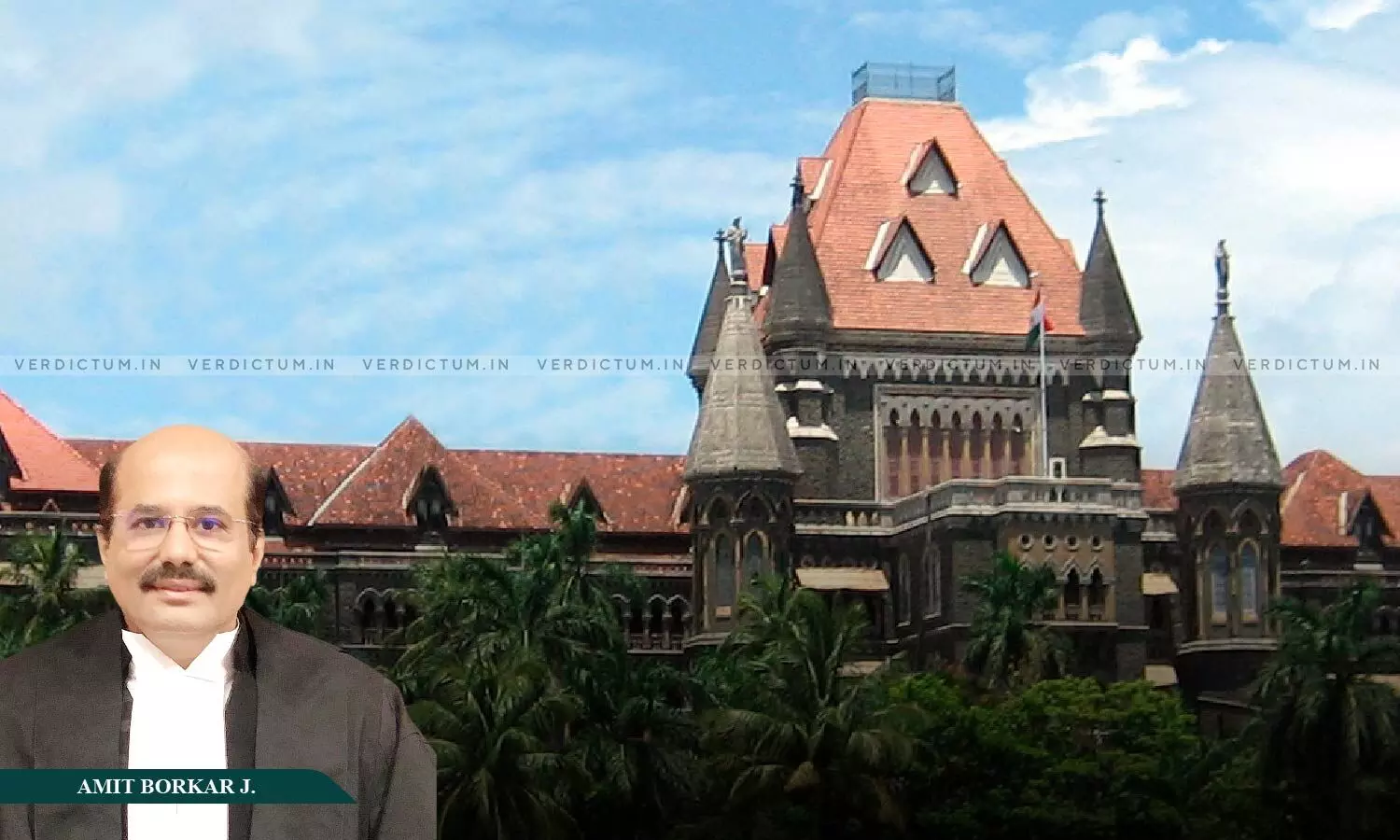
Justice Amit Borkar, Bombay High Court
Mere Allegation Of Forgery Cannot Stop Referral To Arbitration U/S 11 A&C Act: Bombay High Court
 |
|The Bench held that the alleged inability of 90-year-old, bedridden father to understand English is a disputed fact to be decided by the Arbitral Tribunal.
The Bombay High Court has held that the decision in Rajia Begum 2026 SCC OnLine SC 135 does not mean that every allegation of forgery is sufficient to stop a reference to arbitration under Section 11 of the Arbitration and Conciliation Act, 1996; the real test is whether the material makes the non-existence of the arbitration agreement so clear that arbitration cannot be allowed to start.
Applying this test, the Court appointed a Sole Arbitrator in a son's application against his mother and stepmother's relative over the redevelopment of the family property, "Patkar House," holding that the mother's allegation that the underlying Development Agreement was never executed by her late husband, then said to be 90 years old, bedridden and unable to understand English, though a serious and disputed claim, was not by itself enough to defeat the arbitration reference where independent material supported the agreement's existence.
A Bench Justice Amit Borkar in an application under Section 11(6) read with Section 11(12)(a) of the Arbitration and Conciliation Act, 1996, observed, “The decision in Rajia Begum does not mean that every allegation of forgery is sufficient to stop arbitration. The Supreme Court explained in paragraph 12 that a mere allegation of fraud simpliciter is not sufficient. The important question is whether the allegation affects the arbitration agreement and whether the material is such that the Court cannot even prima facie find that the concerned party had agreed to arbitrate. Paragraph 13 of Rajia Begum is relevant in this regard. The Supreme Court held that the first test is satisfied only where the arbitration clause or agreement cannot be said to exist in a clear case in which the Court finds that the party against whom breach is alleged cannot be said to have entered into the arbitration agreement”.
Advocate Dr. Abhinav Chandrachud appeared for the applicant and Advocate Aloukik R. Pai appeared for the respondent.
“The submission based upon Rajia Begum succeeds only to a limited extent. I accept that where the arbitration agreement is alleged to be forged, the Court has to consider that objection as a jurisdictional issue. However, I do not accept that merely raising such an allegation requires rejection of the Section 11 Application. The real test is whether the material makes the non-existence of the arbitration agreement so clear that arbitration cannot be allowed to start. In the present case, that position is not reached”, the Bench had further noted.
Under the Agreement, the applicant was said to have been given full, exclusive and irrevocable rights to redevelop Patkar House by his father and Respondent No.1, his mother. His father died in April 2025. The applicant alleged that Respondent No.1 thereafter breached the Agreement's restrictions by executing a Gift Deed dated February 4, 2026 in favour of Respondent No.2, and that Respondent No.2 subsequently attempted to interfere with his possession and redevelopment rights. The applicant invoked arbitration by notice dated June 15, 2026 and nominated a former Judge of the Bombay High Court as Sole Arbitrator, which the respondents did not accept, leading to the present application.
Respondent No.1 denied ever executing the Development Agreement, contending that her late husband's advanced age, ill health, limited mobility following a partial foot amputation, and lack of fluency in English made it impossible for him to have understood or agreed to its terms, and that the document's attesting witnesses had never in fact witnessed its execution.
On the Supreme Court's ruling in Rajia Begum, it was argued that an arbitration agreement alleged to be forged strikes at the root of arbitral jurisdiction and is non-arbitrable, requiring the Court to first decide the forgery allegation. Respondent No.2 separately contended that she was not a signatory to the Development Agreement and held independent ownership rights over two shops in the building under an earlier Gift Deed dated January 23, 2024, predating the Development Agreement, such that disputes concerning those shops could not be referred to arbitration against her, relying on the Supreme Court's ruling in Ajay Madhusudhan Patel.
The Court held that while a forged arbitration agreement would indeed be non-arbitrable under Rajia Begum, the applicant's case did not rest solely on the disputed Development Agreement, since a subsequently registered Will of the deceased father, and recital C of Respondent No.1's own later Gift Deed, both referred to the redevelopment arrangement with the applicant, supplying sufficient prima facie material to proceed.
Accordingly, the Court allowed the application and appointed a Sole Arbitrator to adjudicate the disputes, expressly leaving open all objections regarding forgery, fabrication, validity, stamping, and Respondent No.2's status as a non-signatory for determination by the Tribunal, converted the applicant's pending Section 9 application into one under Section 17 before the Tribunal, and rejected the respondents' oral request for a stay of the order.
Cause Title: Kiran Narendra Patkar v. Milan Narendra Patkar & Anr. (Neutral Citation: 2026:BHC-OS:19040)
Appearances:
Applicant: Dr. Abhinav Chandrachud, Shubham Choudhari, Somnath Kale, Nikhil Adkine, Advocates.
Respondents: Aloukik R. Pai, Advocate.