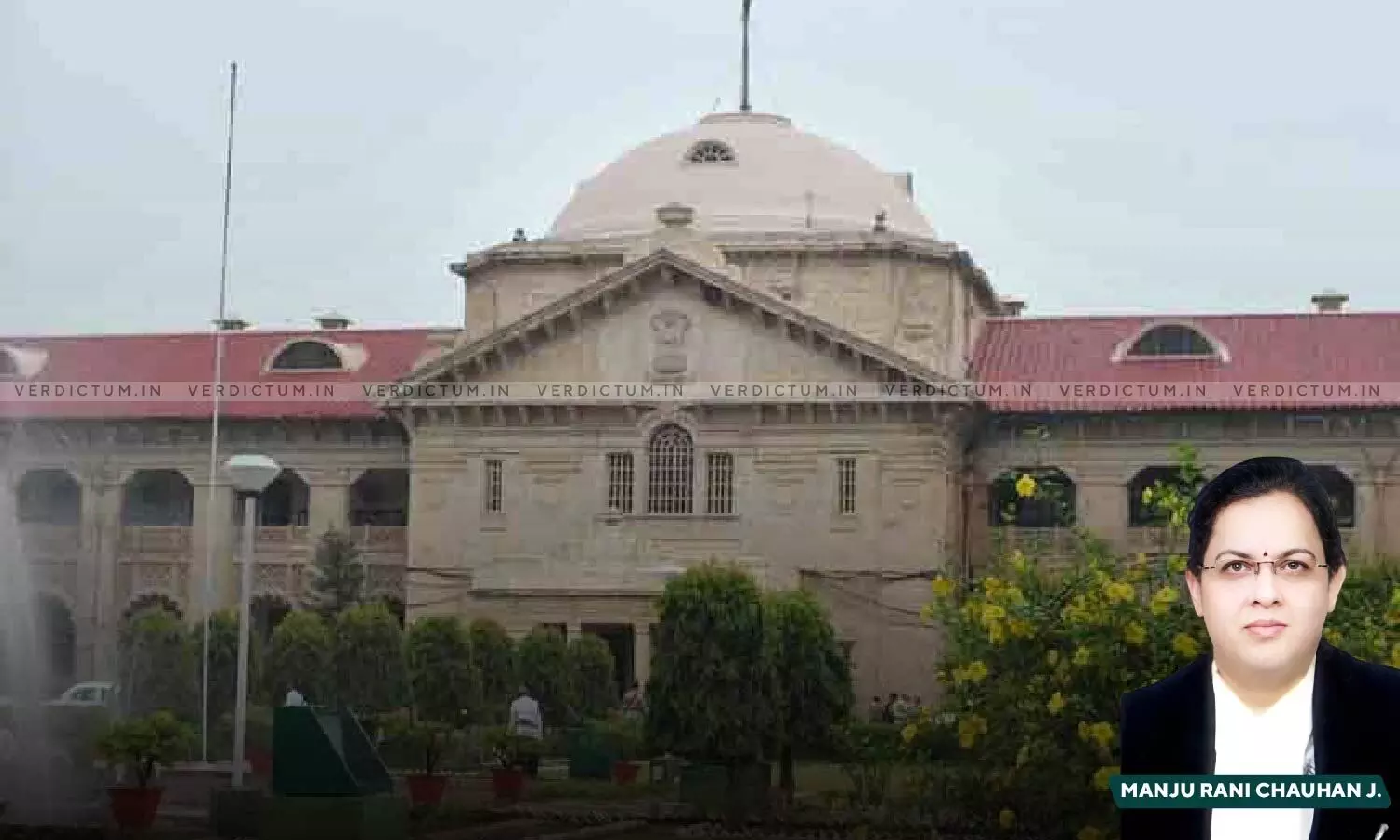
Justice Manju Rani Chauhan, Allahabad High Court
Participation In Recruitment Process Under Interim Order Does Not Create Right To Selection Contrary To Eligibility Conditions: Allahabad High Court
 |
|The Court held that, in the matter at hand, experience and valid Rehabilitation Council of India registration established professional competence but could not replace the requirement that applicants be presently engaged as Special Educators.
The Allahabad High Court has held that candidates permitted under an interim order to participate in a recruitment examination cannot claim consideration of their candidature, declaration of results, selection or appointment when they do not satisfy the notified eligibility conditions.
Dismissing a petition filed by 13 candidates whose engagements had ended in 2019, the Court upheld the condition limiting the selection exercise to Special Educators presently working on a contractual, daily-wage or outsourced basis.
The Court was hearing a writ petition challenging a general instruction in an advertisement issued by the Uttar Pradesh Basic Education Board and the rejection of the petitioners’ representations seeking consideration for appointment as Special Educators.
A Single Judge Bench of Justice Manju Rani Chauhan observed: “An interim order is necessarily interlocutory in character and cannot have the effect of conferring upon the beneficiary a right which is dependent upon the final adjudication of the proceedings. The Supreme Court in Secretary, Union Public Service Commission and another v. S. Krishna Chaitanya, reported in (2011) 14 SCC 227, has cautioned against permitting candidates to derive an advantage from participation in an examination pursuant to an interim order when their very entitlement to participate is under adjudication. Equally, in Abhimanyoo Ram v. State of U.P. and another, reported in (2008) 17 SCC 73, the Supreme Court has held that where participation in the selection process is secured by virtue of an interim order and the proceedings ultimately fail, the candidate cannot be permitted to derive any benefit from such interim order”.
The Bench added: “Thus, the mere fact that the petitioners were permitted to participate in the examination pursuant to the interim order passed by this Court cannot, by itself, create in their favour any right to have their candidature considered, to have their result declared, or to claim selection or appointment contrary to the governing eligibility conditions and the settled legal position. Any advantage flowing solely from the interim order must necessarily abide by the final outcome of the proceedings and cannot ripen into a legal right merely by reason of the petitioners having undergone the examination.”
Advocate Ami Tandon appeared for the petitioners. Standing Counsel Shailendra Singh, appeared for the respondents.
Background
The 13 petitioners had previously served as Itinerant Teachers or Resource Teachers under the Integrated Education for Disabled Scheme. They held specialised qualifications in special education and were engaged at the district level between 2005 and 2011.
Their engagements were renewed for successive academic sessions until 2019. Although the concerned authorities had recommended further renewal, the petitioners were excluded from the subsequent renewal exercise.
The Court dismissed their earlier writ petition challenging the non-renewal in 2025. The Court relied upon Director, Institute of Management Development, U.P. v. Pushpa Srivastava (1992), which held that a contractual employee does not possess a right to continue beyond the stipulated period.
The petitioners preferred an appeal against that decision. A Division Bench permitted them to submit representations seeking regular appointment under the prevailing policy and directed the competent authority to consider those claims. The representations were subsequently rejected.
Meanwhile, in Rajneesh Kumar Pandey and Others v. Union of India and Others (2021), the Supreme Court had recognised the need for qualified Special Educators to secure inclusive education for children with special needs. In subsequent proceedings, the Supreme Court directed Uttar Pradesh to initiate the process of filling approximately 4,900 vacant posts.
The resulting advertisement invited applications from Special Educators working on a contractual, daily-wage or outsourced basis. It required candidates to submit the contract letter or engagement order issued by the competent authority.
The petitioners challenged that condition because they had not been engaged since 2019. They relied upon their previous service, specialised qualifications and valid Rehabilitation Council of India registrations and alleged that the distinction between presently engaged and formerly engaged Special Educators violated Articles 14 and 16 of the Constitution.
During the proceedings, an interim order permitted the petitioners to appear before the Screening Committee without insisting upon the disputed condition. Their results were directed to be kept in sealed covers and made subject to the final outcome of the petition.
Court’s Observations
The Court examined the Supreme Court’s directions and found that the selection exercise was intended to screen the existing pool of Special Educators already working on a contractual, daily-wage or outsourced basis.
The Court observed: “The expression ‘who were working’, read in the context of the aforesaid directions, assumes significance. The Screening Committee was required to consider the candidature of Special Educators who were already engaged and to assess their suitability having regard, inter alia, to their past experience and the prescribed eligibility conditions. The emphasis of the directions was thus upon Special Educators who were already working, rather than upon persons who had ceased to be in engagement and were no longer rendering such services.”
The Court found it undisputed that the petitioners had not worked as Special Educators since 2019. They therefore fell outside the class of candidates contemplated by the recruitment exercise.
The Court further held that the object of the process was not to provide an employment advantage to persons who had previously worked as Special Educators. It was intended to ensure the availability of competent professionals for children requiring specialised educational assistance.
The Court accepted that the petitioners’ experience and valid Rehabilitation Council of India registrations demonstrated their competence as Special Educators. It nevertheless held that satisfying one eligibility requirement could not cure their failure to satisfy another independent condition.
The Court held: “The petitioners seek to overcome this admitted position by relying upon their past experience and their subsisting RCI registration. Neither circumstance, however, can substitute the eligibility condition prescribed for the present selection. Possession of the requisite professional qualification and registration establishes their competence in the field; it does not, by itself, create a right to participate in a selection process governed by a specific condition as to the category of candidates to be considered.”
Referring to State of Madhya Pradesh and Others v. Raghuveer Singh Yadav and Others (1994) and Tej Prakash Pathak and Others v. Rajasthan High Court and Others (2025), the Court reiterated that eligibility is governed by the conditions stipulated at the commencement of the recruitment process.
The Court also referred to Dr. M.V. Nair v. Union of India and Others (1993), distinguishing eligibility to enter the field of consideration from suitability assessed during selection.
The Court rejected the contention that limiting the recruitment exercise to presently working Special Educators created an arbitrary distinction between employed and unemployed candidates.
It held that the relevant classification arose from the class identified by the Supreme Court and bore a rational connection with the object of screening Special Educators already engaged in teaching children with special needs.
The Court observed: “The contention founded upon Articles 14 and 16 of the Constitution is equally unpersuasive. The constitutional guarantee of equal opportunity in public employment does not confer an unconditional right upon every otherwise qualified person to participate in every recruitment process. Equality operates amongst persons falling within the class legitimately identified for consideration. In the present case, the classification emanates from the very directions pursuant to which the selection exercise has been undertaken and bears a rational nexus with its object—namely, to identify and screen the pool of Special Educators already engaged for imparting specialised education to children with special needs.”
The Court applied the classification principles stated in State of West Bengal v. Anwar Ali Sarkar (1952) and Ram Krishna Dalmia v. Justice S.R. Tendolkar and Others (1958). It also referred to J&K Public Service Commission and Others v. Dr. Narinder Mohan and Others (1994), reiterating that Article 16 protects equality of opportunity among candidates satisfying the prescribed eligibility framework.
The Court held that replacing the expression “presently working” with “having worked in the past” would amount to rewriting the eligibility condition. Such a modification would also depart from the framework formulated pursuant to the Supreme Court’s directions.
The Court stated: “This Court, in exercise of its power of judicial review, cannot substitute the expression ‘presently working’, as employed in the impugned advertisement, with the expression ‘having worked in the past.’ Such an exercise would amount to rewriting the eligibility criteria prescribed by the competent authority and would, therefore, transgress the permissible limits of judicial review. More importantly, such a course would run contrary to the express framework and directions laid down by the Hon’ble Supreme Court pursuant to which the recruitment process has been undertaken.”
The Court relied on Maharashtra Public Service Commission v. Sandeep Shriram Warade and Others (2019) to reiterate that prescribing qualifications and recruitment criteria lies primarily within the employer’s domain.
Referring to Secretary, State of Karnataka and Others v. Uma Devi and Others (2006) and State of Karnataka and Others v. M.L. Kesari and Others (2010), it further held that past contractual service did not create an enforceable right to regular appointment.
The Court found that the petitioners had been permitted to participate only because of an interim order requiring their results to remain sealed and subject to the outcome. Their participation could not confer an eligibility status that they did not otherwise possess.
The Court held: “Needless to say, the petitioners, not being eligible under the express condition stipulated in the advertisement, as they were not in service at the relevant time, cannot claim any vested or enforceable right to appointment merely on the ground that they were permitted to appear in the examination pursuant to the interim order passed by this Court. Such participation, being the consequence of an interim indulgence, cannot confer upon the petitioner an eligibility which he did not otherwise possess under the governing conditions of recruitment.”
The Court also declined relief based on sympathy or the possibility that the petitioners might succeed in their pending appeal against the earlier dismissal of their challenge to non-renewal. It held that such a possibility was conjectural and could not justify departure from the recruitment conditions.
Conclusion
The Allahabad High Court dismissed the writ petition after finding no legal or constitutional infirmity in the eligibility condition restricting consideration to Special Educators presently working on a contractual, daily-wage or outsourced basis.
It held that the petitioners’ participation pursuant to the interim order did not entitle them to consideration of their candidature, declaration of results, selection or appointment. The Court imposed no costs.
Cause Title: Rakesh Kumar and 12 Others v. State of Uttar Pradesh and 4 Others (Neutral Citation: 2026:AHC:189900)
Appearances
Petitioners: Advocates Akhil Kumar Singh, Ami Tandon and Ichhvaku Pratap Shahi
Respondents: Advocates Bipin Bihari Pandey and Shivendra Kumar Singh; Standing Counsel Shailendra Singh