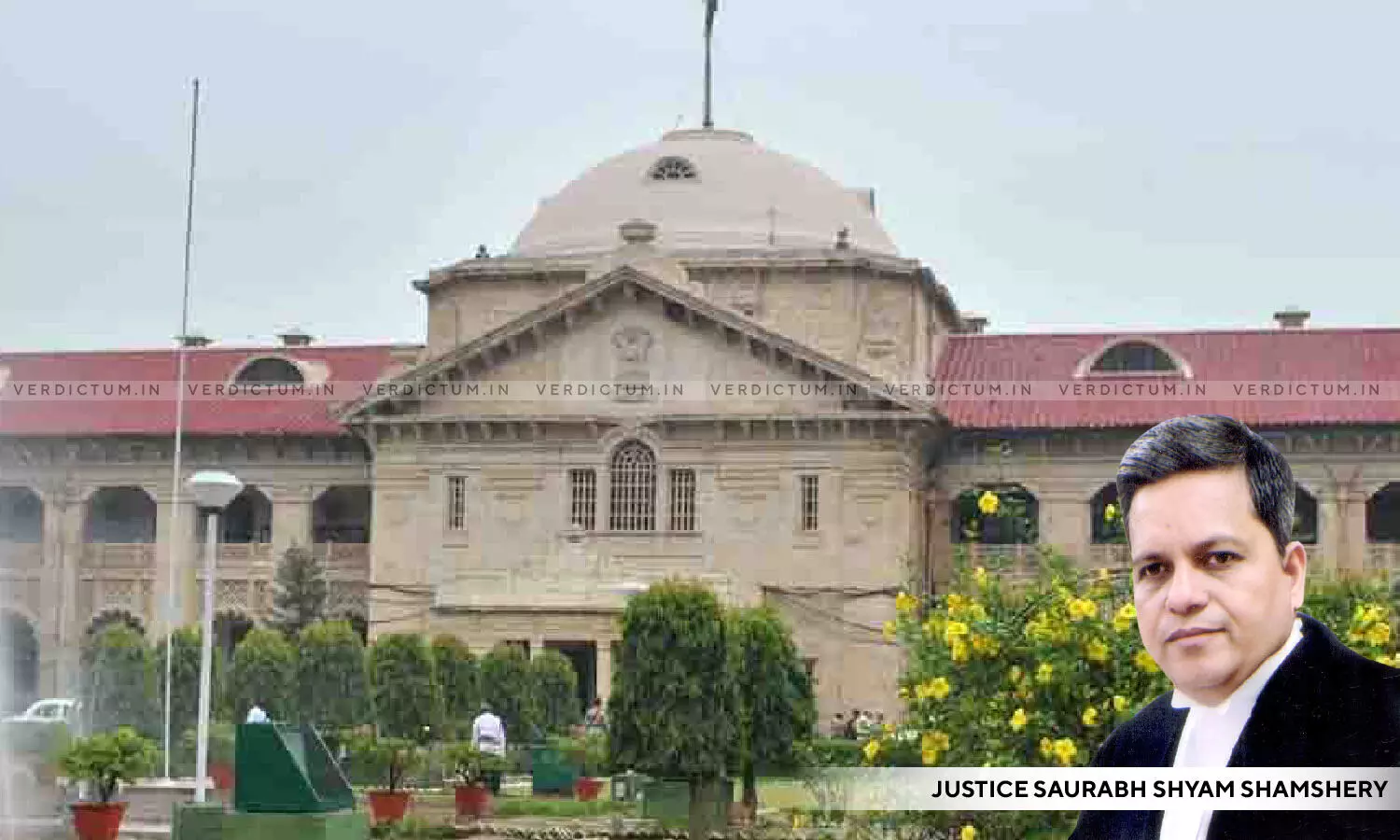
Failure To Record Complainants' Statements Or Permit Cross-Examination Can Vitiate ICC Inquiry Under POSH Act: Allahabad High Court
 |
|The Court held that an Internal Complaints Committee (ICC) inquiry conducted under the POSH Act stands vitiated where the record does not disclose whether complainants' statements were recorded, whether copies thereof were supplied to the respondent, or whether an opportunity of cross-examination and oral hearing was afforded.
The Allahabad High Court has held that an Internal Complaints Committee (ICC) conducting an inquiry under the Sexual Harassment of Women at Workplace (Prevention, Prohibition and Redressal) Act, 2013 must adhere to the principles of natural justice, including recording the complainants' statements, furnishing relevant material to the respondent and providing an opportunity to cross-examine the complainants wherever required.
The Court observed that an ICC inquiry cannot be sustained where the report is silent on whether complainants' statements were recorded, whether copies of such statements were supplied to the delinquent employee, and whether he was afforded an opportunity of cross-examination and oral hearing.
A Bench of Justice Saurabh Shyam Shamshery, while allowing a writ petition filed by an Associate Professor of Astrophysics challenging the report of the Internal Complaints Committee and the consequential disciplinary action initiated against him under the POSH Act, observed: “Though petitioner was provided copy of complaints but certain details were not provided, such as when they are served upon ICC and that though no specific procedure was prescribed under Rule 7 still it has been consistently held in various judgments of this Court and Supreme Court that principle of natural justice be followed and that ICC shall have power as vested in Civil Courts under Code of Civil Procedure so far as summoning and enforcing attendance of any person and examine him in Court is concerned”.
The Bench added: "However, there is no reference in ICC report, whether statements of complainants were recorded before Committee or not and if statements were recorded, whether a copy of same was provided to petitioner or not. There is no reference, whether petitioner was asked to cross-examine the complainants or was provided any opportunity of oral hearing... Therefore, the Court finds that procedure adopted by ICC was defective. Accordingly, its outcome, i.e., inquiry report as well as order passed by Council and Institute cannot sustain."
P.N. Saksena, Senior Advocate, represented the appellant, while Advocate Udai Chandani represented the respondents.
Background
The petitioner, an Associate Professor-G of Astrophysics at the Harish Chandra Research Institute, challenged disciplinary proceedings initiated pursuant to multiple complaints of sexual harassment made by female students and post-doctoral researchers under the POSH Act.
The Internal Complaints Committee conducted an inquiry and found the petitioner guilty of sexual harassment and mental harassment, recommending disciplinary action. Acting upon the report, the Governing Council imposed the penalty of "Censure" and prohibited the petitioner from supervising female students, post-doctoral fellows and research associates.
Aggrieved thereby, the petitioner approached the High Court contending that the complaints were barred by limitation under Section 9 of the POSH Act and that the inquiry had been conducted in violation of Section 11 of the Act, Rule 7 of the 2013 Rules and the principles of natural justice.
Court's Observations
The Court first examined whether the Internal Complaints Committee had conducted the inquiry in accordance with Section 11 of the POSH Act read with Rule 7 of the Sexual Harassment of Women at Workplace (Prevention, Prohibition and Redressal) Rules, 2013.
Referring to the statutory framework, the Court noted that Rule 7 expressly requires that the inquiry be conducted in accordance with the principles of natural justice, while Section 11 confers upon the ICC powers akin to those vested in a Civil Court for summoning witnesses and examining them on oath.
Examining the record, the Court found that the mandatory procedural safeguards had not been followed. The Court found the inquiry report to be completely silent on whether the Committee had even examined the complainants and whether the petitioner had been supplied with their statements.
Holding that these deficiencies struck at the fairness of the inquiry, the Court concluded: "Therefore, the Court finds that the procedure adopted by ICC was defective. Accordingly, its outcome, i.e., inquiry report as well as order passed by Council and Institute cannot sustain."
The Court thereafter considered whether the matter should be remitted to the ICC. Before doing so, it examined the scope of Section 9 of the POSH Act dealing with limitations for filing complaints.
The Bench noted that the complaints related to incidents occurring over a period of time, and many of them did not disclose specific dates. At the same time, it found that the allegations contained in the complaints were serious in nature and, prima facie, fell within the statutory definition of "sexual harassment" under Section 2(n) of the POSH Act. The Court reproduced portions of several complaints alleging unwelcome physical contact, sexually coloured remarks, late-night meetings, inappropriate messages and other acts of harassment.
The Court also considered the Supreme Court's decision in X v. Nirmal Kanti Chakrabarti, observing that although Section 9 prescribes a limitation period, complaints should not invariably be rejected at the threshold merely on account of delay, particularly where serious allegations are made and the complainants may have hesitated to complain while working under the delinquent employee.
The Bench observed: "The Court is not aware that when these complaints were made to ICC as on complaint no date was mentioned in record and also taking note that even in X vs. Nirmal Kanti Chakrabarti (supra) Supreme Court has observed that in certain circumstances delay may not be considered adverse to the extent that complaints may be rejected at threshold as it would not be in consonance of object of POSH Act and that normally such complaints are not made immediately, specially when complainants were working under delinquent as it would affect their respective future."
Accordingly, the Court held: "The Court finds that complaints cannot be rejected at threshold without specific consideration."
The Court clarified that the ICC must first determine, by a reasoned order, whether the complaints are maintainable in view of Section 9 before proceeding with a fresh inquiry in accordance with the procedure prescribed under the POSH Act and Rules.
Conclusion
Allowing the writ petition, the Allahabad High Court set aside the disciplinary order and remitted the matter to the Internal Complaints Committee for fresh consideration.
The Court directed the ICC to first determine, by a reasoned decision, whether the complaints were maintainable in light of Section 9 of the POSH Act after considering the time period of the allegations, the dates of the complaints and any explanation for the delay.
It further directed that, if the complaints were found maintainable, the inquiry should thereafter proceed strictly in accordance with the POSH Act, the 2013 Rules and the principles of natural justice. The exercise was directed to be completed within eight weeks.
Cause Title: Dr Tapas Kumar Das v. Harish Chandra Research Institute and Others (Neutral Citation: 2026:AHC:85796)
Appearances
Petitioner: P.N. Saksena, Senior Advocate, assisted by Advocates Badal Chatterjee, Chandan Sharma, Roshni Shukla and Vishakha Pande.
Respondents: Advocates Udai Chandani and Rahul Agarwal.