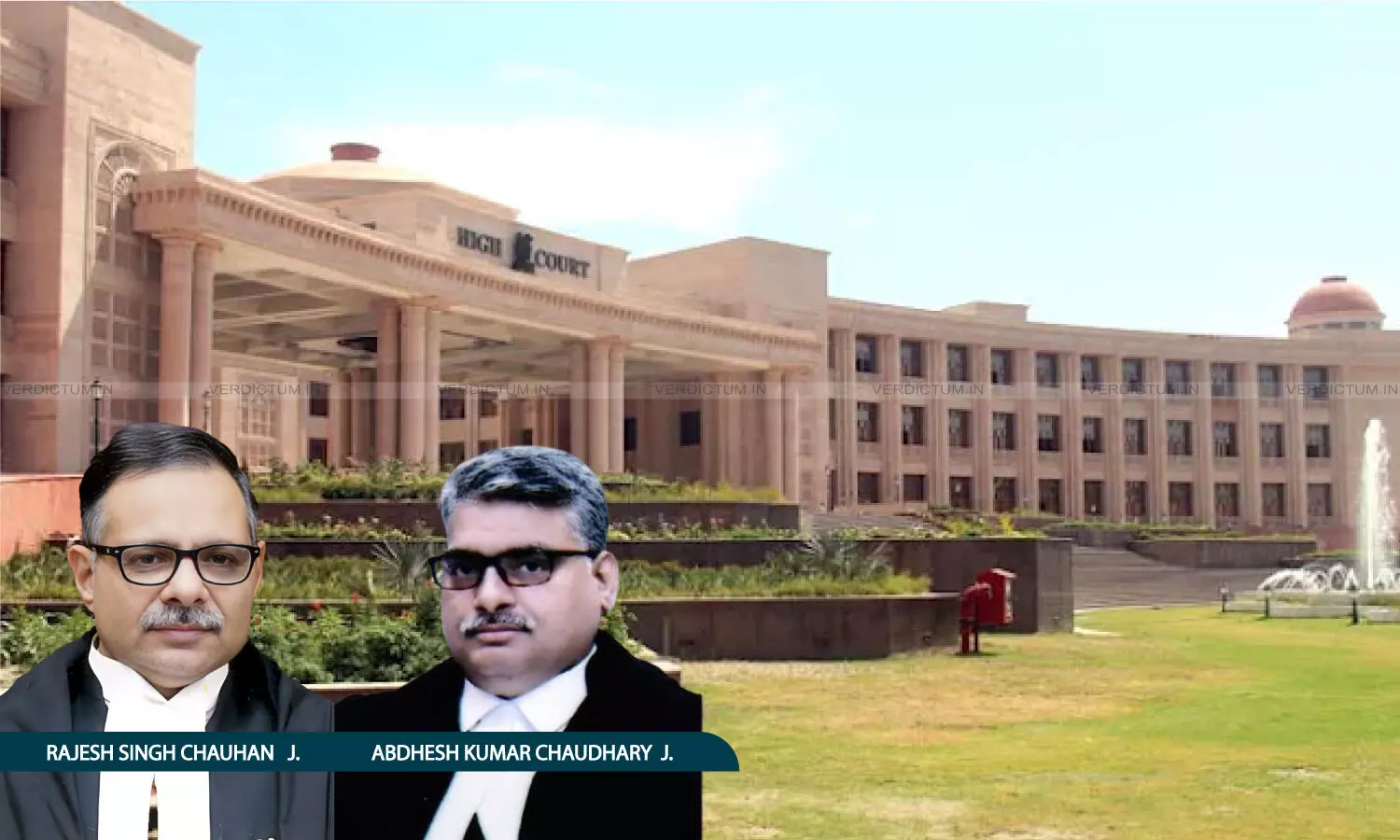
Justice Rajesh Singh Chauhan, Justice Abdhesh Kumar Chaudhary, Allahabad High Court, Lucknow Bench
Life Imprisonment Not Automatic In Dowry Death Cases: Allahabad High Court Reduces Convicts’ Sentence To Period Already Undergone
 |
|The Court upheld the conviction in a dowry death case involving the death of a woman and her infant daughter inside the matrimonial home, but reduced the life sentence after finding that the trial court had not recorded reasons for imposing the maximum punishment under Section 304B IPC.
The Allahabad High Court has held that life imprisonment is not an automatic consequence of conviction for dowry death under Section 304B IPC, since the provision permits sentencing discretion between the statutory minimum of seven years and life imprisonment depending on the facts of each case.
The High Court reduced the sentence of life imprisonment to the period already undergone by the convicts, while upholding their conviction under Sections 304B and 498A IPC and Section 4 of the Dowry Prohibition Act, 1961.
The Court was hearing appeals arising from a dowry death case in which a woman and her infant daughter were found dead in the matrimonial home. The trial court had convicted the husband and his relatives for dowry death, cruelty and dowry demand, while acquitting them of murder-related charges.
A Bench of Justice Rajesh Singh Chauhan and Justice Abdhesh Kumar Chaudhary, observed: “This issue has engaged the attention of this Court, as well as the Hon’ble Supreme Court in several cases, which arose out of Section 304B read with 498A I.P.C. and wherein the Hon’ble Supreme Court while interpreting the expression ‘may’ mentioned in Section 304B I.P.C. held that it is not mandatory for the Courts in every case to award life imprisonment to the accused, once he is found guilty of offence under the said provision. It was held that the Courts could award sentence in exercise of its discretion between seven years to life imprisonment, depending on the facts of each case, which must not be less than 7 years and the extreme punishment of life terms should be awarded in ‘rare cases’ but not in all cases as a routine.”
The Bench further stated: “There is no automatic award of life imprisonment under Section 304B I.P.C after conviction. Some finding and/or reasoning ought to be given by the learned Trial Court for arriving at such a belief for awarding a life imprisonment under the provisions of Section 304B I.P.C. This Court does not find any plausible reason appended by the learned Trial Court as to why the maximum punishment of life imprisonment had been awarded to the appellants in this present case.”
Advocate Dhananjay Kumar Singh appeared for the appellants, while S.P. Singh, Additional Government Advocate, appeared for the State.
Background
The prosecution's case was that the deceased, aged about 25 years, had been married for about six years and was subjected to demands for a motorcycle and ₹1 lakh in cash. The complaint alleged that she was physically and mentally tortured over dowry demands and was later killed along with her infant daughter.
The trial court convicted the appellants under Section 304B IPC, Section 498A IPC and Section 4 of the Dowry Prohibition Act. It sentenced them to life imprisonment for dowry death, two years’ imprisonment for cruelty, and six months’ imprisonment under the Dowry Prohibition Act, with a fine.
Before the High Court, the appellants challenged the conviction and also argued that even if the conviction was upheld, the maximum sentence of life imprisonment was unwarranted. They relied on V.K. Mishra v. State of Uttarakhand (2015), Hem Chand v. State of Haryana (1994), State of Karnataka v. M.V. Manjunathegowda (2003), and G.V. Siddaramesh v. State of Karnataka (2010).
Court’s Observations
The Court first examined whether the statutory ingredients of Section 304B IPC were satisfied. It noted that the evidence showed marriage within seven years of death, death inside the matrimonial home, and the demand of dowry shortly before the incident.
On the meaning of “soon before her death”, the Court observed: “Before proceeding any further, this Court is conscious that the usage of the word “soon” in Section 304B I.P.C. ought not to be interpreted in terms of days or months or years, but as necessarily should indicate that the demand of dowry should not be stale or an aberration of the past, but rather should be a continuing cause for the death under Section 304B of the I.P.C. However, on an appreciation of the evidence of P.W.-2, P.W.-3 and P.W.-5, it is apparent that the demand of dowry was within 10 days of the death of the deceased and as such it can be well construed that the demand of dowry was “soon before her death”.”
The Court then considered the medical and inquest evidence. It noted that the woman and infant had sustained incised wounds caused by a sharp-edged weapon, and that the bodies were recovered from the matrimonial home.
The Court held: “In view of the above, for the cause of death, we find that the death having been caused otherwise than under normal circumstances, an important ingredient to attract the penal provision of Section 304B of the I.P.C is proved against the Appellants.”
Having found that the foundational facts were established, the Court applied the statutory presumption under Section 113B of the Evidence Act.
The Bench observed: “Once the presence of this concomitants are established or shown or proved by the prosecution even to their foundational effect by preponderance of possibility, the initial presumption of innocence is faded and replaced by an assumption of guilt by the deeming provision of law, thereby shifting the burden of proof upon the guilty to dislodge his guilt beyond reasonable doubt as per Section 113B of the Indian Evidence Act.”
The Court found that the accused had not led any defence evidence to rebut the presumption. It also rejected the husband’s explanation that unknown persons had killed the deceased and the child.
The Court noted: “Although, the Appellants were permitted to produce evidence in defence, however, none of the accused/appellants produced any defence witnesses. There is absolutely no material on record to substantiate the aforesaid assertion of the Appellants as stated by the convict-Husband in his statement recorded under Section 313 Cr.P.C.”
The Bench further underscored the absence of any plausible explanation for the deaths inside the matrimonial home: “Further, this Court also could not shut its eyes to the fact that the Husband ought to be the protector of his wife and 15 months old girl child. It is he who is responsible for their safety and well-being. Further, we cannot be oblivious to the fact that two dead bodies were found at the house of the Appellants and they were unable to give any plausible explanation as is required under Section 108 of the Indian Evidence Act from them.”
The Court rejected the argument that non-examination of the person whose mobile phone was allegedly used to communicate the dowry harassment was fatal. It held that other evidence sufficiently established dowry demand shortly before death.
The Court also dealt with the argument that the recovery witness had turned hostile. Referring to Paulmeli v. State of T.N. (2014), Ramesh Harijan v. State of U.P. (2012), and Bhajju v. State of M.P. (2012), the Court reiterated that the testimony of a hostile witness is not automatically washed off the record.
The Court stated: “As far as the consideration of the evidence/deposition of a hostile witness is concerned, the rejection of the entire testimony of a prosecution witness, who has been cross- examined by the prosecution, would not only harm the case of the prosecution but perhaps also of the defence in a given case. This is because as the law stands today, the benefit of the testimony of such witness can be taken by both the prosecution and the defence, allowing them to use it to build their case.”
The Court held that the prosecution had established the legal requirements for the offences under Sections 304B and 498A IPC with the aid of Section 113B of the Evidence Act.
The Bench concluded: “For all the aforesaid reasons and taking into account all the above supervening factors, the evidence brought on records clearly established the legal requirements for an offence falling under Sections 304B and 498A of the I.P.C. with the aid of Section 113B of the Indian Evidence Act to be conclusively proved against the appellant and the conviction, therefore, do not call for any interference.”
It therefore upheld the conviction under Section 304B IPC, Section 498A IPC and Section 4 of the Dowry Prohibition Act.
On sentence, the Court held that the trial court had not explained why all convicts were placed in the same bracket and awarded life imprisonment, despite Section 304B IPC prescribing a range between seven years and life imprisonment.
The Court relied on Hari Om v. State of Haryana (2014), where the Supreme Court reduced a life sentence in a dowry death case after noting that the courts below had not given reasons for treating the case as one warranting the maximum punishment.
The High Court then examined mitigating factors, relying on Navas v. State of Kerala (2024). It noted that the appellants had no prior criminal history, had undergone long incarceration, had no reported adverse conduct in jail, and came from a financially weak rural background.
The Court observed: “No doubt, the age by itself is not a determinative factor, however, it remains that the Apex Court has held that age at the time of crime is also a mitigating factor for consideration while assessing the possibility of reformation and reintegration of the convict into society. The probability of the accused being reformed and rehabilitated, and the likelihood of his and/or her not indulging in criminal conduct again, are equally important considerations while evaluating whether continued incarceration for the remainder of natural life would serve the ends of justice.”
The Court added: “It has come on record that the Appellants have been in Jail for term spanning more than seven years, which is the minimum prescribed under Section 304B I.P.C. Their conduct in jail does not indicate any adverse remarks, may be demonstrating remorse and reflecting a genuine possibility of reformation. The socio-economic condition of the Appellants also deserves consideration. The material on record reflects that the family of the accused belonged to a financially weak background and are villagers engaged in agricultural activities.”
In its epilogue, the Court said the case showed the need to treat repeated complaints of dowry harassment as pleas for help, not as ordinary matrimonial discord.
The Court remarked: “The present case is one such case wherein the deceased, on several occasions, communicated to her family members, particularly her brother, sister-in-law and mother, the persistent dowry demands and the cruelty to which she was being subjected by her in-laws. According to this Court, such repeated complaints ought not to have been treated as ordinary matrimonial disagreements; rather, they must have been recognized as genuine cries for help, protection and timely intervention.”
The Bench further observed: “The legislative intent behind provisions such as Sections 498A and 304B of the Indian Penal Code was not merely to punish offenders after the commission of the offence, but also to deter such conduct and provide effective legal protection to married women. The present case is not merely about holding the accused accountable and convicting them as per law, rather it conveys a larger message that every plea for help made by a daughter must be treated with compassion, seriousness and prompt action.”
Conclusion
The High Court upheld the conviction under Sections 304B and 498A IPC and Section 4 of the Dowry Prohibition Act, but partly allowed the appeals on sentence.
The life sentence under Section 304B of the IPC was reduced to the period already served. The sentence under Section 498A IPC and Section 4 of the Dowry Prohibition Act, including the fine, was left unaltered. The Court directed the release of the appellants who remained in custody, if not required in any other case, and discharged the bail bonds of those already on bail, subject to compliance with Section 437A CrPC/Section 481 BNSS.
Cause Title: Dinesh Kumar and Ors. v. State of U.P. (Neutral Citation: 2026:AHC-LKO:50697-DB)
Appearances
Appellants: Advocates Deepshikha Singh, Dhananjay Kumar Singh, Ghulam Mohammad Kamil, Kunwer Dhananjay Singh, Piyush Kumar Singh and Vyas Narayan Shukla
Respondent: Government Advocate
Click here to read/download Judgment