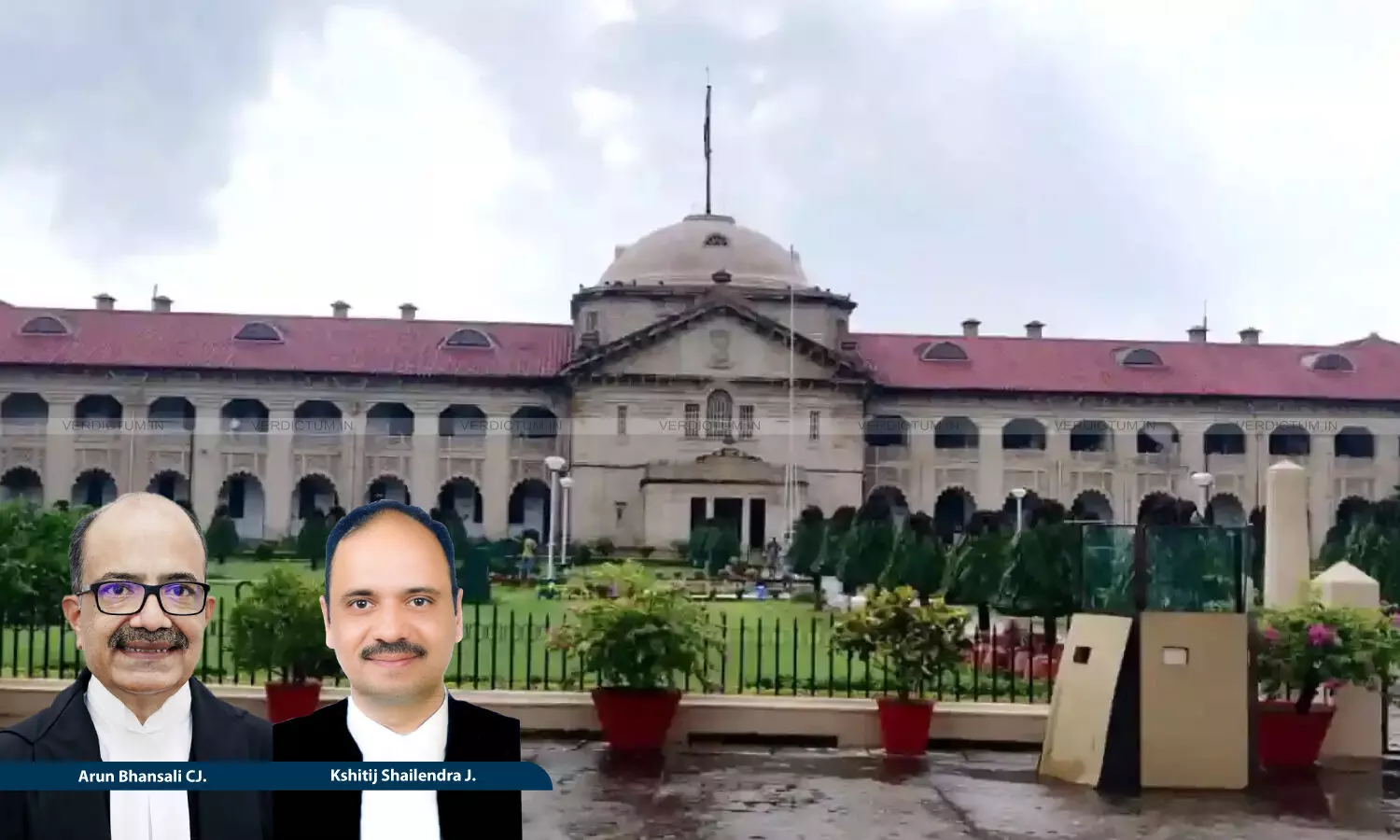
Chief Justice Arun Bhansali, Justice Kshitij Shailendra, Allahabad High Court
30% Representation Requirement Promptly Fulfilled: Allahabad High Court Upholds Bulandshahr Bar Elections After 4 Women Advocates Nominated Post-Poll
 |
|The Bench said that the nomination of four women advocates "cannot be said to be per se illegal", and directed the Bar Association to amend its bye-laws within a month in line with the Supreme Court's directions in Deeksha N Amruthesh.
The Allahabad High Court has refused to set aside the entire 2025-26 election of the Civil Bar Association, Bulandshahr, despite the admitted fact that no woman advocate was elected to any of the twelve office-bearer posts. The Court held that the subsequent nomination of four women advocates by the elected body, made within four days of the polls, satisfied the 30% representation requirement mandated by the Supreme Court, and that no useful purpose would be served by quashing the elections on this ground.
The petition was filed as a Public Interest Litigation by Advocate Bhavna Pandit, practising in the Bulandshahr district court.
The Court further held that the nomination could not be treated as illegal merely because it did not strictly follow the procedure later prescribed by the Supreme Court, since no woman candidate had come forward to contest in the first place. It nonetheless directed the Bar Association to formally amend its constitutional documents within one month to build in the 30% reservation for all future elections, and to route the present nomination through the Administrative Judge for regularisation.
a Division Bench of Chief Justice Arun Bhansali and Justice Kshitij Shailendra. The Bench observed, “…though we find that the respondents did not make provision for 30% representation of women lawyers, the elections were held on 16.04.2026, on which date itself the earlier order dated 13.03.2026 was clarified/modified by the Hon’ble Supreme Court, soon whereafter on 20.04.2026, nomination of four women Advocates was made by the elected body. Therefore, despite the fact that the said nominations were made over and above the strength of the elected body, it cannot be said that presently, there is less than 30% representation of women lawyers in the body elected on 16.04.2026 and the requirement of 30% representation was promptly fulfilled within next 4 days. As a matter of fact, 30% of 16 (12+4) comes to 4.8 and, therefore, inclusion of four women Advocates in the elected body, by way of prompt nomination, fulfils the purpose”.
Advocate Ajay Kumar appeared for the petitioner and Rajiv Singh, Standing Counsel appeared for the respondent.
The petitioner had challenged the Bar Association elections held on 16 April 2026, in which none of the 79 eligible women voters was elected as an office bearer, contending that this violated the Supreme Court's order dated March 13, 2026 in Deeksha N Amruthesh v. State of Karnataka & Ors. SLP (Civil) 1404 of 2025, which mandated at least 30% representation for women in Bar Association elections across the country. The respondents contended that the Supreme Court's order reached them only on April 08, 2026, after the election schedule had already been notified, and that the elected body had, on April 20, 2026, nominated four women advocates, one as Joint Treasurer and three as Executive Members, in purported compliance.
Notices were issued in May 2026, followed by an exchange of affidavits and final hearing on August 31, 2026. The Court traced the trajectory of the Supreme Court's orders in Deeksha, from the Karnataka-specific directions of January 2025 to the pan-India mandate of March 13, 2026, and its subsequent clarification on April 16, 2026 permitting nomination where women do not contest elections.
The Court noted that the respondents could not plead ignorance of a Supreme Court order in the public domain, but found that the nominations, made promptly and covering more than 30% of the enlarged body of sixteen, cured the deficiency without requiring fresh elections. It declined to order any fact-finding inquiry by the Registrar General, holding it would waste administrative resources without altering the outcome.
The writ petition was accordingly disposed of with directions to amend the bye-laws within one month, intimate the nomination to the Administrative Judge for consultation with the District and Sessions Judge and senior-most woman member, and to let the existing elected and nominated body continue functioning unless otherwise ordered.
Cause Title: Bhavna Pandit v. State of U.P. and 16 others (2026:AHC:189815-DB)
Appearances:
Petitioner: Ajay Kumar, Advocate.
Respondent: Rajiv Singh, Standing Counsel, Nigamendra Shukla, Ashutosh Kumar Pal, Advocates.