

Andhra Pradesh High Court Pulls Up Authorities For "Arm-Twisting" 80-Year-Old Ex-Serviceman To Delay Land Relief
The court directed the state to delete the veteran's land from the Section 22A prohibited property list within two months, holding that officials cannot use parallel, fraudulent litigation as an excuse to deny binding government orders.

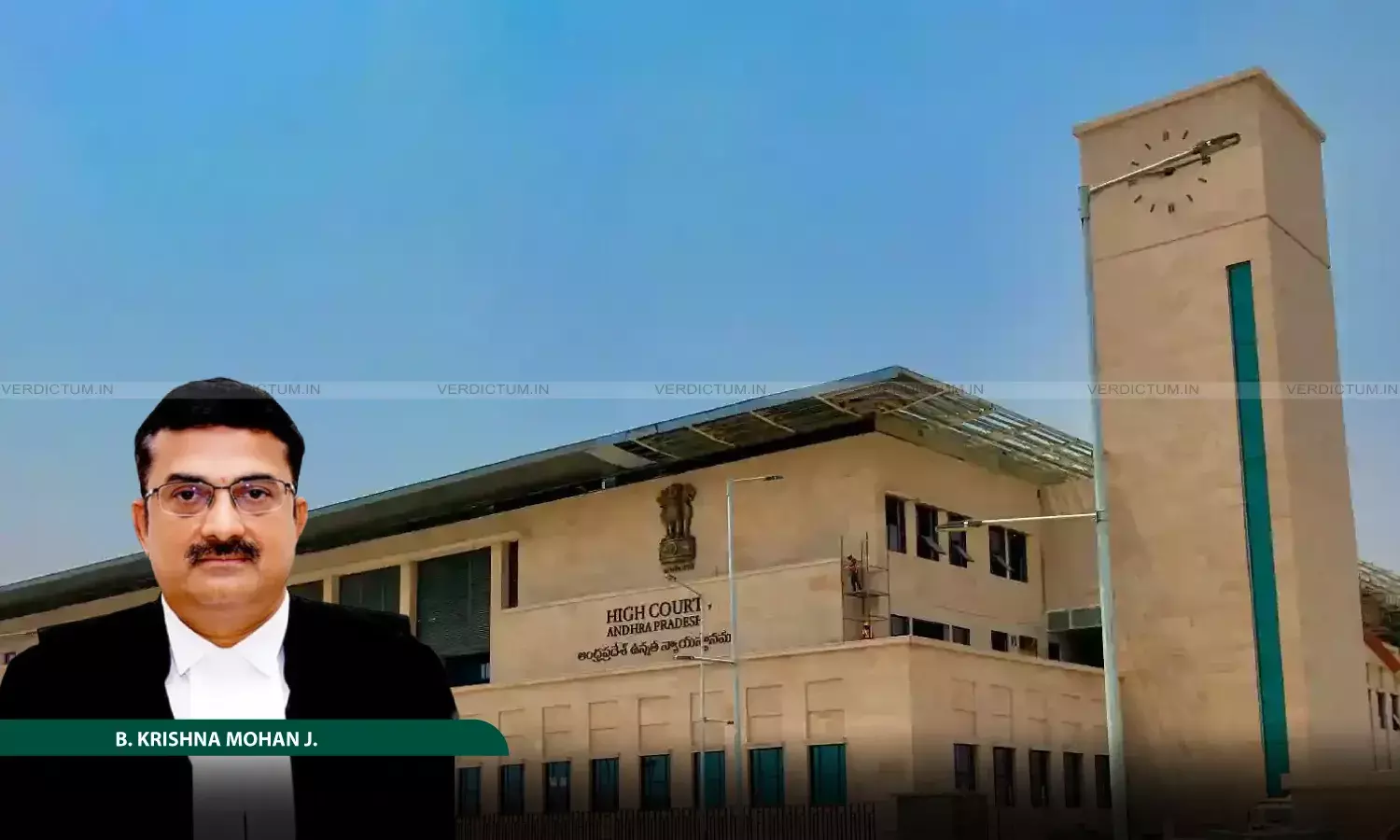
The Andhra Pradesh High Court slammed state revenue authorities for adopting "arm-twisting methods" to deliberately deny and delay land de-notification relief to an octogenarian Ex-Serviceman, directing the respondents to clear the property from the Section 22A prohibitory list within two months.
Pulling up the officials for protracting the litigation on one pretext or the other, the Court observed that the petitioner’s status as a veteran and his continuous receipt of benefits sufficiently established his identity, existence, and absolute entitlement to the subject property.
The court held that successive government memos ordering the deletion of the land were fully binding on the authorities, and that they could not shield their administrative non-compliance behind a parallel, cross-border legal claim that had already been exposed as entirely built upon forged and fabricated documents.
The Bench of Justice B Krishna Mohan observed, "The respondents ought to have seen that the petitioner is an Ex-Serviceman belonging to an octogenarian group and continues to receive the benefits till date, which itself sufficiently establishes his identity, existence and entitlement. It is a classic case of adopting arm twisting method by the respondent authorities concerned to deny and delay the relief sought by the petitioner by protracting the litigation on one count or the other and unless quietus is shown to this lis, justice will not be met and the individual would suffer an irreparable loss and hardship."
Pillix Law Firm appeared for the Petitioner.
Brief Facts of the Case
The petitioner, an octogenarian Ex-Serviceman, was assigned a piece of land in Madurawada Village, Visakhapatnam District, under a valid D-Form Patta and remained in continuous possession. In 2002, the Tahsildar unilaterally cancelled the assignment without issuing a show-cause notice. The Revenue Divisional Officer (RDO) set aside this resumption on merits in November 2016 and restored the land to the petitioner.
Following the restoration, the 1st Respondent issued a Government Memo deleting the land from the Section 22A prohibited properties list. Due to administrative non-compliance, the petitioner secured a High Court order in 2020 directing its implementation, followed by another enforcement Memo from the 1st Respondent.
A parallel claim raised by a rival was rejected by revenue authorities after her title documents were found to be forged and fabricated, leading to criminal registration against her. Ramayamma pursued prolonged litigation across the High Courts of Andhra Pradesh and Telangana. Although the Telangana High Court eventually directed a review of her case, the respondents used this ongoing cross-border litigation as a pretext to delay executing the binding de-notification orders passed in favor of the petitioner.
Contentions of the Parties
The Petitioner contended that the petitioner's status as an Ex-Serviceman and his entitlement to the subject property stood conclusively validated by the appellate revenue authority, the 1st Respondent’s successive Memos, and the specific orders of the High Court. It was submitted that the failure of Respondent Nos. 2 to 5 to delete the land from the Section 22A prohibitory list and update the revenue records—despite explicit, clear-cut mandates from the Government and the Judiciary—amounted to administrative harassment.
The petitioner argued that the rival claimant’s case was built entirely upon a fabricated document, which had already been declared a fake by the Joint Collector, prompting orders for criminal prosecution against her. The petitioner, being an octogenarian facing extreme old age ailments and acute financial distress, contended that he urgently needed to alienate the property to clear outstanding debts. The ongoing administrative delays were causing him irreparable loss and hardship.
Per contra, the Respondents argued that the revenue authorities were caught between conflicting judicial directions operating concurrently across two different High Courts for the exact same parcel of land. It was contended that the Telangana High Court's review order explicitly directed a fresh enquiry into the rival claimant's representation by taking into account the entire case matrix. The respondents argued that this judicial command effectively negated and bottlenecked the straight implementation of the 1st Respondent's Memos.
Observations of the Court
The Court observed that the material available on record clearly established the petitioner’s identity as an Ex-Serviceman and his valid entitlement to the subject property. The Court noted that the land was duly assigned to him, and that neither the Tahsildar nor the Revenue Divisional Officer (RDO) had ever disputed the genuineness of the petitioner's patta.
The Court observed that the unilateral resumption order passed by the 3rd Respondent was rightly set aside on merits by the RDO via an appellate order. The Court highlighted the appellate findings that the Tahsildar had completely failed to produce any proof of serving a prior show-cause notice upon the petitioner, and had failed to establish any violation of the assignment condition requiring cultivation within three years.
Consequently, the Court held that the subject land stood legally restored to the petitioner, rendering any subsequent transfer of possession to the Visakhapatnam Urban Development Authority (VUDA) void and without legal effect.
The Court observed that the revenue authorities had incorrectly treated the parallel claim of Smt. K. Ramayamma as a live dispute to defeat the petitioner's legitimate relief. It was noted that successive official enquiries, including a report by the Tahsildar and an order by the District Collector, had conclusively established that the D-Form Patta relied upon by Ramayamma was fake, forged, and fabricated, which had already prompted the initiation of criminal prosecution against her.
The Court observed that the respondents could not shield their non-compliance behind the Telangana High Court's review orders. The Court clarified that the Telangana High Court had merely directed the authorities to evaluate Ramayamma's claim strictly in terms of G.O. The Court noted that upon such evaluation, her claim was bound to be rejected owing to the established fraud. Since no court or authority had ever issued a de-notification order in her favor, the Court found that there was no conflict of claims preventing the implementation of the petitioner's de-notification.
The Court held that the successive Government Memos, which explicitly acknowledged the petitioner’s undisputed rights and ordered the deletion of the land from the Section 22A prohibitory list, were absolute and binding on the Respondent Nos. 2 to 5.
The Court remarked, "The 2nd respondent also ought to have seen the clarification issued by the CCLA vide its circular CCLA Lr.No.Ass.I(1)/350/2002 dated 04.05.2022, wherein it clearly states that any Ex-Servicemen who has been assigned with and is at liberty to sell the same after 10 years provided the District Collector only has to look whether the assignment is genuine or not and if the assignee is truly an Ex-servicemen. In the present case, neither the respondent No.3 nor the RDO have disputed the genuineness of the patta issued to the petitioner. Hence, the 2nd respondent cannot act contrary to the record to deny the benefit for the petitioner."
For the reasons recorded above, the High Court allowed the Writ Petition and directed Respondent Nos. 2 and 4 to strictly implement the Government Memos. The authorities were ordered to delete the subject land from the prohibitory list maintained under Section 22-A of the Registration Act, 1908, and to grant all consequential reliefs to the petitioner within a mandatory period of two months.
Cause Title: M Appa Rao v. The State of Andhra Pradesh and Ors. [Writ Petition No. 2018/2025]
Appearances:
Petitioner: Pillix Law Firm
Respondents: Government Pleader