Defendant Father Cannot Seek DNA Test In Partition Suit To Disprove Plaintiff Daughter’s Paternity: Andhra Pradesh High Court
The Court held that a defendant in a partition suit cannot compel a plaintiff to undergo a DNA test merely to disprove paternity, observing that the party disputing the relationship must establish the same through other admissible evidence.
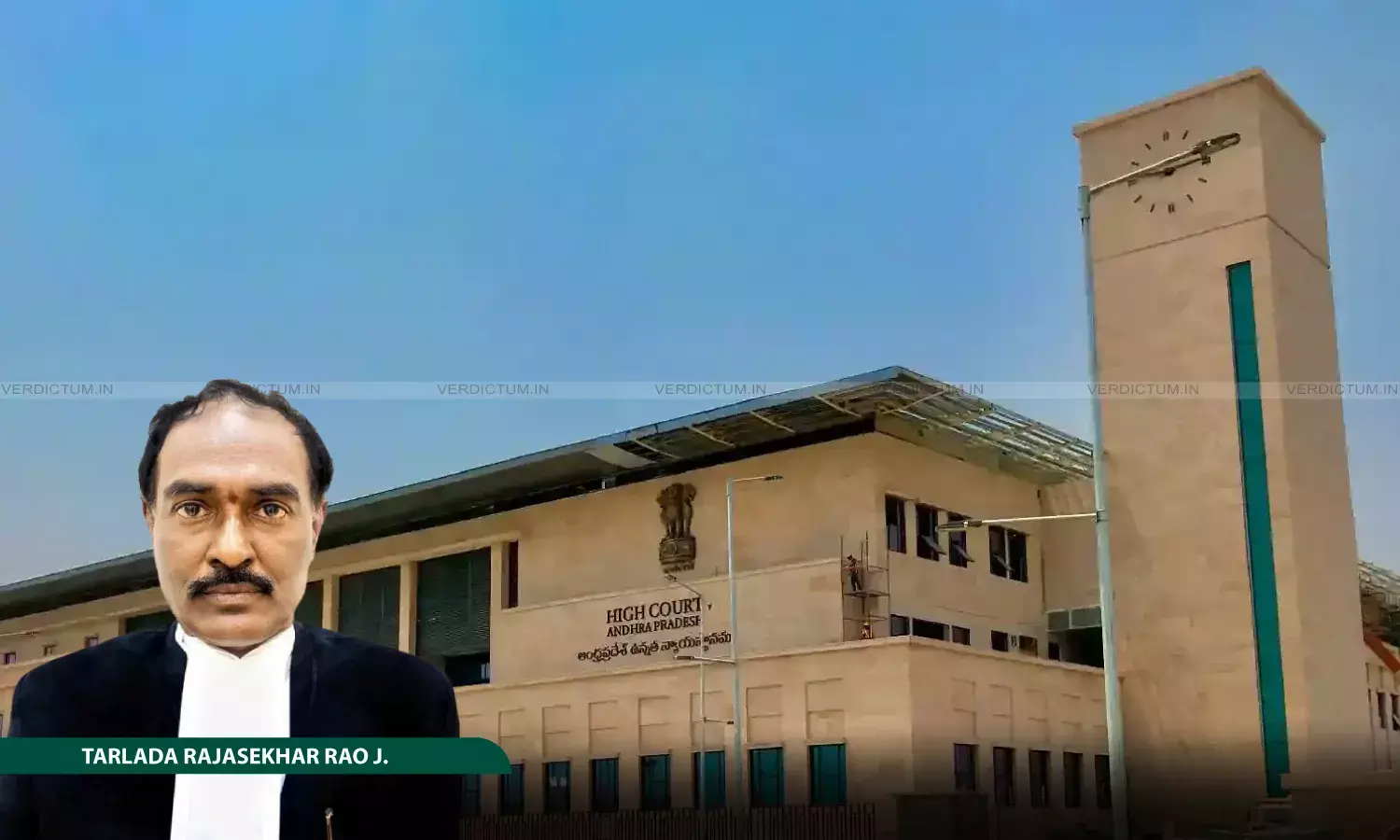
Justice Tarlada Rajasekhar Rao, Andhra Pradesh High Court
The Andhra Pradesh High Court has held that a defendant disputing the paternity of a plaintiff in a partition suit cannot seek a direction for DNA testing to establish that the plaintiff is not his biological daughter.
The Court observed that even if the defendant disputes paternity, he must adduce evidence in accordance with the law and cannot compel the plaintiff to undergo a DNA test.
The Court was hearing a Civil Revision Petition challenging an order passed by the IV Additional District Judge, Vizianagaram, dismissing an application filed under Order XXVI Rule 10-A read with Section 151 CPC seeking appointment of a commissioner for conducting DNA testing between the parties in a partition suit.
A Bench of Justice Tarlada Rajasekhar Rao observed: “Even assuming that the respondent is not a daughter of the petitioner herein. The petitioner cannot file an application to send the respondent for a DNA test, particularly when the plaintiff is claiming partition of the suit schedule properties to prove that the respondent is not a daughter of the petitioner.”
The Court further observed: “He has to adduce the evidence in any other manner to prove that the respondent is not the daughter of the petitioner. The petitioner cannot seek a DNA test.”
Advocate Rayaprolu Srikanth appeared for the petitioner.
Background
The respondent/plaintiff instituted a partition suit claiming a share in the suit schedule properties. The petitioner/first defendant disputed the claim and contended that the plaintiff was not his biological daughter but was born to his elder brother.
To substantiate the said contention, the petitioner filed an application seeking the issuance of a commission for conducting a DNA test at a government-approved forensic science laboratory. The petitioner contended that DNA testing would conclusively determine the issue of paternity and would go to the root of the dispute in the partition suit.
The Trial Court dismissed the application, observing that the burden lies upon the plaintiff to establish her case through cogent oral and documentary evidence and that the plaintiff cannot rely upon the weakness of the defence. Aggrieved by the same, the petitioner approached the High Court under Article 227 of the Constitution.
Court’s Observation
The High Court referred to its earlier decision in a connected matter, relying upon the Supreme Court judgment in Aparna Ajinkya Firodia v. Ajinkya Arun Firodia (2024), wherein it was held that questions relating to DNA testing must be viewed through the prism of the child and not merely through the prism of the parents.
The Court reproduced the Supreme Court’s observation: “The child cannot be used as a pawn to show that the mother of the child was living in adultery.”
The High Court also relied upon Goutam Kundu v. State of West Bengal (1993), wherein the Supreme Court held that courts should not order blood tests as a matter of course and that the presumption under Section 112 of the Evidence Act regarding the legitimacy of a child born during a valid marriage is extremely strong.
The Court observed that ordering DNA or blood tests without compelling reasons may adversely affect the dignity, social status and identity of the child.
The Bench held that the petitioner cannot shift the burden onto the plaintiff by compelling her to undergo scientific testing merely because he disputes the relationship.
The Court further observed that if the petitioner intended to dispute paternity, he was required to establish the same through legally admissible evidence and not by seeking coercive DNA testing in a partition proceeding.
Rejecting the petitioner’s contention that refusal to undergo DNA testing should invite adverse inference, the Court upheld the Trial Court’s view that such applications cannot be entertained as a matter of routine in civil disputes involving inheritance and partition.
The Bench ultimately held that the Trial Court had rightly dismissed the application and that no interference was warranted under Article 227 of the Constitution.
Conclusion
The Andhra Pradesh High Court held that a defendant disputing paternity in a partition suit cannot compel the plaintiff to undergo a DNA test and must instead establish the defence through other admissible evidence.
Accordingly, the Civil Revision Petition challenging the dismissal of the DNA test application was dismissed with costs.
Cause Title: Saradaga Narasayya Reddy v. Dingu Kanaka Mahalakshmi (Neutral Citation: APHC010204952026)