

Private Expert Reports Can Be Relied Upon In Commercial Suits; Court-Appointed Expert Not Mandatory: Andhra Pradesh High Court
The Court held that commercial courts cannot reject expert reports solely because the expert was privately engaged by a litigating party; admissibility and evidentiary value must be tested during trial.

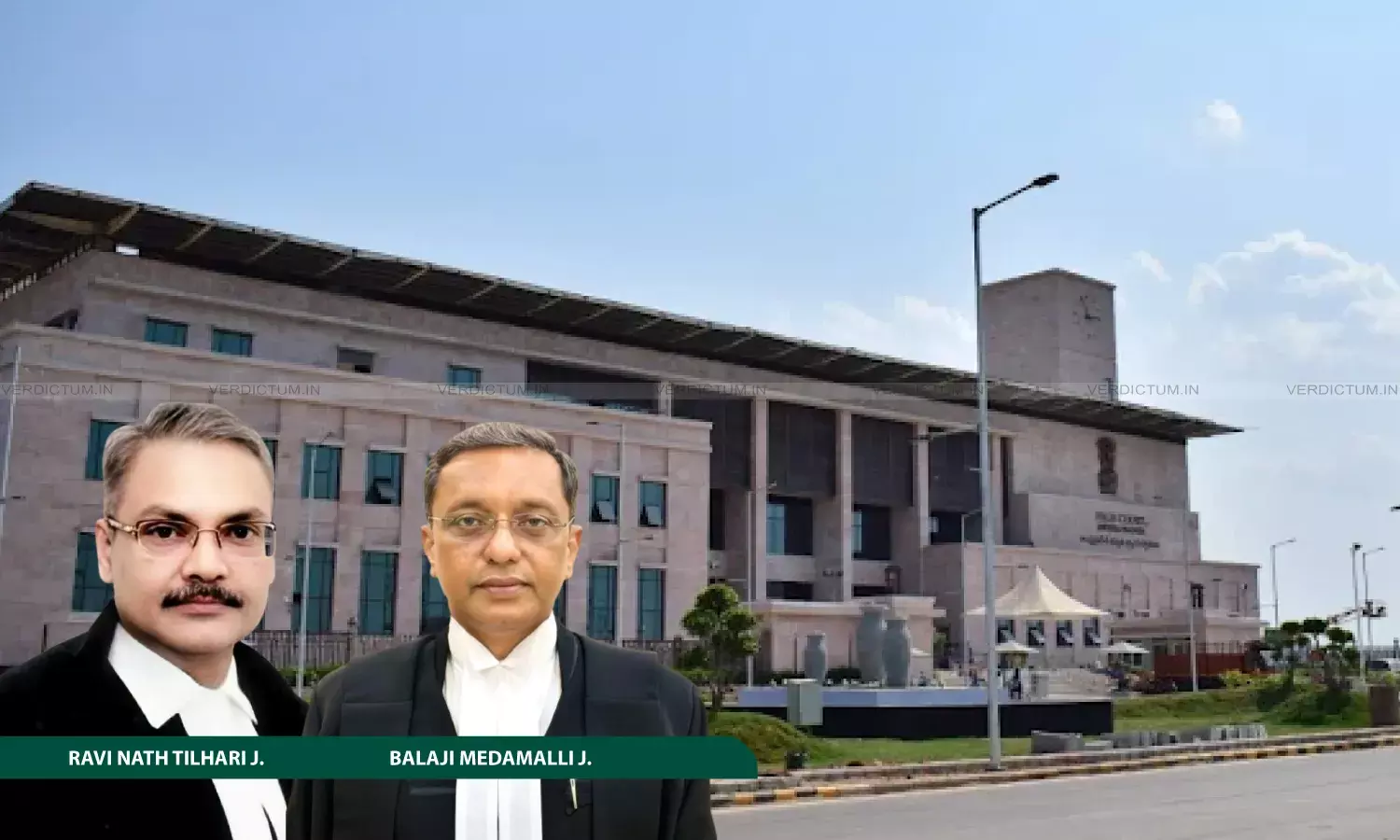
The Andhra Pradesh High Court has held that a party to a commercial dispute is not barred from privately engaging an expert and placing the expert’s report on record, even without prior appointment by the Court. The Court clarified that while appointment of a commissioner or expert by the Court is a judicial function, such power does not exclude litigants from independently obtaining expert opinions in support of their claims.
The Court further observed that the relevancy, admissibility, and evidentiary value of a privately obtained expert report are matters to be examined during trial after the expert is produced and subjected to cross-examination. Merely because an expert was not appointed through judicial intervention does not render the report inherently inadmissible, it said.
Justice Ravi Nath Tilhari and Justice Balaji Medamalli observed, “The submission that a party cannot engage a private expert and place on the record in evidence his report is misconceived. Order XXVI Rule 9 and 10 of CPC, provides for the appointment of Commissioner. But on the ground that the expert was not appointed by the Court in the exercise of judicial function it cannot be said that the report obtained by the plaintiff privately cannot be taken on record. The appointment of Commissioner or expert may be the function of the Court, but that does not preclude to engage an expert and submit that report in evidence as also to produce such an expert to prove the report…”.
“…In such a case the other side shall also have opportunity to file his evidence if so required as also to cross examine the expert, and produced as a witness in evidence. No doubt, the Court can pass order for appointment of the expert, but that does not mean that a party cannot engage a private expert and submit the report of his opinion”, it noted further.
Advocate MRK Chakravarthy appeared for the petitioner-defendant, and Advocate D.S. Sivadarshan appeared for the respondent-plaintiff.
The respondent/plaintiff had instituted a commercial suit seeking recovery of various amounts allegedly arising out of contractual disputes, including claims relating to unpaid running account bills, retention money, idling of machinery, loss of profits, overheads, breach of agreement, and business losses. The aggregate claim exceeded ₹6.42 crore along with interest.
In the first revision petition, the defendant challenged an order permitting the plaintiff to place on record a Certificate of Registration of Firm through a memo during cross-examination of PW-1. The High Court held that the Commercial Courts Act and amended provisions of Order XI CPC prescribe a specific procedure for bringing additional documents on record, which could not be bypassed by filing a mere memo.
Accordingly, the order was set aside, though liberty was granted to the plaintiff to file a proper application in accordance with law.
The second revision petition concerned an order allowing the plaintiff to place on record an expert report dated August 26, 2024 prepared by a privately engaged claims expert. The defendant argued that only a court-appointed expert could furnish such evidence and alleged that the report was belatedly introduced despite being within the plaintiff’s knowledge earlier.
Rejecting the contention, the Court held that there exists no statutory prohibition against privately engaging experts. The Court drew a distinction between a court-appointed commissioner and an expert witness independently relied upon by a party. It observed that such reports do not automatically become evidence merely upon filing and must still be proved through examination of the expert and tested through cross-examination.
“Firstly, a plea of fact cannot be taken for the first time in the Civil Revision Petition under Article 227 of the Constitution of India and secondly, merely on the amount being same under one head, it cannot be presumed or inferred that the report dated 26.08.2024 is not a report after the institution of the suit but was in power, possession or custody of the plaintiff/respondent at the time of institution of suit”, it noted.
Therefore, agreeing with the precedents on the matter, the Bench said, “An expert can be engaged privately without the intervention of the court as well and his report can be filed in the Court. However, the relevancy and the admissibility of that report shall be subject to the proof, to be determined or seen at the stage of trial”.
Accordingly, the Court found no illegality in the Special Court’s order permitting the report to be taken on record subject to proof, relevancy, and admissibility during trial. Consequently, the civil revision petition was dismissed, while the other was allowed to the limited extent of requiring compliance with procedural requirements.
Cause Title: ISGEC Heavy Engineering Limited v. M/S Fe Engineering C.R.P. Nos.1209
Appearances:
Petitioner: MRK Chakravarthy, Advocate.
Respondent: D.S. Sivadarshan, Advocate.