

Mere Disinclination To Agree To Reunion Offer Cannot Be Treated As "Wrong" U/S 23 Hindu Marriage Act: Andhra Pradesh High Court
The Court held that mere unwillingness or disinclination to agree to reunion cannot by itself amount to “wrong” under Section 23(1)(a) of the Hindu Marriage Act to deny relief of divorce sought under Section 13(1A)(ii) for non-compliance with a decree of restitution of conjugal rights.
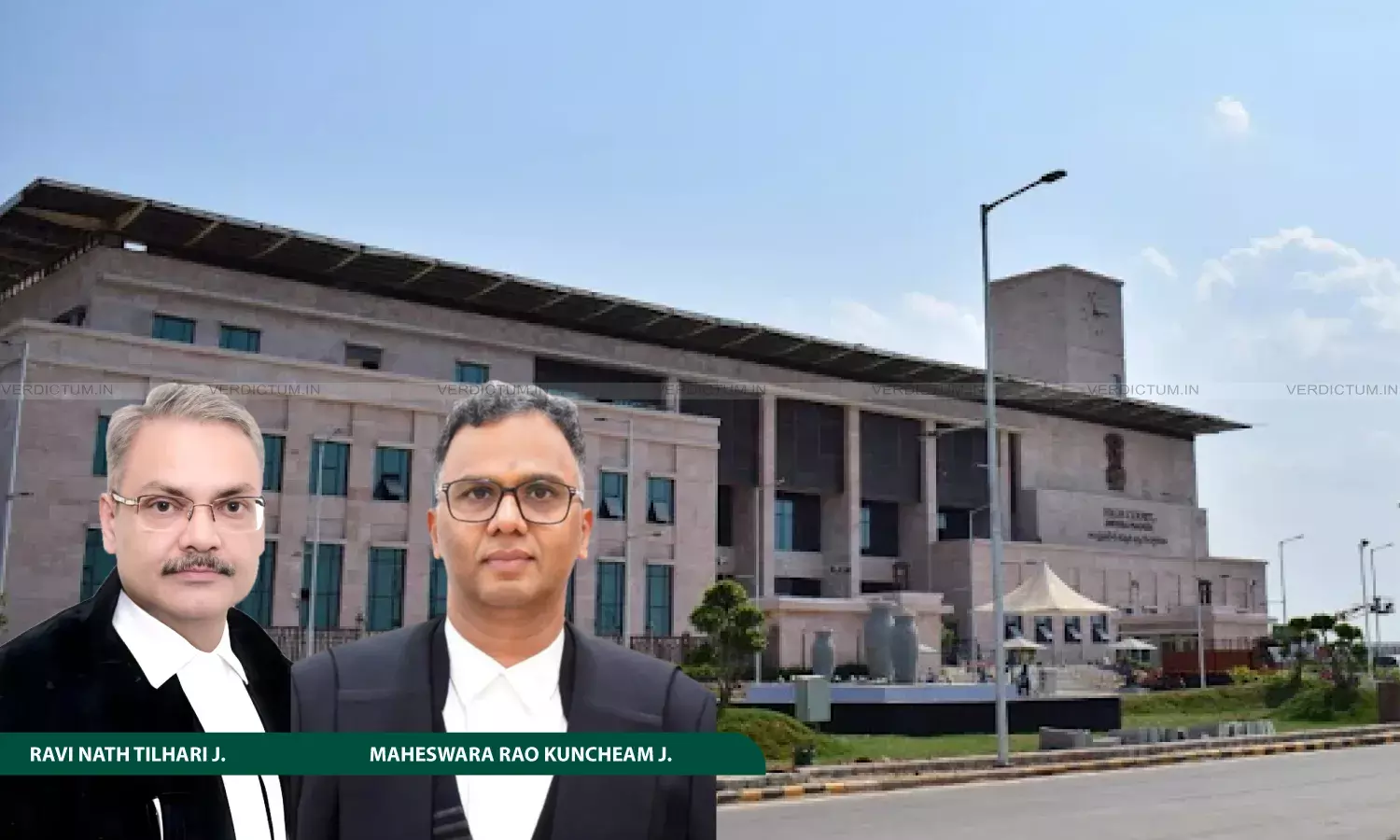
Justice Ravi Nath Tilhari, Justice Maheswara Rao Kuncheam, Andhra Pradesh High Court
The Andhra Pradesh High Court has held that mere disinclination of a spouse to agree to an offer of reunion cannot be termed “wrong” within the meaning of Section 23(1)(a) of the Hindu Marriage Act, 1955, to deny a decree of divorce otherwise maintainable under Section 13(1A)(ii) of the Act.
The Court observed that the conduct alleged must be something more than a “mere disinclination to agree to an offer of reunion” to disentitle a party from obtaining divorce on the ground of non-restitution of conjugal rights for the statutory period.
The Court was hearing an appeal filed by a husband challenging the dismissal of his divorce petition under Section 13(1A)(ii) of the Hindu Marriage Act. The Family Court had refused divorce, holding that the husband himself was responsible for non-compliance with a decree for restitution of conjugal rights earlier obtained by the wife.
A Division Bench comprising Justice Ravi Nath Tilhari and Justice Maheswara Rao Kuncheam, while relying on the Supreme Court’s ruling in Dharmendra Kumar v. Usha Kumar (1977) observed: “In order to be a ‘wrong’ within the meaning of Section 23(1)(a), the conduct alleged has to be something more than a mere disinclination to agree to an offer of reunion, it must be misconduct serious enough to justify denial of the relief to which the husband or the wife is otherwise entitled.”
Advocate K. A. Narasimham appeared for the appellant-husband, while Advocate Anup Koushik Karavadi appeared for the respondent-wife.
Background
The parties were married on 05.02.1992 and had one male child. Owing to matrimonial disputes, the husband had earlier filed a divorce petition, while the wife filed a petition seeking restitution of conjugal rights under Section 9 of the Hindu Marriage Act.
By a common order dated 12.07.2001, the Family Court dismissed the husband’s divorce petition and allowed the wife’s petition for restitution of conjugal rights. Thereafter, the husband instituted proceedings seeking divorce under Section 13(1A)(ii) on the ground that there had been no restitution of conjugal rights for more than one year after the decree.
The wife opposed the petition, contending that she repeatedly approached the husband to resume cohabitation, but he refused to take her back into the matrimonial home. She maintained that she was still willing to join her husband.
The Family Court accepted the wife’s case and dismissed the divorce petition, holding that the husband lacked bona fides and had himself prevented compliance with the restitution decree.
Court’s Observation
The High Court extensively examined Sections 13(1A)(ii) and 23(1)(a) of the Hindu Marriage Act and referred to precedents, including Smt. Saroj Rani v. Sudarshan Kumar Chadha (1984), Dharmendra Kumar v. Usha Kumar (1977), Dr N.G. Dastane v. Mrs S. Dastane (1975) and Pavuluri Murahari Rao v. Povuluri Vasantha Manohari (1984).
The Bench noted that under Section 13(1A)(ii), either spouse could seek dissolution of marriage where there had been no restitution of conjugal rights for one year or more after the passing of a restitution decree.
Referring to Section 23(1)(a), the Court reiterated that relief could be denied only where the petitioner was “taking advantage of his or her own wrong.”
The Court observed that the expression “wrong” under Section 23(1)(a) had consistently been interpreted to mean serious misconduct and not mere unwillingness to reconcile.
The Bench scrutinised the oral evidence led by the wife and her witnesses and found significant contradictions regarding the alleged attempts made by the wife to join the husband after the restitution decree.
The Court found the testimony of RW-2 unreliable on account of inconsistencies in dates and chronology and further held that even if the husband had postponed reunion or shown reluctance, such conduct did not amount to “wrong” within the meaning of Section 23(1)(a).
The Bench remarked: “ …from the evidence of RW.1 and RW.3, even if considered and taken together, what follows at the most is the disinclination of the husband to take the wife back. Such a disinclination, though not established, cannot be termed „wrong‟, as held in Smt. Saroj Rani (supra) that the conduct alleged has to be something more than a mere disinclination to agree to an offer of reunion, to deny the relief”.
The Bench also observed that the burden of proving that the husband prevented compliance with the restitution decree lay upon the wife, which burden had not been discharged. The Court further noted that the wife had never sought execution of the decree for restitution of conjugal rights under Order XXI Rule 31 CPC.
The Bench concluded that “the act or conduct of the husband is not such nor could be so proved, as to attract any wrong on his part within the meaning of Section 23 (1) (a) to deny the relief of dissolution of marriage under Section 13 (1A) (ii) of the Hindu Marriage Act”.
Conclusion
The High Court held that the husband had successfully made out a ground for divorce under Section 13(1A)(ii) of the Hindu Marriage Act and that the Family Court had erred in invoking Section 23(1)(a) to deny relief.
Allowing the appeal, the Court set aside the judgment of the Family Court and dissolved the marriage solemnised between the parties on 05.02.1992.
Cause Title: TR v. TLD
