

No Separate Prior Notice Required Before Invoking Suo Motu Revisional Power U/ 9 ROR Act: Andhra Pradesh High Court
The Bench held that only one notice under proviso to Section 9 Read with Rule 23(2), is statutorily contemplated; dismissed and writ appeal.

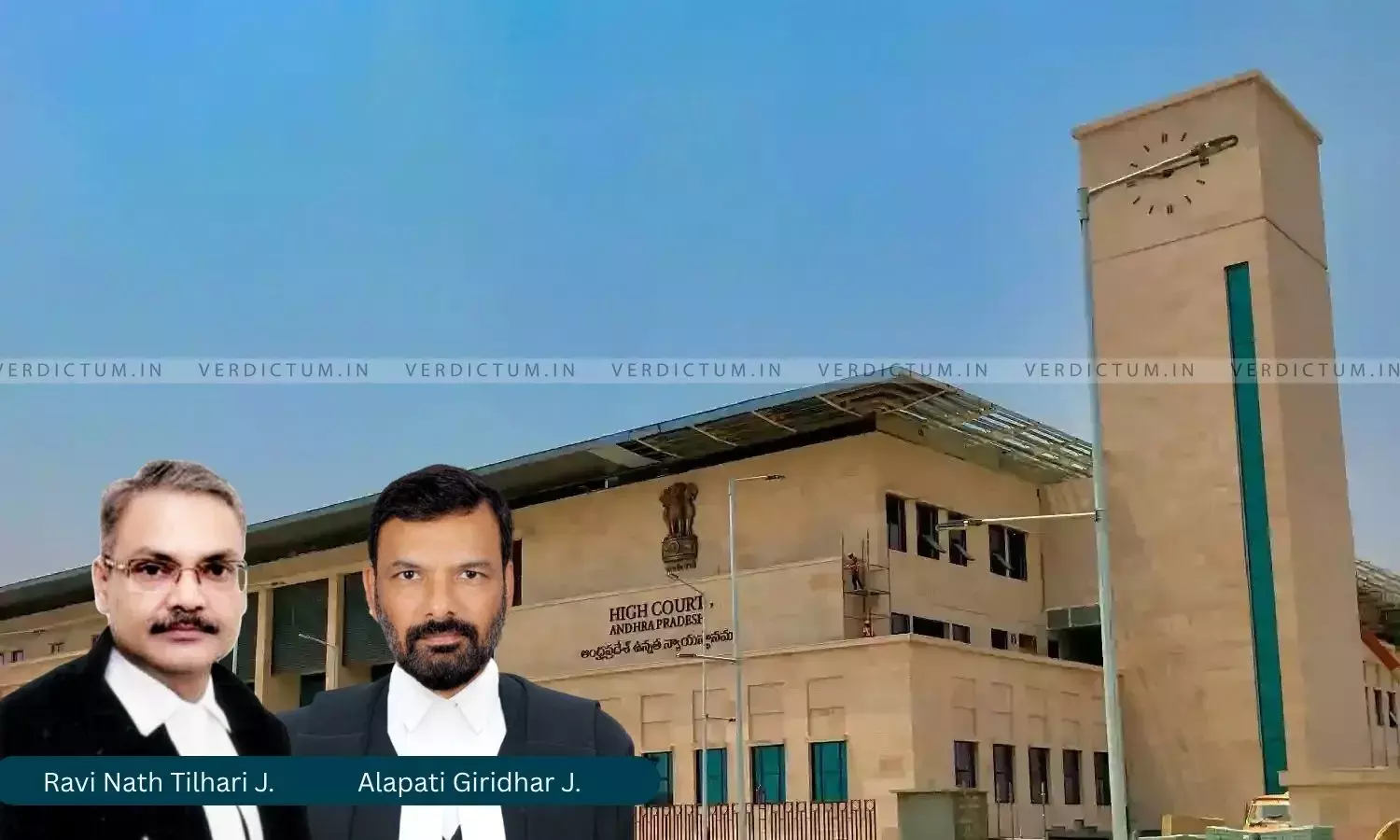
The Andhra Pradesh High Court has held that the exercise of suo motu revisional power by the competent authority under Section 9 of the Andhra Pradesh Rights in Land and Pattadar Passbooks Act, 1971 does not require the issuance of a prior show-cause notice asking why such power should not be invoked, before the substantive notice under the proviso to Section 9 is issued. The Court held that only one notice is contemplated by the statutory scheme, comprising the grounds of revision communicated under Section 9 read with Rule 23(2) of the Andhra Pradesh Rights in Land and Pattadar Pass Books Rules, 1989, and that this alone constitutes sufficient compliance with the principles of natural justice.
The Bench expressly overruled a Single Judge decision of the same Court in Healthy Agro Enterprises Pvt Ltd v. State of Andhra Pradesh 2021 SCC OnLine AP 3152, holding that the earlier judgment had incorrectly extended the ratio of the Supreme Court's decision in M/s. D.N. Roy and S.K. Bannerjee and Others v. State of Bihar and Others 1970 (3) SCC 119, which concerned the Mineral Concession Rules, 1960, a statutory framework containing no provision either for suo motu revision or for notice to affected persons, unlike the ROR Act, 1971.
A Division Bench comprising Justice Ravi Nath Tilhari and Justice Alapati Giridhar in a writ appeal filed under Clause 15 of the Letters Patent against an interim order, observed, “In our considered view, for initiation of suo motu proceedings under Section 9 of the ROR Act, 1971, there is no statutory requirement to issue a notice firstly calling upon the person concerned to show cause as to why the suo motu power should not be invoked and then secondly, to issue to the person or persons likely to be adversely affected, another show-cause notice communicating the grounds on which the power is to be exercised, in terms of proviso to Section 9 of the Act read with Rule 23(2) of the Rules, 1989, before any adverse order is passed. Only one notice is contemplated by the statute and in D.N. Roy (supra) also such one notice was the requirement for initiation of the suo moto proceedings”.
Advocate P. Sai Surya Teja appeared for the appellants and K. Dilip Naik, Assistant Government Pleader appeared for the respondent.
The appellants, agriculturists from Venigandia village in Guntur district, had challenged before the Single Judge a notice issued under Section 9 of the ROR Act, 1971, pursuant to a representation made by a private respondent. Their writ petition contended that the Joint Collector-cum-Revisional Authority lacked jurisdiction to issue the notice, since no prior notice proposing initiation of suo motu proceedings had been issued before the impugned notice. The Single Judge had directed the appellants to urge all such grounds, including the jurisdictional objection, before the Joint Collector at the enquiry, while directing the Joint Collector to first decide the question of jurisdiction. Aggrieved, the appellants carried the matter in appeal, seeking stay of further proceedings pursuant to the notice.
Before the Division Bench, the appellants relied on Healthy Agro Enterprises, which had in turn relied on the Supreme Court's ruling in D.N. Roy, to contend that a show-cause notice as to why suo motu proceedings should not be initiated was a mandatory precondition. The Revenue, appearing through the Government Pleader, submitted that Section 9 read with Rule 23(2) already provided for communication of grounds to persons likely to be adversely affected, and that no illegality attached to the notice issued.
On D.N. Roy, the Court noted that the Supreme Court had read the requirement of prior notice into the Mineral Concession Rules, 1960 only because that framework was silent on both the existence of suo motu power and the procedure for its exercise.
The Court held that where, as under the ROR Act, the statute itself expressly confers suo motu power and prescribes the manner of its exercise by requiring communication of grounds under the proviso to Section 9 read with Rule 23(2), the principles of natural justice stand duly incorporated, and no additional or anterior notice can be judicially imposed, since doing so would amount to legislation by the Court.
The Court accordingly held that there was no error of jurisdiction in the issuance of the impugned notice and dismissed the writ appeal, while directing the appellants to file their objections before the Joint Collector, who was directed to decide the matter, including the question of jurisdiction, in accordance with law and expeditiously.
Cause Title: Durgam Paddaiah and others v. The State of Andhra Pradesh, Department of Revenue and others, Writ Appeal No. 999 of 2026
Appearances:
Appellants: P. Sai Surya Teja, Advocate.
Respondent: K. Dilip Naik, Assistant Government Pleader