

Service Of Remand Report Containing Grounds Of Arrest Constitutes Valid Communication Even If Notices U/S. 47 & 48 BNSS Are Silent: Andhra Pradesh High Court
The Bench clarified that the mandatory requirement under Article 22(1) is satisfied if a detailed remand report is served prior to the remand proceedings.

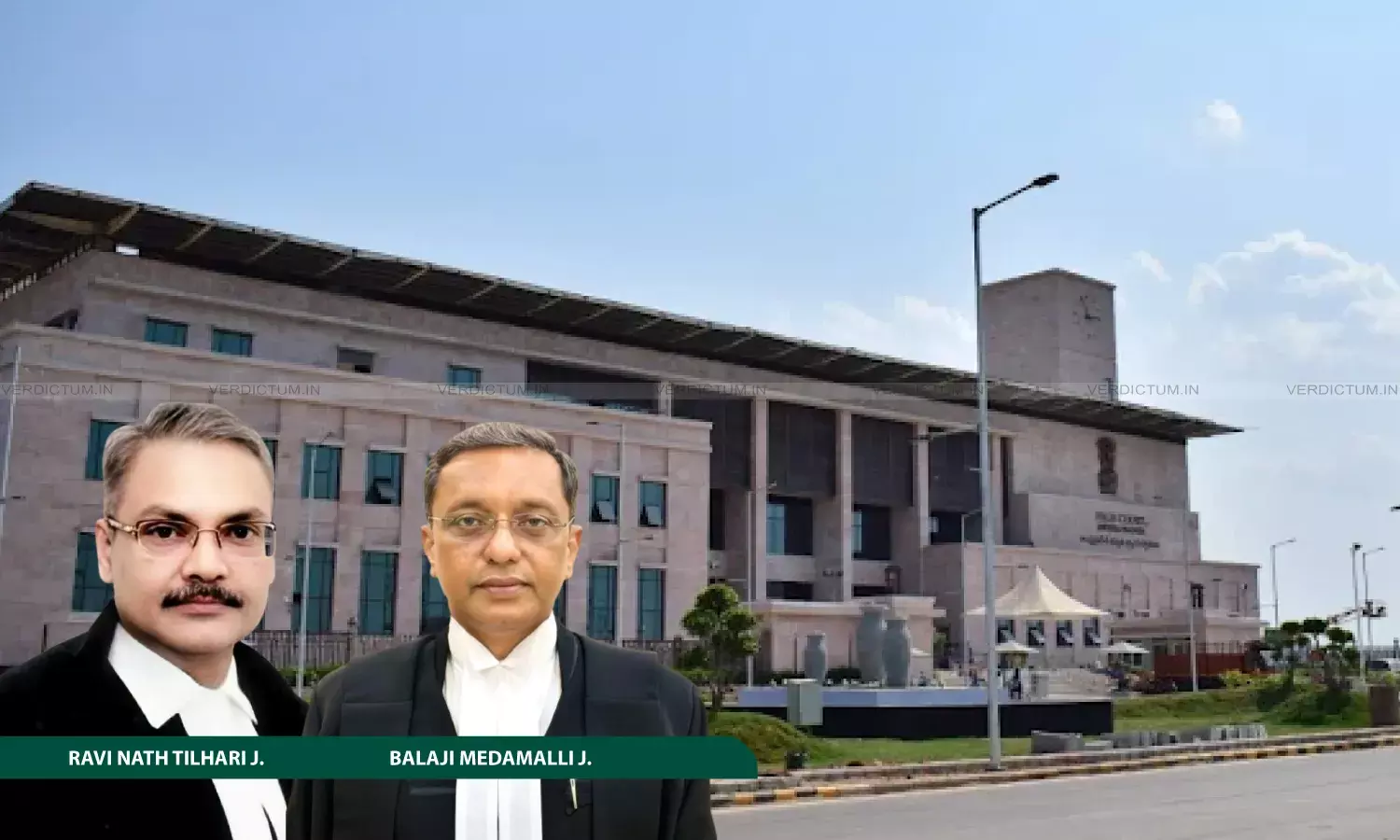
The Andhra Pradesh High Court has held that service of a remand report containing the grounds of arrest constitutes valid communication of the grounds of arrest to an accused, even where notices issued under Sections 47 and 48 of the Bharatiya Nagarik Suraksha Sanhita (BNSS) do not themselves disclose such grounds. The Court clarified that substantial compliance with the constitutional and statutory requirement is achieved once the arrested person is made aware of the basis of arrest through the remand proceedings.
The Court noted that Article 22(1) of the Constitution of India, does not necessitate a specific mode or a formal heading so long as the substance of the accusation is effectively conveyed.
Justice Ravi Nath Tilhari and Justice Balaji Medamalli observed, “We are therefore of the view that the service of the remand report to the arrestees, containing the grounds of arrest is communication of the grounds of arrest to the arrestees even if the notices under Sections 47 & 48 of BNSS did not contain the grounds of arrest”.
Advocate Kuntamukkala Sai Sree Sanjay appeared for the petitioner and J. Krishna Praneeth, Assistant Government Pleader, appeared for the respondents.
The matter arose from a Habeas Corpus petition involving two individuals, Tanigadapa Prasad and Tungala Rukhmini, who were arrested by the Mylavaram Police in 2026.
They were charged under Sections 308(5), 127(1), and 3(5) of the Bharatiya Nagarik Suraksha Sanhita, 2023. Following their arrest, the II Additional Judicial First Class Magistrate, Nuzvidu, ordered their remand to judicial custody on April 09, 2026.
The petitioner challenged the detention primarily on the ground that the grounds of arrest were never formally communicated in writing. It was argued that the notices issued under Sections 47 and 48 of the BNSS served as mere intimations of arrest rather than detailed disclosures of the grounds.
Now, the Court distinguished the present case from precedents where remand was quashed due to non-service of documents. The Bench noted that the petitioner did not dispute that the remand report was served prior to the proceedings or that it contained the factual grounds for arrest.
The Court further rejected a belated verbal contention regarding the language of the report, noting a lack of factual foundation in the pleadings to suggest the detenues did not understand English.
“…Any pleading that the remand report is not in the language which the arrestees understand, has not been raised in the writ petition. Any such pleading or any such ground taken in the writ petition has not been shown to us. Consequently, in the absence of any factual foundation it cannot be presumed that the communication of the grounds of 14 arrest vide the remand report is not in the language which the arrestees do not understand”, the Bencn noted.
“In conclusion, we hold that; there is no violation of Article 22(1) of the Constitution of India. There is no violation of the fundamental right of the arrestees under Article 21 of Constitution of India. The challenge to the remand Order on the aforesaid limited ground is not made out”, the Bench observed.
Consequently, the writ petition was dismissed as lacking merit, and the detention was upheld as legal.
Cause Title: Bolla Kiran v. The State of Andhra Pradesh & 5 others. Writ Petition No: 9972/2026
Appearances:
Petitioner: Kuntamukkala Sai Sree Sanjay, Advocate.
Respondents: J. Krishna Praneeth, Assistant Government Pleader.