

Mere Suspicion Of Slaughter Not Enough: Allahabad High Court Quashes Vehicle Confiscation Under UP Cow Slaughter Act
The High Court found that suspicion arising from interception in a border district could not replace proof of illegal inter-State transportation or slaughter-linked material.
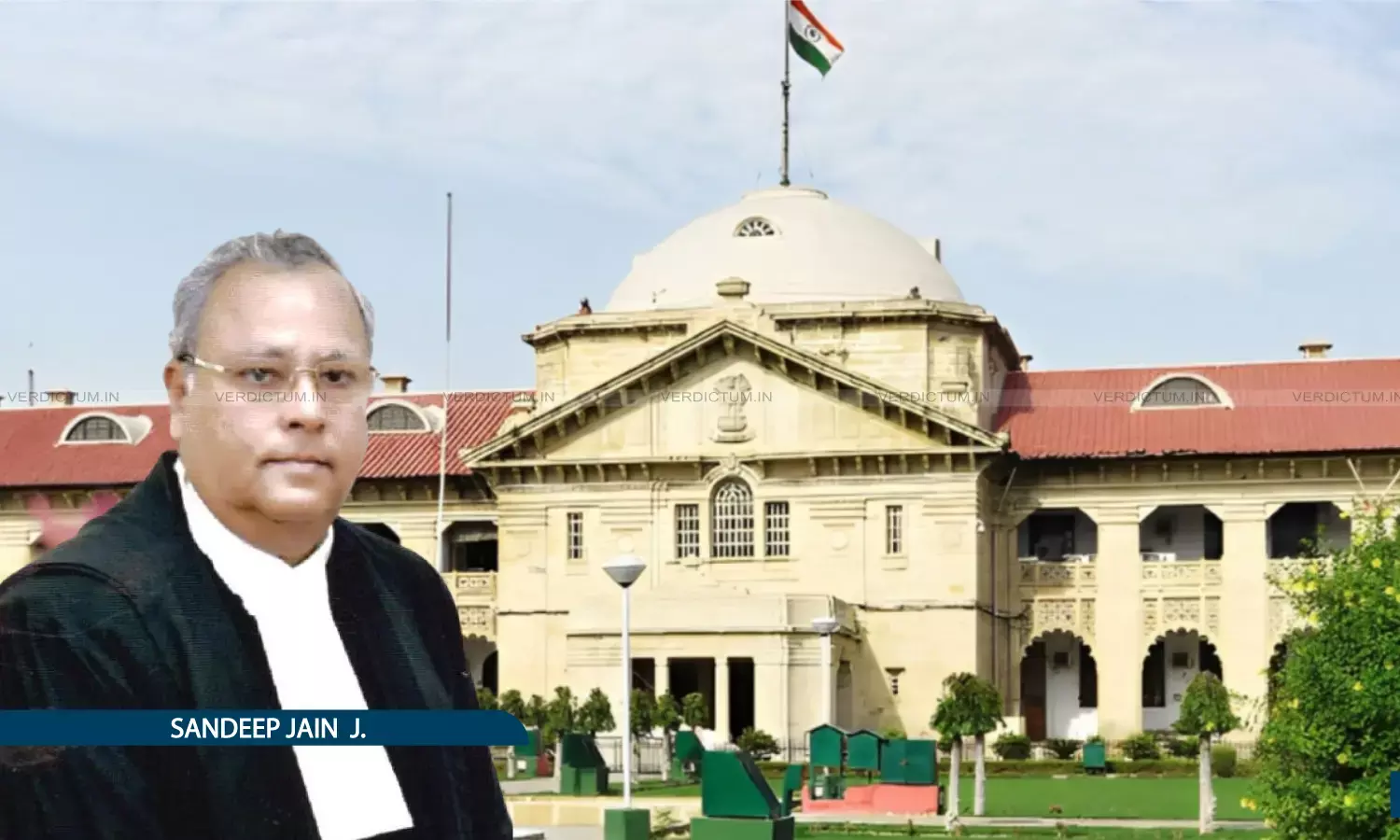
Justice Sandeep Jain, Allahabad High Court
The Allahabad High Court has quashed the confiscation of a commercial transport vehicle seized on suspicion of illegal transportation of bovine animals and directed the State to pay the owner compensation of ₹20,000 per month from the date of seizure till actual release of the vehicle, along with ₹25,000 for mental agony, financial hardship and unnecessary harassment.
The Court held that the statutory presumption under Section 5-A(10) of the Uttar Pradesh Prevention of Cow Slaughter Act, 1955 is not automatic and cannot be invoked unless foundational facts, particularly recovery of beef or cow remains and laboratory confirmation of prohibited substance, are present.
The Court was hearing a writ petition filed by the registered owner of a Tata Ace Gold transport vehicle challenging the orders passed by the District Magistrate, Chandauli and the Commissioner, Varanasi Division, by which the vehicle had been confiscated under the Uttar Pradesh Prevention of Cow Slaughter Act, 1955.
A Bench of Justice Sandeep Jain observed: “ … The reliance placed upon the presumption contained in Section 5-A(10) of the Act of 1955 is equally misconceived. The statutory presumption contemplated therein is not automatic. Such presumption arises only in circumstances specifically provided under the statute, particularly where beef or cow remains are recovered, and laboratory examination confirms the prohibited substance. …
The Bench added: “Admittedly, in the present case, neither any beef nor any remains of slaughtered cow and its progeny were recovered from the petitioner's vehicle. The foundational facts necessary for drawing the statutory presumption are, therefore, completely absent. In the absence of those foundational facts, the burden never shifted upon the petitioner. Consequently, both the authorities have committed a manifest error of law in invoking the statutory presumption against the petitioner.
Advocates Sapana Singh and Vikas Mishra appeared for the petitioner, while the Government Advocate appeared for the respondents.
Background
The petitioner was the registered owner of a Tata Ace Gold Diesel transport vehicle. According to the prosecution, the vehicle was intercepted by police personnel in Chandauli on suspicion that bovine animals were being illegally transported from Uttar Pradesh to Bihar for slaughter. A case was registered under the Prevention of Cruelty to Animals Act, 1960 and the Uttar Pradesh Prevention of Cow Slaughter Act, 1955.
The State alleged that three bovine animals, two cows and one calf, were recovered from the vehicle. The petitioner, however, asserted that only one cow and one calf were being transported, that both belonged to another person, and that the destination was within Uttar Pradesh. He also alleged that the vehicle was falsely implicated after the driver refused to pay illegal gratification.
The District Magistrate relied on the veterinary report, Section 5-B of the Act, the presumption under Section 5-A(10), and Rule 16 of the Uttar Pradesh Prevention of Cow Slaughter Rules, 1964, to hold that a permit was necessary and that the animals were being transported for slaughter. The vehicle was confiscated. The appellate authority affirmed the order, after which the petitioner moved the High Court.
The petitioner argued that there was no evidence that the animals were being transported outside Uttar Pradesh or for slaughter, that no beef or remains of slaughtered cow were recovered, and that no permit was required for transportation within the State. He also submitted that the vehicle was his sole source of livelihood and had been purchased on loan, with monthly instalments of ₹12,599.
The State defended the confiscation, arguing that the vehicle was intercepted in a border district, the petitioner had no permit, and the veterinary report showed cruelty in transportation. It also opposed compensation, contending that the State could not be saddled with monetary liability once confiscation was validly made.
Court’s Observations
The Court found that the confiscation rested on an assumption that because Chandauli shares a border with Bihar, the animals must have been intended to be transported outside Uttar Pradesh for slaughter.
The Court observed: “The entire reasoning adopted by the confiscating authority proceeds on the assumption that since Chandauli shares its border with the neighbouring State of Bihar, the cow and its progeny must necessarily have been intended to be transported into the State of Bihar for slaughter. Such a conclusion is founded merely upon conjectures and surmises and is wholly unsupported by any independent evidence.”
It added: “The existence of an international or inter-State boundary by itself cannot constitute proof of illegal transportation. Unless there exists positive and cogent evidence indicating that the destination of the vehicle was outside the State of Uttar Pradesh or that the transportation was intended for slaughter, no such presumption can legally be drawn merely because the vehicle happened to be intercepted in a border district.”
The Court further noted that neither the driver’s statement, nor documentary evidence, nor any independent witness had been relied upon to establish that the animals were being transported to Bihar.
The Court rejected the State’s argument that the veterinary report supported confiscation on the ground of cruel transportation.
The Court recorded: “A perusal of the veterinary report, which has been placed on record by the petitioner himself, clearly reveals that one cow and one calf were medically examined and both were found to be healthy. The report nowhere records that the animals had sustained any injury or were being transported in such a condition so as to indicate cruelty within the meaning of law.”
It therefore held that the submission that the Veterinary Officer found the animals unsafe, injured or mutilated was factually incorrect and was belied by the medical report itself.
On Rule 16, the Court held that the permit requirement arises only where cow and its progeny are proposed to be transported from Uttar Pradesh to a place outside the State.
The Court observed: “A plain reading of Rule 16 leaves no room for ambiguity that the requirement of obtaining permit is attracted only where cow and its progeny are proposed to be transported from any place within the State of Uttar Pradesh to any place situated outside the State. The Rule does not require any permit for transportation of bovine animals from one place to another within the territorial limits of Uttar Pradesh.”
The Court also relied on earlier decisions of the High Court, including Kaliya v. State of UP And Others (2023) and Munib v. State of UP and 2 others (2024), where it had been held that no permit is required for transporting cow or its progeny within Uttar Pradesh and that confiscation cannot be ordered automatically.
The Court said the matter did not end with setting aside the confiscation orders, since the petitioner had specifically pleaded that the vehicle was his sole source of livelihood and that assertion had not been specifically denied by the State.
The Court noted: “Thereafter, owing to complete deprivation of income resulting from the illegal confiscation, he became incapable of servicing the remaining loan liability. The inevitable consequence of the illegal action of the State has been that the petitioner remained deprived of his only source of income for a substantial period without any legal justification. Article 21 of the Constitution protects not merely life but also the right to livelihood.”
Relying on Nilabati Behera v. State of Orissa (1993), Sube Singh v. State of Haryana (2006) and Indibily Creative Private Ltd. v. Government of West Bengal (2020), the Court held that public law compensation can be awarded where arbitrary State action deprives a citizen of livelihood.
Conclusion
The High Court allowed the writ petition and quashed the vehicle confiscation order passed by the District Magistrate, Chandauli, as well as the appellate order passed by the Commissioner, Varanasi Division.
It directed the respondents to release the petitioner’s vehicle forthwith, if not required in any other case, preferably within one week from production of a certified copy of the judgment.
The State was directed to pay compensation at ₹20,000 per month from September 19, 2024 till actual release of the vehicle. The Court also awarded ₹25,000 as consolidated compensation for mental agony, financial hardship and unnecessary harassment. The amount was directed to be paid within one month.
The Court further observed that since the confiscation was found wholly illegal and arbitrary, the State Government may hold a departmental inquiry and recover the compensation amount from officers found responsible, strictly in accordance with law and after complying with principles of natural justice.
Cause Title: Vinod Kumar Singh v. State Of U.P. And 3 Others (Neutral Citation: 2026:AHC:164202)
