

Bigamous Marriage By Uttar Pradesh Government Servant Can Attract Major Or Minor Penalty: Allahabad High Court
The Court observed that the earlier decisions limiting the punishment to withholding three increments had applied a provision deleted in 1976 and did not constitute binding precedent on the presently applicable Rule 29.
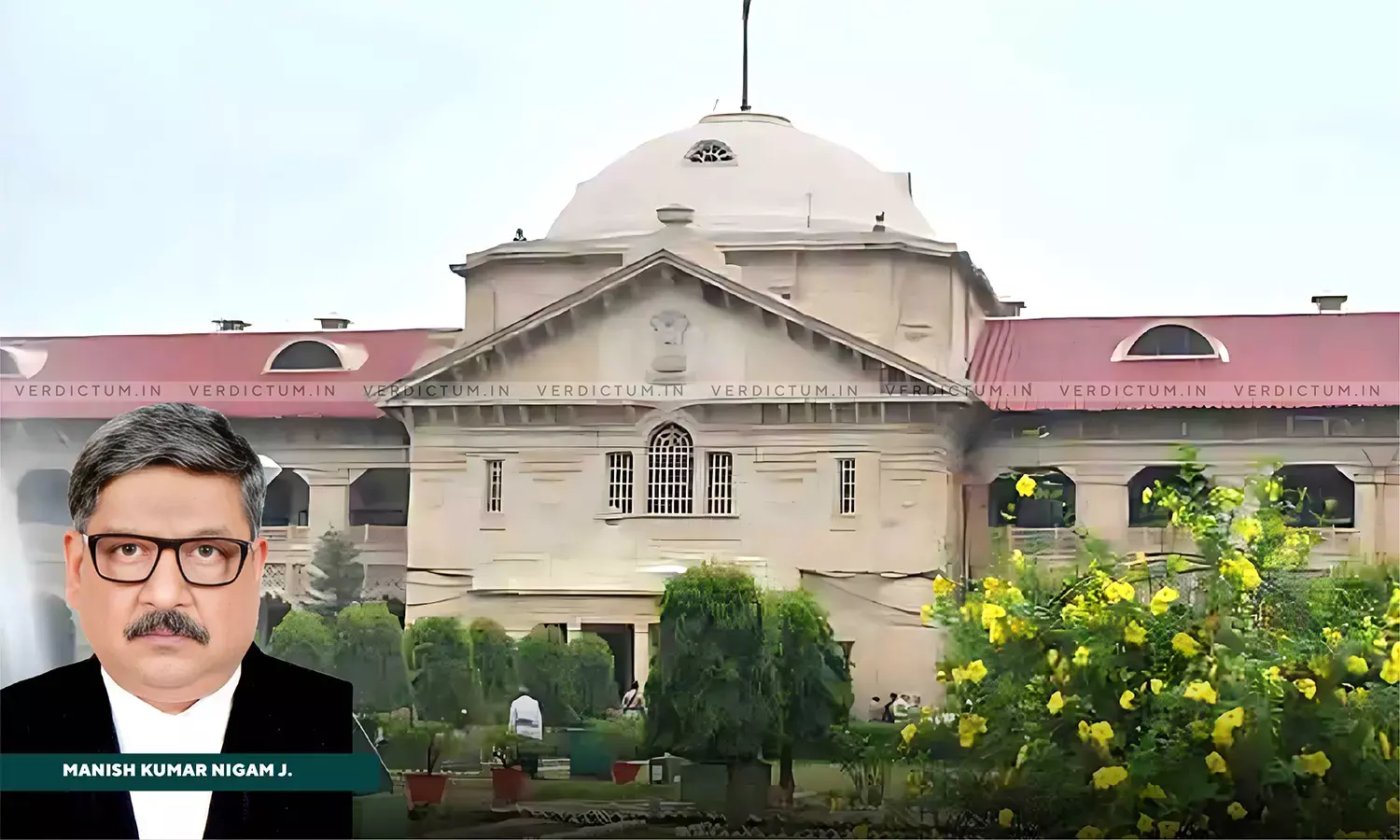
The Allahabad High Court has held that violation of the restrictions on bigamous marriages under Rule 29(1) and (2) of the Uttar Pradesh Government Servants’ Conduct Rules, 1956 can attract either a minor or major penalty, depending upon the facts and circumstances.
The Court dismissed a police constable’s challenge to the initiation of major-penalty proceedings over the allegation that she remarried without divorcing her first husband.
The Court was hearing a writ petition seeking to quash a disciplinary charge sheet issued under Rule 14(1) of the Uttar Pradesh Police Officers of the Subordinate Ranks (Punishment and Appeal) Rules, 1991, and to restrain the authorities from continuing the departmental proceedings.
A Bench of Justice Manish Kumar Nigam observed: “Since Sub-rule (3) of Rule 29 of 1956 Rules has already deleted in the year 1976, it cannot be held that in case of violation of Sub-rule (1) & (2) of Rule 29 of 1956 Rules, only minor penalty i.e. stoppage of three increments can be passed. In my view, it is the discretion of the appointing authority depending upon the facts and circumstances of the case to award punishment for violation of Sub-rule (1) and (2) of Rule 29 of 1956 Rules. I am not inclined to consider the contention of learned counsel for the petitioner that the judgments relied upon by learned standing counsel which related to the statute providing punishment for committing a crime will not be applicable to a departmental proceedings at this stage.”
Advocate Arya Gautam appeared for the petitioner, while Standing Counsel R.S. Umrao appeared for the State respondents.
Background
The petitioner was serving as a constable in the Uttar Pradesh Police. A disciplinary charge sheet was issued against her under Rule 14(1) of the Uttar Pradesh Police Officers of the Subordinate Ranks (Punishment and Appeal) Rules, 1991.
The charge alleged that after entering police service, the petitioner married another person without divorcing her first husband and thereby violated Rule 29 of the Uttar Pradesh Government Servants’ Conduct Rules, 1956.
The petitioner contended that Rule 14(1) prescribes the procedure for imposing a major penalty. According to her, violation of Rule 29 could attract only the minor penalty of withholding increments for three years. She therefore argued that any inquiry should have been initiated under Rule 14(2) of the 1991 Rules, which governs the imposition of minor penalties.
The State responded that Rule 29(3), which referred to withholding increments for three years, had been deleted through the Uttar Pradesh Government Servants’ Conduct (Fourth Amendment) Rules, 1976. Consequently, the appointing authority retained the discretion to impose either a minor or major penalty after considering the circumstances established during the inquiry.
Court’s Observations
The Court traced the legislative history of Rule 29 of the Uttar Pradesh Government Servants’ Conduct Rules, 1956. The original provision prohibited a male government servant with a living wife from contracting another marriage without prior government permission, even if the subsequent marriage was permissible under the applicable personal law.
Rule 29(2) was subsequently inserted to prohibit a female government servant from marrying a person whose wife was living without first obtaining government permission. In 1964, Rule 29(3) was added, prescribing withholding of increments for three years as the minimum punishment for violating either restriction.
The Court found that the entire Rule 29 was substituted in 1976. The substituted provision retained the restrictions contained in sub-rules (1) and (2), but omitted sub-rule (3). The substituted Rule 29 contained no provision prescribing withholding of increments for three years or otherwise confining the disciplinary authority to a minor penalty.
The petitioner relied on several decisions of the High Court in which dismissal or suspension for alleged violation of Rule 29 had been interfered with on the understanding that only a minor penalty could be imposed.
The Court examined Kamaluddin Khan v. State of Uttar Pradesh (2025), Prabhat Bhatnagar v. State of Uttar Pradesh (2023), Kuber Singh v. State of Uttar Pradesh (2020), Shravan Kumar Pandey v. State of Uttar Pradesh (2010), Smt. Rajbala Sharma v. State of Uttar Pradesh (2009), Pati Ram v. State of Uttar Pradesh (2023), Rajveer Singh Constable v. State of Uttar Pradesh (2022) and Ram Pal Singh v. State of Uttar Pradesh (2022).
It found that these decisions had either considered the unamended Rule 29 or granted relief because the alleged second marriage had not been proved. The effect of the 1976 deletion of Rule 29(3) had not been considered.
The Court held: “Thus from the case laws relied upon by learned counsel for the petitioner, it is apparent that in all the cases, unamended Rule 29 has been considered and it has been held by this Court in case of violation of Sub-rule (1) & (2) of Rule 29 of 1956 Rules, only a minor penalty can be imposed. Since all the judgments are passed without considering the effect of the amended provision by which Sub-rule (3) has been deleted, there is no binding of precedent.”
Aneeta Yadav v. State of Uttar Pradesh (2017) was found factually distinguishable because the employee in that case was unaware that the person she married already had a living spouse, and the Court had held that Rule 29 was not attracted.
The Court also considered the State’s reliance on Mohammad Hashim v. State of Uttar Pradesh (2017), State of Madhya Pradesh v. Vikram Das (2019) and Dashrath v. State of Maharashtra (2025), concerning provisions prescribing minimum punishment. It declined at the charge-sheet stage to accept the petitioner’s contention that those decisions were inapplicable merely because they arose under criminal statutes.
The Court clarified that initiation of proceedings under Rule 14(1) of the Uttar Pradesh Police Officers of the Subordinate Ranks (Punishment and Appeal) Rules, 1991 does not compel the disciplinary authority to impose a major penalty. It merely ensures that the more elaborate procedure prescribed for a possible major penalty is followed.
It observed: “Initiation of an inquiry/departmental proceedings under Rule 14(1) of 1991 Rules which prescribes the procedure for award of major penalty does not mean that the disciplinary authority is under an obligation to impose major penalty only, in case the proceedings are initiated under Rule 14(1) of 1991 Rules. In case, after departmental proceedings and after considering the facts and circumstances, the disciplinary authority is of the view that the delinquent employee may be punished with a minor penalty there is no impediment in passing such an order, even after holding an inquiry under Rule 14(1) of 1991 Rules.”
The Court added that the quantum of punishment must be determined only after examining the evidence and circumstances emerging from the departmental inquiry. It cannot be predetermined by whether the proceedings were initiated under Rule 14(1) or Rule 14(2).
The Court explained: “The procedure for holding an inquiry in case of major penalty is more elaborate than in case of minor penalty. It is only on the basis of evidence and circumstances of the case, the disciplinary authority has to take decision regarding the quantum of punishment and not on the basis that inquiry was conducted whether under Rule 14 (1) or 14 (2) of 1991 rules.”
Additionally, it was held that If an inquiry is initiated under the minor-penalty procedure and the authority later considers a major penalty necessary, it must follow Rule 14(1). Conversely, an inquiry initiated under Rule 14(1) does not prevent the authority from ultimately imposing a minor penalty.
The Court held: “While proceeding under Rule 14 (1) of 1991 Rules there is no impediment for the disciplinary authority to punish the delinquent employee with minor penalty depending the facts and circumstances of the case.”
Conclusion
The High Court held that the charge sheet could not be quashed on the ground that only a minor penalty was legally permissible for violating Rule 29 of the Uttar Pradesh Government Servants’ Conduct Rules, 1956.
It clarified that the appropriate punishment, if the charge is established, must be determined by the disciplinary authority after considering the evidence and circumstances. The Court did not determine whether the allegation against the petitioner was proved.
The writ petition was accordingly dismissed.
Cause Title: Vinita Kumari v. State of Uttar Pradesh & Others (Neutral Citation: 2026:AHC:203334)
Appearances
Petitioner: Advocates Arya Gautam, Atipriya Gautam and Rishabh Kesarwani
Respondents: Standing Counsel R.S. Umrao
