MCQ Requiring Single Answer Ceases To Serve Any Evaluative Purpose Once Exam Authority Accepts Two Options As Correct: Allahabad High Court
The Court held that selectively awarding marks to candidates who chose either accepted option would make evaluation of a defective question depend upon chance.
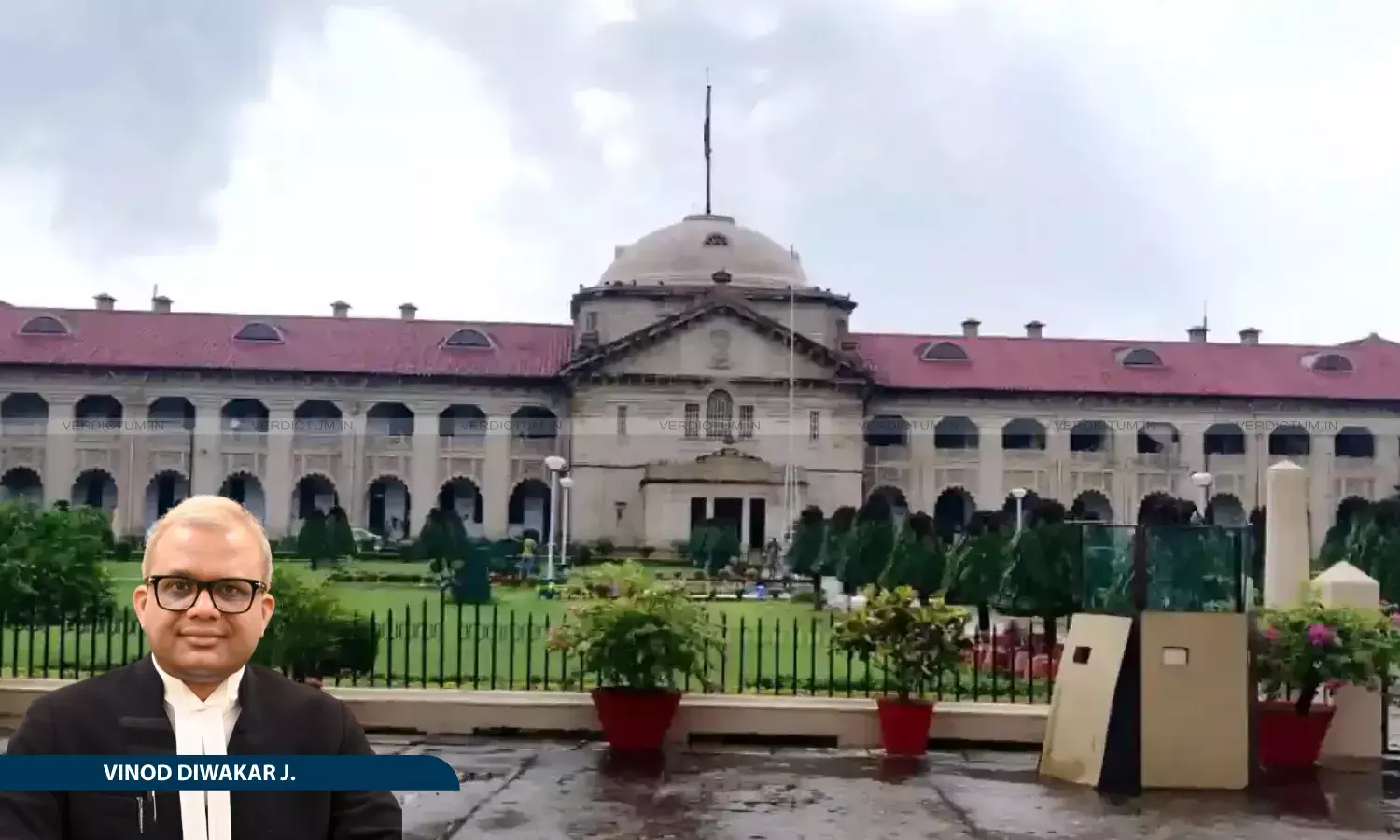
Justice Vinod Diwakar, Allahabad High Court
The Allahabad High Court has held that a multiple-choice question requiring candidates to select one correct answer loses its evaluative purpose when the examining authority accepts two options as correct.
The Court directed the Uttar Pradesh Education Service Selection Commission to exclude two questions, treat UPTET-2026 as comprising 148 questions, compute the qualifying standard at the prescribed percentages and correct the petitioners’ results and scorecards.
The Court was hearing a petition filed by candidates who had fallen marginally below the qualifying threshold. They challenged the examining authority’s decision to award marks only to candidates who had selected either of the two options subsequently accepted as correct.
A Bench of Justice Vinod Diwakar observed: “A multiple-choice question in which the candidate is required to select a single correct answer from four options ceases to serve any evaluative purpose once the examining authority itself accepts two of those options as correct, for the question is then no longer capable of discriminating between a candidate who knows the answer and one who does not.”
Advocates Ankita Singh and Taniya Pandey appeared for the petitioners. Advocate Udayan Nandan appeared for the examining authority, while Standing Counsel Shiv Kumar Singh appeared for the State.
Background
After considering objections to the provisional answer key, the examining authority published a final key, accepting two options as correct for each disputed question. It awarded marks to candidates who selected either accepted option but gave no marks to those who chose another option.
The petitioners initially sought consequential marks. During the hearing, however, they confined their case to the submission that the defective questions should be excluded from evaluation or that equal marks should be given to every candidate.
They argued that UPTET was a qualifying rather than competitive examination and relied on an earlier decision concerning the same test in which questions admitting more than one correct answer had been treated uniformly.
The examining authority submitted that the petitioners had not selected either accepted option and had failed to object to the provisional answer key. It also contended that courts should defer to academic experts and that the questions were not demonstrably erroneous.
Court’s Observations
Judicial Review Of Answer Keys Is Limited
The Court reiterated that evaluation in a public examination must be fair, transparent and consistent with the governing rules. At the same time, courts should ordinarily refrain from substituting their assessment for that of academic experts.
The Court observed: “The scope of judicial review in matters concerning examination questions and answer keys is circumscribed, and courts ordinarily exercise restraint in substituting their own views for those of the examining authority, particularly where the correctness of a question or answer involves academic expertise.”
The Court distinguished the case from an ordinary disagreement between a candidate and an examining authority. Here, the authority itself had determined that each disputed question admitted two correct options, although candidates were required to select only one.
Referring to Uttar Pradesh Subordinate Service Selection Commission v. Ashok Yadav (2026), the Court noted that judicial intervention may be warranted where a question admits two correct answers despite requiring the selection of only one. It also relied on Ran Vijay Singh v. State of Uttar Pradesh (2018), which identified exclusion of the offending question as a solution to such an impasse.
Defective Questions Had To Be Excluded
The Court held that once the authority accepted two answers as correct, the questions could no longer distinguish between candidates who knew the answer and those who did not. Crediting marks only to candidates who happened to select one of those options would make the result dependent upon chance.
The Court stated: “Once a question is excluded from evaluation, no marks fall to be awarded to any candidate in respect of it, and the option to award a mark to the candidate becomes immaterial. The methodology adopted by the Commission- of crediting full marks to those candidates alone who happened to select one of the two options later accepted as correct- cannot be sustained. It rests upon the fortuity of a choice made in respect of a question that was incapable of a single correct answer, and it is the very course which the Supreme Court set aside by its order dated 05.08.2026 in the appeal against Sunil Kumar Singh (supra), read in the light of Ran Vijay Singh (supra).”
The Court noted that, in U.P.P.S.C. v. Sunil Kumar Singh (2026), the Supreme Court had set aside the High Court’s direction granting full marks to candidates who selected either of two accepted answers. It held that exclusion, rather than selectively awarding marks, treated all candidates uniformly.
The Court also noted that the examining authority had dropped another defective question from the same examination. It held: “There is no intelligible basis upon which two questions found to admit of two correct answers each should be treated differently from a third question dropped from the same paper.”
Consequential Benefit Must Be Uniform
The Court considered Smt. Shimla Singh v. State of Uttar Pradesh (2018), which concerned the same qualifying examination and questions for which more than one answer had been accepted. It noted that the earlier decision required candidates to be treated uniformly rather than limiting the benefit to those who selected an accepted option.
Referring to Rishal v. Rajasthan Public Service Commission (2018), the Court held that where the fault lies with the examining body, the corrective benefit should not be confined to candidates who objected or approached the Court. The result should be revised uniformly for similarly situated candidates.
The Court also relied on Rajesh Kumar v. State of Bihar (2013) to hold that a writ court may mould relief according to the pleadings and the legal controversy, even where the precise relief is not reproduced in an individual prayer clause.
The Court consequently directed that the two disputed questions be excluded and that the paper be treated as containing 148 questions. The qualifying standard was to be recalculated at the prescribed percentages, and the petitioners’ results and scorecards were to be corrected wherever necessary.
Corrected Result Creates No Right To Appointment
The Court confined the petitioners’ entitlement to correction of their eligibility-test results and consequential qualifying status.
The Court clarified: “The relief granted to the petitioners shall not, by itself, confer any right to appointment or selection in any subsequent recruitment process. Their entitlement shall remain confined to the correction of their UPTET-2026 results and the consequential eligibility status, subject to the applicable rules.”
Conclusion
The High Court disposed of the petition by directing the exclusion of Questions 36 and 37, uniform extension of the consequential benefit and recomputation of the petitioners’ scores on the basis of a 148-question paper.
It clarified that the corrected results would not independently confer any right to appointment or selection in a subsequent recruitment process.
Cause Title: Vijay Sonkar and Others v. State of Uttar Pradesh and Others (Neutral Citation: 2026:AHC:225670)