Arbitrary State Action Warrants Compensation: Allahabad High Court Awards ₹15L For Vehicle Seized Over Cattle-Slaughter Suspicion
The Court also awarded ₹25,000 for harassment and directed the vehicle's release within one week, unless required in another case.
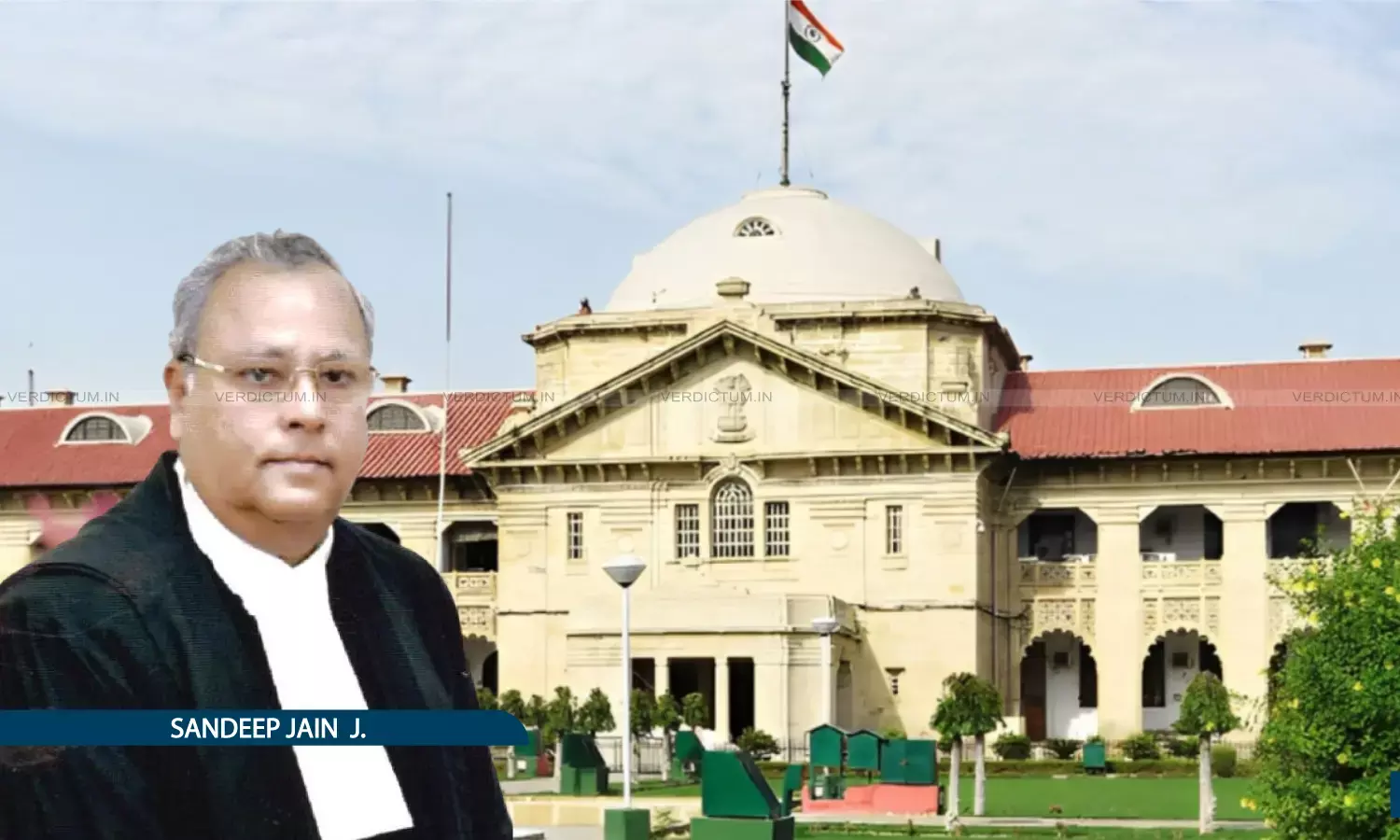
Justice Sandeep Jain, Allahabad High Court
The Allahabad High Court, while stating that arbitrary State action depriving a citizen of livelihood warrants compensation, awarded approximately ₹15 lakh in compensation to the owner of a commercial vehicle that was illegally confiscated over suspicion that it was transporting cattle for slaughter.
The Court was hearing a petition under Article 226 of the Constitution challenging the confiscation of the petitioner's vehicle under Section 5-A of the Uttar Pradesh Prevention of Cow Slaughter Act, 1955, and the appellate order affirming it. The petitioner also sought the vehicle's release.
A Bench of Justice Sandeep Jain observed: “It is apparent that whenever the instrumentalities of the State, by arbitrary and illegal exercise of statutory powers, deprive a citizen of his legitimate means of earning his livelihood, the constitutional courts are fully empowered to award compensation in exercise of their public law jurisdiction. Compensation in such cases is not merely restitutive but also serves as a constitutional remedy against arbitrary exercise of State power”.
The Bench added: “Having regard to the facts of the present case, the nature of the vehicle, the admitted repayment of substantial monthly loan installments and the ordinary earning capacity of a commercial transport vehicle, this Court is of the considered opinion that the petitioner's monthly loss of income can reasonably be assessed at Rs.40,000/- per month.”
Advocates Ashish Jaiswal and Sushil Kumar Mishra appeared for the petitioner. The Additional Government Advocate represented the State.
Background
The petitioner owned a commercial goods vehicle that was seized while transporting two bullocks allegedly intended for slaughter outside Uttar Pradesh. The District Magistrate ordered its confiscation, finding that the animals were transported cruelly and that the vehicle was used for illegal gain. The Commissioner dismissed the petitioner's appeal.
The petitioner argued that no evidence established either an out-of-State destination or an intention to slaughter the animals. He also submitted that no cruelty had been proved and that confiscation had deprived him of the vehicle used to earn his livelihood.
He stated that the vehicle had been purchased through a loan carrying monthly instalments of ₹27,709. The loss of income allegedly prevented timely repayment and exposed him to penal interest. The State maintained that the bullocks were being transported illegally for slaughter and that confiscation was justified.
Court's Observations
Border-District Interception Did Not Prove Out-Of-State Transport
Referring to Saurabh Bajaj v. State of Chhattisgarh (2026), the Court noted that missing transportation documents do not establish that cattle were being carried for slaughter. It also relied on Kaliya v. State of U.P. (2023) and Munib v. State of U.P. (2024), which held that no permit was required for transportation within Uttar Pradesh and that confiscation was not automatic.
The Court found no statement, document or independent witness establishing that the vehicle's intended destination was outside Uttar Pradesh.
It observed: “The entire reasoning adopted by the confiscating authority proceeds on the assumption that since Mirzapur is adjoining with the neighbouring State of Bihar, the cows and its progeny must necessarily have been intended to be transported to the State of West Bengal for slaughter. Such a conclusion is founded merely upon conjectures and surmises and is wholly unsupported by any independent evidence. The existence of an international or inter-State boundary by itself cannot constitute proof of illegal transportation. Unless there exists positive and cogent evidence indicating that the destination of the vehicle was outside the State of Uttar Pradesh or that the transportation was intended for slaughter, no such presumption can legally be drawn merely because the vehicle happened to be intercepted in a border district.”
Allegation Of Cruel Transport Lacked Medical Evidence
The Court found that the two bullocks had not been examined by a veterinary doctor and that the State had produced no veterinary report. It held that no material established injuries endangering the animals' lives or mutilating their bodies, as contemplated under Section 5-B of the Act.
The Court held: “The absence of any medical examination report of the animals, therefore, renders the allegation of their being transported in a cruel manner unsupported by any cogent evidence. Consequently, no case is made out for attracting the provisions of Section 5-B of the Act, 1955. There is no material on record to establish that cruelty was inflicted upon the animals while they were being transported in the petitioner's vehicle. It is, therefore, apparent from the record that the authorities below have erred in recording a finding that the animals were being transported in a cruel manner in the petitioner's vehicle.”
The Court consequently found the confiscation affected by patent illegality, non-application of mind and misinterpretation of the statutory provisions.
Illegal Confiscation Deprived Petitioner Of Livelihood
The Court noted that the petitioner's assertion that the vehicle was his sole source of livelihood had not been specifically denied. His loan account also supported the pleaded monthly instalments and resulting financial liability.
It observed: “The inevitable consequence of the illegal action of the State has been that the petitioner remained deprived of his only source of income for a substantial period without any legal justification. Article 21 of the Constitution protects not merely life but also the right to livelihood.”
Relying on Nilabati Behera v. State of Orissa (1993), Sube Singh v. State of Haryana (2006) and Indibily Creative Private Limited v. Government of West Bengal (2020), the Court held that monetary compensation was available in public law for an established infringement of fundamental rights. It assessed the monthly loss at ₹40,000 after considering the nature and ordinary earning capacity of the commercial vehicle and the loan instalments.
Conclusion
The High Court allowed the petition and quashed the confiscation and appellate orders. It directed the authorities to release the vehicle forthwith, preferably within one week of receiving the certified judgment, unless it was required in another case.
The authorities were directed to pay ₹40,000 per month from the date of seizure until actual release, together with ₹25,000 for mental agony, financial hardship and harassment. Payment must be made within one month of receiving the certified judgment, failing which simple interest at eight per cent per annum would apply from the judgment's date until payment.
The Court granted liberty to pursue enforcement remedies for non-compliance. It also permitted the State to hold a departmental inquiry and, after observing natural justice, recover the compensation and interest from any officer found responsible for the illegal exercise of power.
Cause Title: Tej Prakash v. State of Uttar Pradesh and Others (Neutral Citation: 2026:AHC:228068)