

Headscarf Not Essential Part Of Islamic Faith: Allahabad High Court Refuses To Permit Hijab Over Prescribed School Uniform
The Bench further noted that except the petitioner, no other girl student was donning the headscarf, even those belonging to the same religious community.

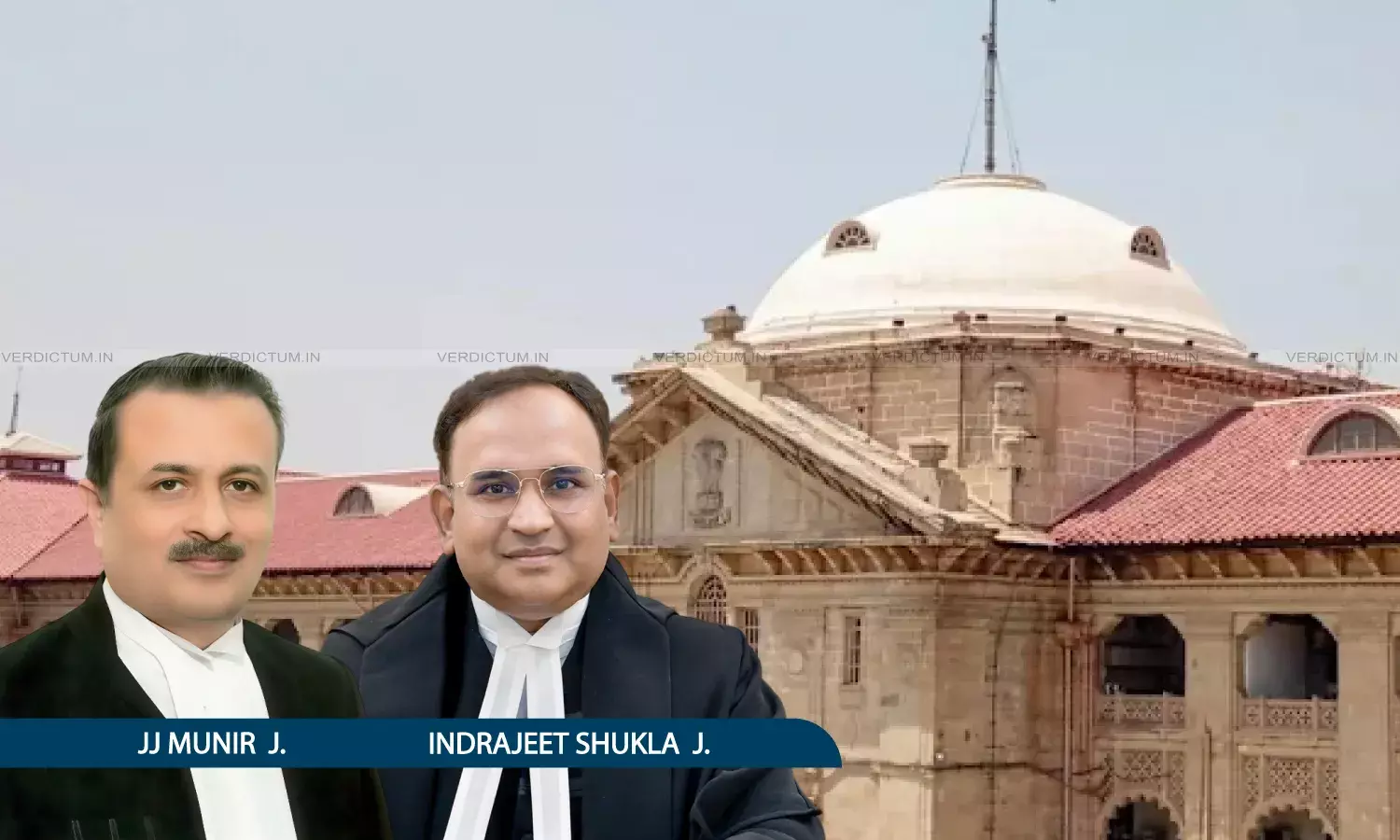
The Allahabad High Court has dismissed a writ petition seeking a mandamus directing a private unaided school to permit a minor student to wear a headscarf in addition to its prescribed uniform, holding that conformity to institutional discipline, of which a uniform forms an essential part, cannot be diluted by an individual student's preference absent a demonstrated violation of enforceable rights.
The Court further held that the petitioner had failed to lay the necessary factual and legal foundation to establish that wearing a headscarf constitutes an essential religious practice under Article 25 of the Constitution of India, observing that a bare assertion, unsupported by pleadings or religious text, cannot sustain such a claim, and that the school's uniform policy, being religion-neutral and uniformly applied, did not amount to discrimination under Articles 14 and 19(1)(a).
A Division Bench comprising Justice J.J. Munir and Justice Indrajeet Shukla in a petition filed by a minor student through her mother against the State of U.P. and a private school in Prayagraj affiliated to the Central Board of Secondary Education, observed, “We have perused the photographs from various classes relating to the petitioner. Except for her, no other girl student is donning the headscarf, even those belonging to the same religious community, as the petitioner. Wherever this issue has arisen, the High Courts have been unanimous in opinion that wearing a headscarf is not essential part of the Islamic faith for a women to don, in the absence of which, faith would be jeopardized. Here, as already remarked, no such factual foundation has been laid or material placed on record to establish a case that the donning of a headscarf is an essential part of religion for a Muslim female, forsaking which, would oust the girl or woman concerned from the faith that she professes and practices. In the absence of this kind of a pleading and material, we are unable to hold for the petitioner on the facts obtaining here. The existing precedents would take care of the question, which go against her on this point”.
“…The School in this case does not seek to curtail the petitioner’s freedom of faith at all. All that they require is conformity to institutional discipline, of which a uniform is an essential part. In the event, individual students were permitted to aid or depart, even a little bit from the prescribed uniform on subjective grounds, it would militate against the idea of a uniform. It would transfer the authority to determine School discipline from the institution to individual students”, the Bench further noted.
Advocate Ejaz Ahmad Khan appeared for the petitioner and Girijesh Kumar Tripathi, Additional Chief Standing Counsel appeared for the respondent.
The petitioner, who had studied at Tagore Public School, Attarsuiya, Prayagraj from Class VI to Class X wearing a headscarf without objection, was denied admission to Class XI on the ground that the headscarf violated the school's prescribed dress code. She approached the District Magistrate, who called for a report from the District Inspector of Schools despite lacking jurisdiction over the private institution. The Assistant DIOS recorded statements from both the petitioner and the School Principal, with the Principal maintaining that the uniform dress code applied equally to all students, that other students from the same community complied with it, and that permitting an exception would affect institutional discipline.
With administrative remedies exhausted without success, the petitioner approached the High Court under Article 226, seeking a mandamus compelling the school to allow the headscarf, contending that her right to dress in a manner consistent with her faith was protected under Articles 14, 19(1)(a) and 21, and that denial of admission on this ground was discriminatory and violative of her fundamental rights. The parties agreed to have the petition heard and decided on the existing record.
The Court relied on its own earlier decision in Pradeep Kumar Srivastava v. Ministry of Human Resource Development, New Delhi and others, 2014:AHC:79135-DB, the Kerala High Court's ruling in thima Thasneem (Minor) and another v. State of Kerala and others, 2018 SCC OnLine Ker 5267, the Bombay High Court's decision in Fathema Hussain Sayed a Minor v. Bharat Education Society and others, 2002 SCC OnLine Bom 713, and extensively on the Karnataka High Court Full Bench's judgment in Resham v. State of Karnataka (2022) 1 HCC (Kar) 43, which had held that wearing a hijab is not an essential religious practice in Islam.
“We must remark here that the District Magistrate after all would have no control over the School, the School being private, unaided and affiliated to the CBSE. Nevertheless, we do not say that the School is not subject to our writ because after all education is in itself a public function, entrusted to private hands for the purpose of better and far reaching realization of the goal of education for a very big size of the population, particularly education upto Class-XII…”, the Bench said.
“It is to be noted that the assertion in the writ petition, that wearing a headscarf is an essential religious practice, is a bare assertion. There is no pleading or authoritative religious text or material placed on record, sufficient by itself to establish, that the practice asserted by the petitioner about the obligation to wear a scarf inside the classroom, is obligatory upon her and the nonobservance thereof would alter the fundamental character of her faith. A claim, placing reliance upon Article 25 of the Constitution, cannot be accepted for the sake of mere assertion, without the necessary factual and legal foundation laid for the purpose. A perusal of the writ petition shows that there are no pleadings to that effect by the petitioner, except that she has been doing it since she was a child and ever-since she joined the School in Class-VI”, it further said.
It noted that the Supreme Court's split verdict in Aishat Shifa (Hijab Case-2 J.) v. State of Karnataka and others, (2023) 2 SCC 1 left the question unsettled at the apex level, and that a subsequent interim stay order of the Supreme Court in a related Bombay High Court matter, being unreasoned and provisional, did not constitute binding precedent. The Court found no pleaded material establishing that the headscarf was obligatory to the petitioner's faith.
Cause Title: Sukaina Rizvi v. State of U.P. and Others (2026:AHC:176816-DB)
Appearances:
Petitioner: Ejaz Ahmad Khan, Mohd. Monis and Zeenat Jahan, Advocates.
Respondents: Girijesh Kumar Tripathi, Additional Chief Standing Counsel, and Alok Tiwari, Counsel.