Superior Officer’s Report, Public Servant’s Version Must Be Considered Before Ordering Probe U/S 175(4) BNSS: Allahabad High Court
The Court set aside a Special Judge’s direction to register an FIR against police personnel after finding that the contemporaneous police report and the official-duty context had not been considered.
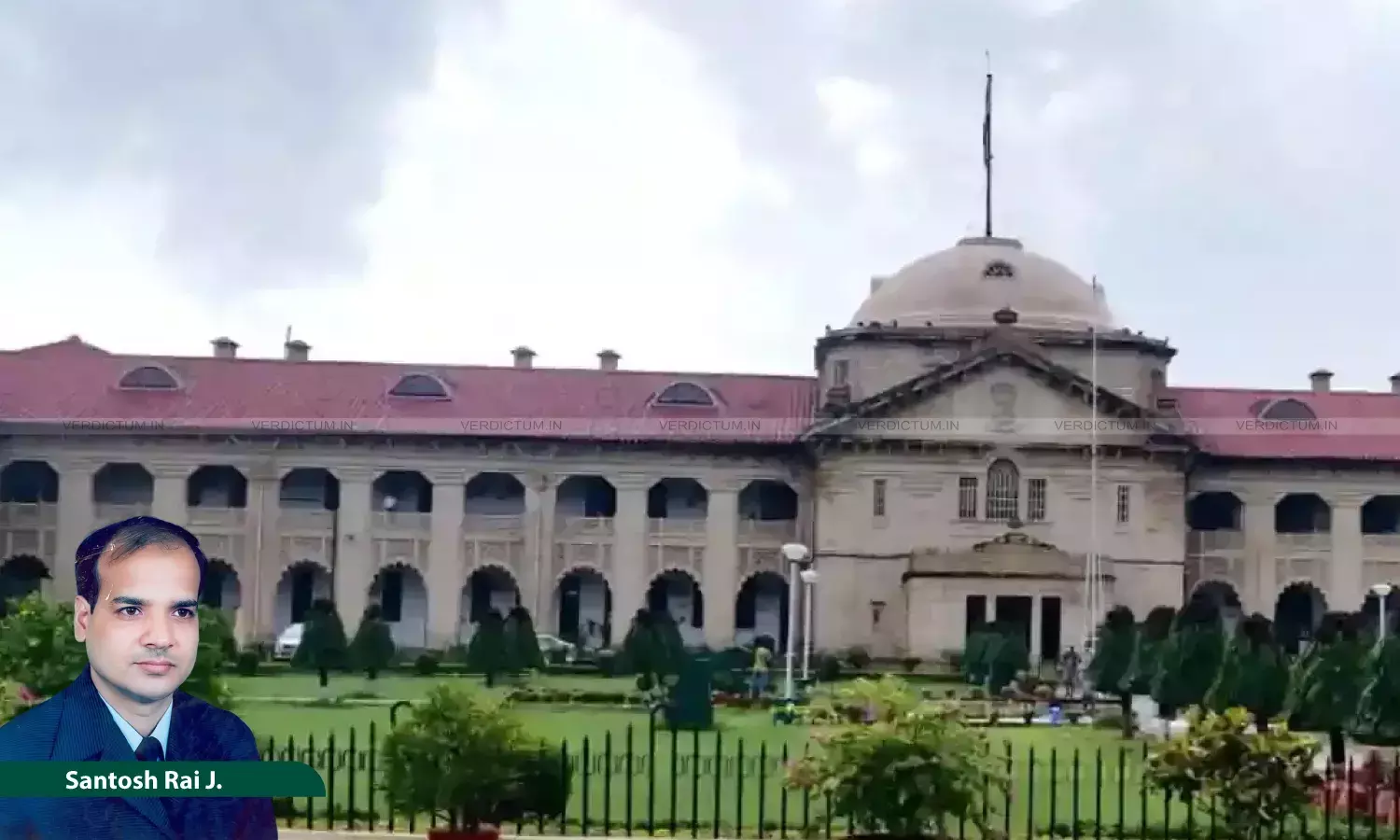
The Allahabad High Court has held that the requirements under Section 175(4) of the Bharatiya Nagarik Suraksha Sanhita, 2023, cannot be reduced to an empty formality when a complaint concerns acts allegedly committed by a public servant during official duty.
The Court held that the report of an officer superior to the concerned public servant and the public servant’s explanation of the circumstances leading to the incident must be considered before an investigation is ordered.
The Court was hearing a criminal appeal challenging an order by which the Special Judge under the SC/ST Act had allowed an application under Section 173(4) BNSS and directed registration of an FIR and investigation against a police officer and other personnel.
A Bench of Justice Santosh Rai observed: “The requirement of Section 175(4) BNSS is substantive and cannot be reduced to an empty formality. Where the allegations arise out of an incident occurring in the course of official police action, the Court is required to take into consideration the report of the officer superior to the concerned public servant as well as the assertions of the public servant explaining the circumstances which led to the incident. The purpose of such consideration is to enable the Court to distinguish between an act having a reasonable nexus with official duty and an act which is wholly extraneous to such duty. In the present case, the contemporaneous police report and surrounding circumstances were therefore directly relevant to the statutory inquiry contemplated by Section 175(4) BNSS.”
Advocate Ajay Tripathi appeared for the appellant. Additional Government Advocate Rajesh Kumar Shukla appeared for the State, while Advocate Raju Chaudhary, holding brief for Advocate Jai Prakash Singh, appeared for the complainant.
Background
The complainant alleged that the appellant, a police sub-inspector, and two unidentified police personnel forcibly entered her house at night, used caste-related derogatory words and took away her son. She alleged that he was detained for more than 24 hours before his arrest was formally shown.
The police officer maintained that the complainant’s son was an accused in another criminal case in which she was the investigating officer. According to her, he was apprehended following information about his presence and was released to his mother on the same day through a custody-release document.
The Special Judge found discrepancies in the police records and noted that the custody-release document had not accompanied the police report. Relying on the complainant’s video material and transcripts, the Special Judge directed the registration of an FIR, investigation by an independent gazetted officer and submission of an investigation report within 15 days.
The police officer challenged that decision, contending that the Special Judge had mechanically accepted the allegations without properly considering the police report, her explanation, the contemporaneous record or the safeguards under Sections 175(3) and 175(4) BNSS.
Court’s Observations
Application’s Description Does Not Determine The Court’s Power
The Court held that merely describing an application as one under Section 173(4) BNSS does not empower the Special Court to direct registration of an FIR. Where the substance of the relief sought is a direction to register and investigate a criminal case, the requirements governing the exercise of power under Sections 175(3) and 175(4) must be examined.
The Court observed: “Accordingly, an application merely described or treated as an application under Section 173(4) BNSS cannot, by that nomenclature, confer upon the Special Court the power to order registration of an FIR. If the substance of the prayer is for a direction to the police to register a criminal case and investigate, the judicial authority must examine whether the application satisfies the requirements of Section 175(3) BNSS and whether the conditions precedent for exercise of that jurisdiction exist. The distinction is material because Section 175(3) BNSS involves a judicial direction for investigation, and such power is required to be exercised upon proper application of mind to the allegations, the material placed by the applicant, the prior approach to the police authorities and the necessity for investigation by the police. Therefore, an order allowing an application under Section 173(4) BNSS, without considering the statutory requirements of Section 175(3) & (4) BNSS, cannot be sustained merely on the ground that the applicant had invoked Section 173(4) BNSS.”
Section 175(3) Introduces Three Procedural Safeguards
The Court stated that Section 175(3) BNSS materially differs from Section 156(3) CrPC. Before directing an investigation, the court must consider the application supported by an affidavit, decide what inquiry is necessary and consider the submission made by the police officer.
The Bench considered State of Haryana v. Bhajan Lal (1992) and relied on Anil Kumar v. M.K. Aiyappa (2013), Priyanka Srivastava v. State of U.P. (2015), Ramdev Food Products v. State of Gujarat (2015) and Babu Venkatesh v. State of Karnataka (2022) while examining why an investigation cannot be directed mechanically.
Addressing the additional requirements introduced by the BNSS, the Court stated: “The provision does not merely state that the Magistrate may order an investigation after considering the application under Section 173(4) BNSS. It specifically provides under Section 175(3) BNSS that the Magistrate may do so ‘…..and after making such inquiry as he thinks necessary and submission made in this regard by the police officer…..’ The expression so employed by the Legislature is a deliberate departure from the comparatively simple language of Section 156(3) Cr.P.C., which merely empowered the Magistrate to order such investigation. The additional requirements introduced by Section 175(3) BNSS are therefore substantive procedural safeguards and cannot be treated as an empty formality.”
The Court clarified that the discretion conferred by the words “such inquiry as he thinks necessary” concerns the nature and extent of the inquiry. It does not permit the court to disregard the requirement of applying its mind to whether an inquiry is necessary.
Section 175(4) Adds Protection In Complaints Against Public Servants
Relying on Om Prakash Ambadkar v. State of Maharashtra (2026), the Court stated that Section 175(4) is a new safeguard for public servants accused of cognizable offences allegedly committed during the discharge of official duties.
The Court also considered XXX v. State of Kerala (2026), which held that Sections 175(3) and 175(4) must be read harmoniously, with Section 175(4) adding a special procedural layer where the proposed investigation concerns a public servant.
Quoting the Supreme Court, the Court stated: “On a plain and contextual reading of the scheme of Section 175, we find that sub-section (3) vests the Judicial Magistrate (empowered under Section 210) with the power to order investigation, while sub-section (4) while conferring similar power additionally prescribes a special procedural safeguard to be observed by the Judicial Magistrate (empowered under Section 210) where the proposed direction could concern a public servant. While the authority to direct investigation flows from sub-section (3) as well as from sub-section (4), the latter provides a qualifying procedural layer.
The Bench further highlighted: Ordinarily, sub-sections of a section of an Act usually deal with related, parallel aspects with one sub-section dealing with a general principle and the other providing for a specific aspect, on its own terms. Viewed in this light, sub-section (3) lays down the general principle whereas sub-section (4) dives into specifics of public servants in the given situation, introducing an additional procedural requirement before the power to order investigation is exercised.”
Referring to XXX v. State of Kerala (2026), the Court noted the Supreme Court’s guidance that where an alleged offence prima facie arose during official duty, the Section 175(4) procedure had to be followed. Where the connection was doubtful, the court could follow that procedure as a matter of caution; the general procedure under Section 175(3) would apply where the conduct was wholly extraneous to official duty.
Police Report And Official-Duty Context Were Overlooked
The Court found that the application itself disclosed that the allegations concerned police personnel and arose from police action involving the complainant’s son. The appellant was the investigating officer in the criminal case in which the son was accused.
The Special Judge had called for and received a detailed police report. The High Court, however, found that the report was not judicially examined against the allegations, the appellant’s official status and the statutory requirements.
The Court observed: “The aforesaid circumstances prima facie indicate that appellant Sandhya Jaiswal and the other police personnel were dealing with Case Crime No.300 of 2026 in the course of police investigation and the exercise of their official functions. Whether every alleged act was reasonably connected with official duty was a matter requiring judicial consideration; it could neither be presumed conclusively in favour of the police personnel nor ignored altogether. The learned Special Judge was, therefore, under a legal obligation to examine the nature of the allegations and the available record and to determine the applicability of the mandatory procedure under Section 175(4) BNSS before directing investigation.”
The Court also considered the custody-release document bearing the complainant’s signature and mobile number, which stated that her son had been handed over to her. It held that if the Special Judge doubted its genuineness or contents, clarification or production of the original could have been sought instead of disregarding it.
No Meaningful Consideration Of Police Officer’s Submission
The Court found that the impugned order neither stated that an inquiry under Section 175(3) was undertaken nor explained why no further inquiry was necessary despite the police report and contemporaneous material.
It further found no meaningful consideration of the police officer’s submission. The omission affected all three requirements under Section 175(3): consideration of the affidavit-supported application, undertaking such inquiry as considered necessary and consideration of the police officer’s submission.
The Court held that this was not a mere procedural irregularity but went to the exercise of jurisdiction.
The Court stated that the appellant, as the investigating officer in the related criminal case, was discharging official duties in good faith. In the absence of material showing that the alleged acts were committed otherwise than during official functions, the protection under Section 22 of the SC/ST Act required consideration, subject to its legal requirements.
The Bench clarified, however, that it was not conclusively presuming that every alleged act was connected with official duty. That question required examination under Section 175(4).
Special Judge’s Order Was Non-Speaking And Non-Reasoned
The Court held that the Special Judge proceeded on the allegations as though they constituted conclusive material for directing investigation. The report of the superior officer, the police officer’s explanation and the necessity of an inquiry were not properly considered.
The Court concluded: “The learned Court has neither undertaken the requisite consideration as to whether an inquiry under Section 175(3) BNSS was necessary nor recorded ‘cogent reasons’ for dispensing with such inquiry. Further, in view of the allegations against police/public servants and the material disclosing the earlier police action and criminal cases involving the complainant, the applicability and requirements of Section 175(4) BNSS were required to be specifically considered. The impugned order, being ‘non-speaking and non-reasoned’ and suffering from material non-application of mind, cannot be sustained.”
The Court expressly refrained from giving any final opinion on the truth or otherwise of the allegations made by the complainant.
Conclusion
The Court allowed the appeal and set aside the Special Judge’s order directing registration of an FIR and investigation. Any consequential proceedings arising from the impugned order also stood quashed.
The Registrar (Compliance) was directed to serve a copy of the High Court’s order on the concerned court through the District and Sessions Judge within 48 hours by fax or email.
Cause Title: Sandhya Jaisawal v. State of U.P. and Another (Neutral Citation: 2026:AHC:214563)
Appearances
Appellant: Advocates Ajay Tripathi and Surya Prakash Pandey
Respondents: Additional Government Advocate Rajesh Kumar Shukla; Advocate Jai Prakash Singh; Advocate Raju Chaudhary